Overview
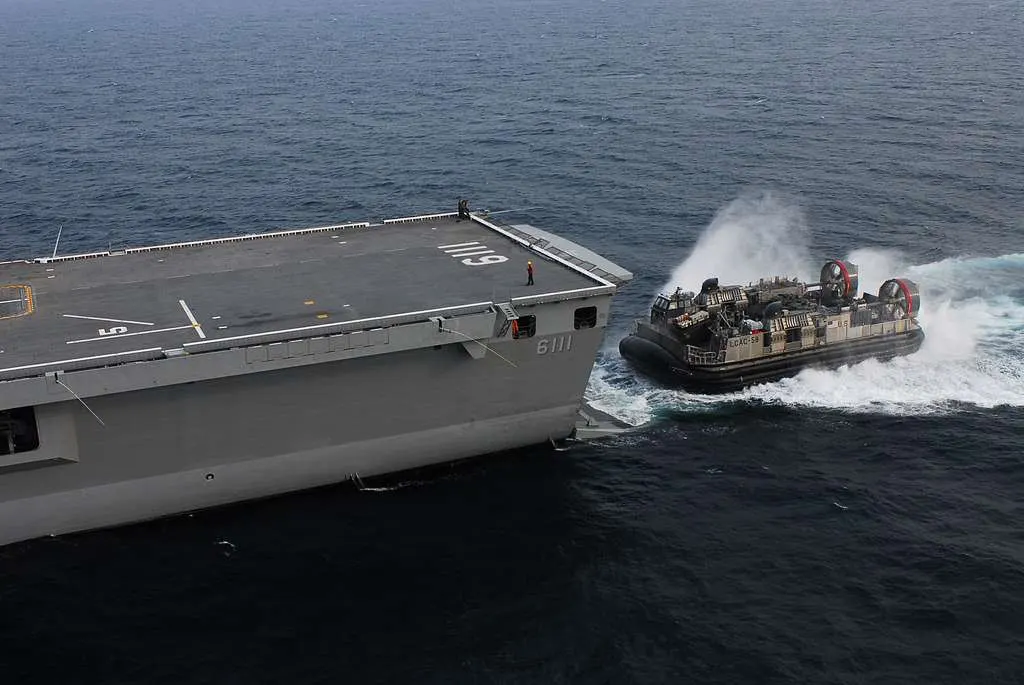
The LCAC-1 is a high-speed amphibious support platform operated by the Republic of Korea Navy. Typically deployed alongside large amphibious ships, it is designed to rapidly transport troops and equipment to coastal areas. Its air-cushion technology minimizes the effects of the water’s surface and difficult terrain, allowing it to maintain a high level of mobility.
- Key features
- High-speed mobility: Capable of transporting troops and equipment rapidly at speeds of up to 74 km/h (40 knots)
- All-weather operations: Can operate across a range of terrain, including sand, mud, and ice
- Integrated operations with large amphibious ships: Deployed alongside Dokdo-class and Cheonwangbong-class amphibious ships
- Versatile applications: Used not only in military operations but also for disaster relief and emergency transport missions
Development Background
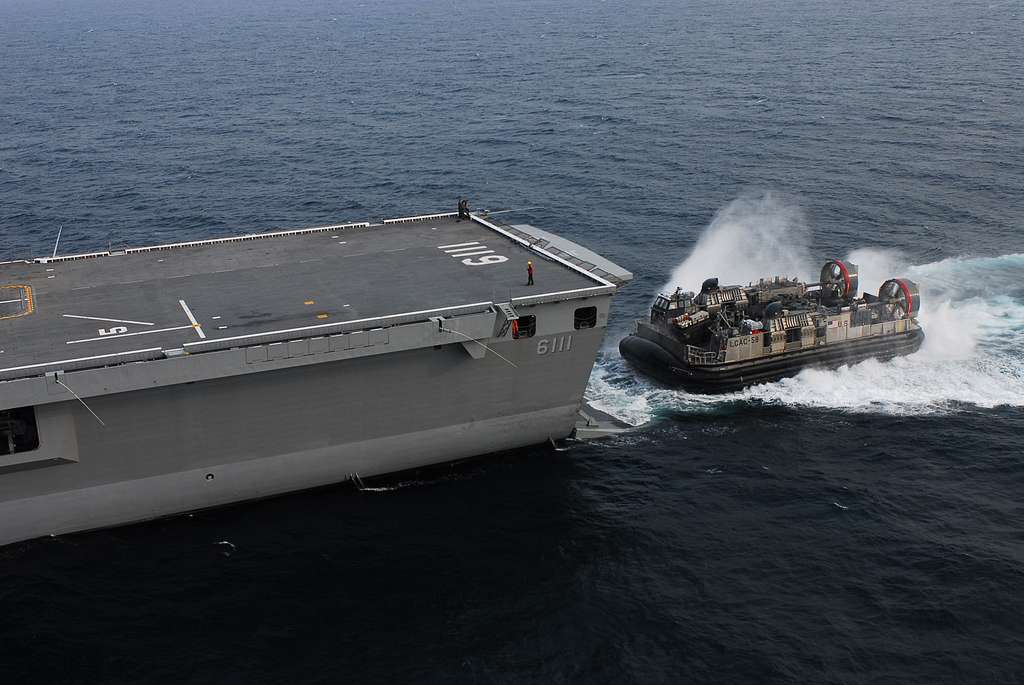
The Republic of Korea Navy introduced air-cushion craft to maximize the mobility of mechanized amphibious operations. Compared with conventional landing ships for tanks (LSFs), these craft offer superior mobility and can effectively deliver troops and equipment across challenging terrain.
- Development timeline
- Early 2000s: The need to introduce air-cushion craft was assessed
- 2007: The LCAC-1 was introduced and entered service
- Since the 2010s: Continued operations in coordination with Dokdo-class and Cheonwangbong-class amphibious ships
Advantages and Disadvantages
🔹 Advantages
✔ High-speed mobility: Optimized for amphibious operations along the coast and inland ✔ Operable across varied terrain: Capable of operating not only on water but also along shorelines, in marshland, and across snowfields ✔ High transport capacity: Can carry large equipment, including tanks, self-propelled artillery, and armored vehicles ✔ Faster amphibious deployment: Enables troops to be landed more quickly than with conventional transport craft
🔻 Disadvantages
❌ Limited defensive capability: Its onboard defensive armament is limited ❌ Noise: Powerful engines generate high noise levels ❌ High operating costs: Maintenance requirements and fuel consumption are substantial
Comparison with Air-Cushion Craft in Neighboring Countries (China, Japan, and North Korea)
| Category | LCAC-1 (South Korea) | Type 726 (China) | Type 1 Hovercraft (Japan) | North Korean Hovercraft (Estimated) |
|---|---|---|---|---|
| Displacement | 100 tons | 150 tons | 50 tons | 30–80 tons (estimated) |
| Dimensions (beam × length × height) | 15 m × 27 m × 7 m | 16 m × 30 m × 8 m | 9 m × 20 m × 5 m | 8 m × 15 m × 5 m (estimated) |
| Top speed | 74 km/h | 80 km/h | 70 km/h | 50–60 km/h (estimated) |
| Transport capacity | One tank and 30 personnel | Two tanks and 50 personnel | One light armored vehicle and 20 personnel | Limited (estimated) |
| Key advantage | High speed and ability to conduct integrated operations | Capacity to carry large cargo loads | Support for coastal defense | Capability for small-scale mobile operations |
Comparison with Air-Cushion Craft Operated by Advanced Nations (the United States, the United Kingdom, Russia, and France)
| Category | LCAC (United States) | SR.N4 (United Kingdom) | Murena Class (Russia) | L-Cat (France) |
|---|---|---|---|---|
| Displacement | 185 tons | 200 tons | 550 tons | 100 tons |
| Dimensions (beam × length × height) | 15 m × 30 m × 8 m | 20 m × 32 m × 10 m | 20 m × 57 m × 10 m | 15 m × 30 m × 7 m |
| Top speed | 75 km/h | 65 km/h | 60 km/h | 72 km/h |
| Transport capacity | One tank and 50 personnel | Two tanks and 80 personnel | Three tanks and 100 personnel | One tank and 30 personnel |
| Key advantage | Heavy-load transport and Marine amphibious support | High-volume transport capacity | Support for large-scale amphibious operations | Multirole transport capability |
Future Development
- Development of next-generation air-cushion craft: Greater mobility and improved defensive capabilities are needed
- Exploring export opportunities: Pursuing sales to countries in Southeast Asia and the Middle East
- Improving operational efficiency: Researching ways to reduce maintenance costs and improve engine performance