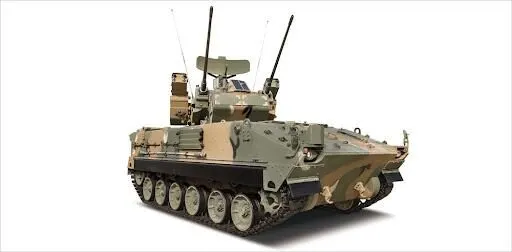
Overview
The Hybrid Biho is a South Korean-developed self-propelled anti-aircraft system that significantly enhances the original Biho self-propelled anti-aircraft gun by adding surface-to-air missiles. Designed primarily to counter low-flying aircraft and drone threats, it has become a key asset for protecting armored units and critical facilities.
- Key features
- Combined armament: Twin 30mm cannons plus Shin-gung surface-to-air missiles
- Rapid target engagement: Uses radar and EO/IR sensors
- Mobility and protection: Retains the mobility of its K200 armored vehicle platform
- Capable of intercepting drones and helicopters: Enhanced ability to counter low-altitude threats

Development Background
South Korea was already operating the original Biho self-propelled anti-aircraft gun, equipped with twin 30mm cannons, but it was criticized for having insufficient range compared with modern air-defense systems equipped with missiles. As aerial threats from North Korea, China and Russia grew, the limitations of relying solely on anti-aircraft guns became increasingly clear. To address that shortfall, South Korea developed a combined air-defense system equipped with surface-to-air missiles.
- Development timeline
- 2013: Development of the Hybrid Biho began
- 2015: Prototype vehicle unveiled and performance evaluation conducted
- 2018: Deployment with the Republic of Korea Army began
- 2020s: Overseas export efforts and further performance upgrades pursued
Pros and Cons
🔹 Advantages
✔ Powerful air-defense capability: Combines twin 30mm autocannons with Shin-gung missiles ✔ Can engage a range of targets: Capable of intercepting low-flying aircraft, drones and helicopters ✔ Excellent mobility: The K200-based platform can operate across a variety of terrain ✔ Precision engagement capability: Uses electro-optical/infrared (EO/IR) systems and tracking radar ✔ Air-defense network integration: Can operate as part of an integrated radar and air-defense network
🔻 Disadvantages
❌ Missile limitations: The Shin-gung missile has a relatively limited range of about 7 km ❌ Limited protection: Its basic armor leaves it vulnerable to anti-tank weapons ❌ Limited ability to engage high-speed aircraft: It has constraints when facing supersonic aircraft
Comparison with Neighboring Countries’ Self-Propelled Anti-Aircraft Guns (China, Japan and North Korea)
| Category | Hybrid Biho (South Korea) | PGZ-09 (China) | Type 87 Self-Propelled Anti-Aircraft Gun (Japan) | North Korean Self-Propelled Anti-Aircraft Gun |
|---|---|---|---|---|
| Weight | 26 tons | 35 tons | 45 tons | 25–30 tons (estimated) |
| Dimensions (W × L × H) | 3.0m × 6.8m × 3.2m | 3.2m × 7.5m × 3.5m | 3.5m × 7.8m × 3.6m | 3.0m × 7.0m × 3.3m (estimated) |
| Top speed | 65 km/h | 55 km/h | 60 km/h | 50 km/h (estimated) |
| Armament | Two 30mm autocannons + Shin-gung missiles | Two 35mm autocannons + TY-90 missiles | Two 35mm autocannons | 30–37mm autocannons (estimated) |
| Armor | Basic ballistic protection | Enhanced armor | Composite armor | Basic ballistic protection (estimated) |
| Engine power | 450 hp | 500 hp | 600 hp | 400–500 hp (estimated) |
| Key advantage | Enhanced air-defense capability through missile integration | Can engage high-speed aircraft | Superior protection | Can create a defensive network through large-scale deployment |
Comparison with Self-Propelled Anti-Aircraft Guns from Advanced Military Powers (the United States, the United Kingdom, Russia and France)
| Category | Hybrid Biho (South Korea) | M-SHORAD (United States) | Sky Sabre (United Kingdom) | Tunguska (Russia) | Mistral M3 (France) |
|---|---|---|---|---|---|
| Weight | 26 tons | 22 tons | 30 tons | 34 tons | 20 tons |
| Dimensions (W × L × H) | 3.0m × 6.8m × 3.2m | 2.8m × 7.0m × 3.0m | 3.2m × 7.5m × 3.4m | 3.4m × 7.8m × 3.6m | 2.9m × 6.5m × 3.0m |
| Top speed | 65 km/h | 80 km/h | 70 km/h | 60 km/h | 75 km/h |
| Armament | Two 30mm autocannons + Shin-gung missiles | 30mm autocannon + Stinger missiles | 35mm autocannon + missiles | 30mm autocannon + 9M311 missiles | Mistral short-range missiles |
| Armor | Basic ballistic protection | Ballistic-protected vehicle platform | Composite armor | Composite armor + ERA | Basic ballistic protection |
| Engine power | 450 hp | 350 hp | 500 hp | 780 hp | 300 hp |
| Key advantage | Combined air-defense capability and excellent mobility | Integration with U.S. military networks | Superior protection | Powerful firepower and integrated air-defense missiles | Compact and lightweight, enabling rapid response |
Future Development
- Hybrid Biho upgrades: Improvements to Shin-gung missile performance and vehicle protection
- Development of the K30 Biho PIP: Further enhancements to air-defense capability and automated systems
- Expanded overseas exports: Export efforts targeting Southeast Asian and Middle Eastern countries
- Stronger network integration: Development of electronic-warfare countermeasures and integrated air-defense capabilities