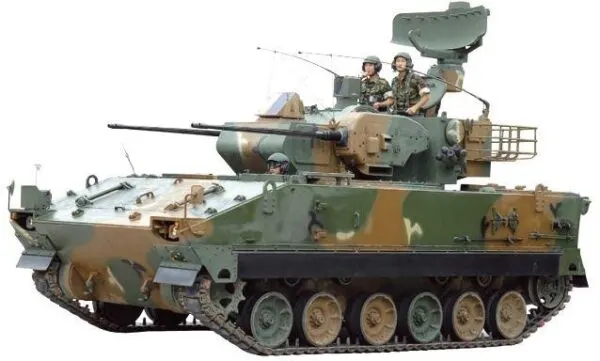
K30 Biho Self-Propelled Anti-Aircraft Gun: A Comparison
Overview
The K30 Biho is a self-propelled anti-aircraft gun system independently developed by South Korea. It is designed to counter airborne threats operating at low altitude, including aircraft, helicopters, and drones. Combining rapid response with high mobility, the system can also be upgraded to the Biho Hybrid configuration by adding Shingung surface-to-air missiles when required.
- Key features
- Powerful anti-aircraft firepower: Equipped with twin 30mm automatic cannons
- Rapid response: Capable of automatic target tracking and real-time engagement
- Mobility and survivability: Built on the K200 armored personnel carrier chassis, giving it strong mobility
- Network integration: Can operate in conjunction with broader air-defense systems

Development Background
The Republic of Korea Army operated the older M167 Vulcan self-propelled anti-aircraft gun, but the system had limitations in mobility, firepower, and detection capability. As aerial threats from North Korea and neighboring countries increased, the need emerged for a more effective low-altitude air-defense system. The K30 Biho was developed to meet that requirement.
- Development timeline
- Late 1980s: Development of an indigenous self-propelled anti-aircraft gun begins
- 1996: K30 Biho prototype vehicle unveiled
- 1999: Mass production begins and the system enters operational service
- From the 2010s onward: Development of the Biho Hybrid upgrade with additional Shingung missiles
Advantages and Limitations
🔹 Advantages
✔ Fast reaction time: Enables automatic target tracking and immediate engagement ✔ Heavy firepower: Armed with two 30mm cannons capable of firing 1,200 rounds per second ✔ Mobility and operational flexibility: Offers high mobility thanks to its K200 armored personnel carrier chassis ✔ Network integration: Can reinforce air defenses by linking with broader air-defense networks
🔻 Limitations
❌ Limited without missiles: As a gun-only system, its effective engagement range is restricted ❌ Difficulty engaging supersonic aircraft: Optimized for slow, low-altitude targets ❌ Limited protection: Its basic armor leaves it vulnerable to anti-tank attacks
Comparison with Self-Propelled Anti-Aircraft Guns in Neighboring Countries (China, Japan, and North Korea)
| Category | K30 Biho (South Korea) | PGZ-09 (China) | Type 87 Self-Propelled Anti-Aircraft Gun (Japan) | North Korean Self-Propelled Anti-Aircraft Gun |
|---|---|---|---|---|
| Weight | 26 tons | 35 tons | 45 tons | 25–30 tons (estimated) |
| Dimensions (width × length × height) | 3.0m × 6.8m × 3.2m | 3.2m × 7.5m × 3.5m | 3.5m × 7.8m × 3.6m | 3.0m × 7.0m × 3.3m (estimated) |
| Top speed | 65 km/h | 55 km/h | 60 km/h | 50 km/h (estimated) |
| Armament | 2 × 30mm automatic cannons | 2 × 35mm automatic cannons | 2 × 35mm automatic cannons | 30–37mm automatic cannon (estimated) |
| Armor | Basic ballistic protection | Enhanced armor | Composite armor | Basic ballistic protection (estimated) |
| Engine power | 450 hp | 500 hp | 600 hp | 400–500 hp (estimated) |
| Key advantage | High mobility and automatic target tracking | Powerful firepower and strong mobility | Superior protection | Can be deployed in large numbers |
Comparison with Advanced-Nation Self-Propelled Anti-Aircraft Systems (the United States, the United Kingdom, Russia, and France)
| Category | M-SHORAD (United States) | Sky Sabre (United Kingdom) | Tunguska (Russia) | Mistral M3 (France) |
|---|---|---|---|---|
| Weight | 22 tons | 30 tons | 34 tons | 20 tons |
| Dimensions (width × length × height) | 2.8m × 7.0m × 3.0m | 3.2m × 7.5m × 3.4m | 3.4m × 7.8m × 3.6m | 2.9m × 6.5m × 3.0m |
| Top speed | 80 km/h | 70 km/h | 60 km/h | 75 km/h |
| Armament | 30mm automatic cannon + Stinger missiles | 35mm automatic cannon + missiles | 30mm automatic cannon + 9M311 missiles | Mistral short-range missiles |
| Armor | Based on a ballistic-protected vehicle | Composite armor | Composite armor + ERA | Basic ballistic protection |
| Engine power | 350 hp | 500 hp | 780 hp | 300 hp |
| Key advantage | Integration with U.S. military networks | Superior protection | Powerful firepower and integrated missiles | Compact, lightweight design and rapid response |
Future Development
- K30 Biho PIP development: Upgrades to the sensor and fire-control systems are being pursued
- Improved protection: The adoption of additional armor and active protection systems is under consideration
- Enhanced networked warfare capabilities: Strengthening real-time data links
- Expanded overseas exports: Targeting markets in Southeast Asia and the Middle East