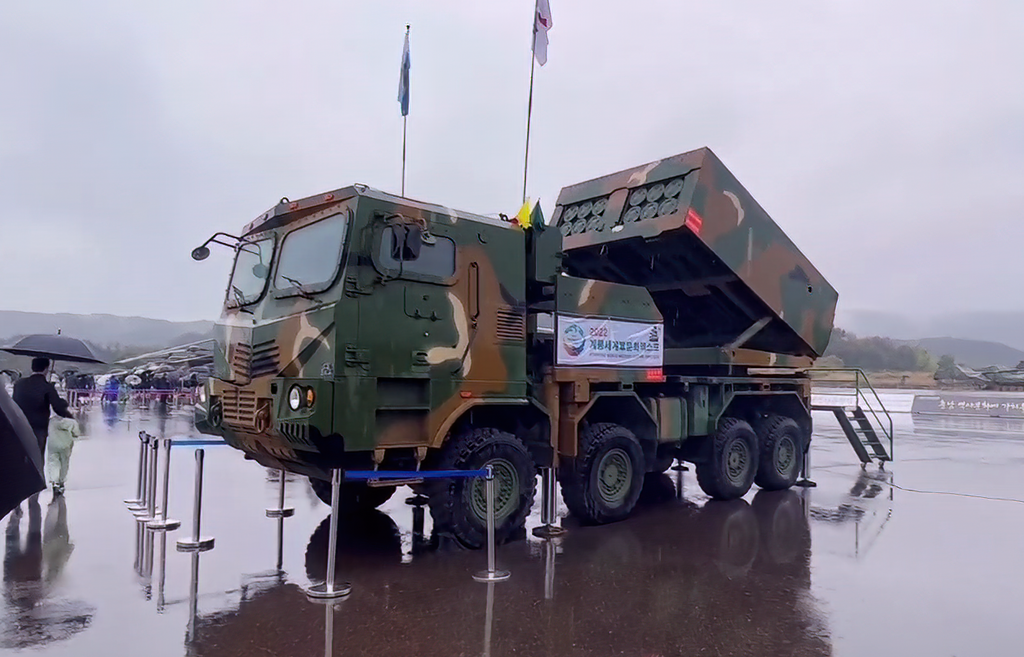
K239 Chunmoo-II MLRS: Comparative Analysis
Overview
The K239 Chunmoo-II is South Korea’s advanced variant of the Chunmoo Multiple Launch Rocket System (MLRS), representing a significant enhancement in range and accuracy over its predecessor. This next-generation precision strike platform combines missile-grade targeting accuracy with extended operational range, substantially strengthening South Korea’s ability to neutralize North Korean long-range artillery and strategic targets.
- Key Characteristics
- Extended Range: Capable of delivering precision-guided munitions beyond 200 kilometers
- Enhanced Guidance Systems: Integrated GPS/INS hybrid guidance for superior accuracy
- High Mobility: Rapid deployment and tactical repositioning with improved survivability
- Versatile Ammunition Options: Multiple payload configurations for operational flexibility

Development Background
Responding to North Korea’s expanding long-range artillery capabilities and the advancing missile systems of neighboring nations, South Korea determined that an upgraded version of the original Chunmoo system was essential. The modernized Chunmoo-II was designed to enhance long-range precision strike capability while reinforcing strategic deterrence.
- Development Timeline
- 2017: Chunmoo-II development plan initiated
- 2019: Performance trials and prototype unveiling
- 2021: Operational deployment begins and production ramps up
- Present: Ongoing capability improvements and international export initiatives
Strengths and Limitations
🔹 Advantages
✔ Extended-Range Precision Strikes: Operational range exceeding 200 kilometers ✔ Superior Accuracy: GPS/INS hybrid guidance enables high hit probability ✔ Rapid Mobility: Quick deployment and repositioning capabilities ✔ Multiple Warhead Options: Tailored configurations for diverse tactical scenarios
🔻 Disadvantages
❌ High Operating Costs: Precision-guided munitions require substantial budget allocation ❌ Ammunition Supply Complexity: Managing diverse ammunition types increases logistical challenges ❌ Limited Protection: Basic armor configuration leaves the platform vulnerable to incoming fire
Image source: North Korea Love Room / CC BY 3.0 / Wikimedia Commons
Regional MLRS Comparison (China, Japan, North Korea)
| Specifications | K239 Chunmoo-II (South Korea) | PHL-16 (China) | Type 19 MLRS (Japan) | KN-25 Super-Large Caliber Rocket (North Korea) |
|---|---|---|---|---|
| Weight | 26 tons | 45 tons | 20 tons | 30 tons (estimated) |
| Dimensions (Width × Length × Height) | 2.9m × 9.7m × 3.2m | 3.2m × 12.5m × 3.6m | 2.8m × 8.5m × 3.0m | 3.0m × 10.0m × 3.3m (estimated) |
| Maximum Speed | 90 km/h | 60 km/h | 80 km/h | 70 km/h (estimated) |
| Primary Armament | 239mm precision-guided rockets | 370mm precision-guided rockets | 227mm rockets | 600mm super-large caliber rockets |
| Armor Protection | Basic ballistic protection | Partial ballistic enhancement | Standard ballistic protection | Basic ballistic protection (estimated) |
| Engine Power | 450 horsepower | 550 horsepower | 400 horsepower | 450 horsepower (estimated) |
| Competitive Advantages | High precision and extended range capability | Superior firepower and range | Interoperability with U.S. forces | Heavy-caliber rocket deployment and mass distribution |
Advanced Systems Comparison (United States, United Kingdom, Russia, France)
| Specifications | M270 MLRS (United States) | GMLRS (United Kingdom) | Tornado-S (Russia) | LRU (France) |
|---|---|---|---|---|
| Weight | 27 tons | 28 tons | 43 tons | 26 tons |
| Dimensions (Width × Length × Height) | 2.9m × 9.7m × 3.2m | 2.9m × 9.5m × 3.2m | 3.2m × 12.3m × 3.5m | 2.9m × 9.6m × 3.2m |
| Maximum Speed | 64 km/h | 80 km/h | 60 km/h | 85 km/h |
| Primary Armament | 227mm rockets | 227mm rockets | 300mm rockets | 227mm rockets |
| Armor Protection | Armored vehicle platform | Armored vehicle platform | Base armor with ERA | Standard ballistic protection |
| Engine Power | 500 horsepower | 450 horsepower | 800 horsepower | 400 horsepower |
| Competitive Advantages | U.S. force integration and sustained supply capability | NATO interoperability | Exceptional firepower and range | Rapid European deployment |
Future Development Directions
- Ammunition Enhancement: Continued development to extend range and improve targeting precision
- Protection Upgrades: Evaluation of reactive armor systems and active defense technologies
- Network Integration: Enhanced real-time data sharing and unified battlefield management capabilities
- Export Expansion: Increased market penetration in Eastern Europe, the Middle East, and Southeast Asia