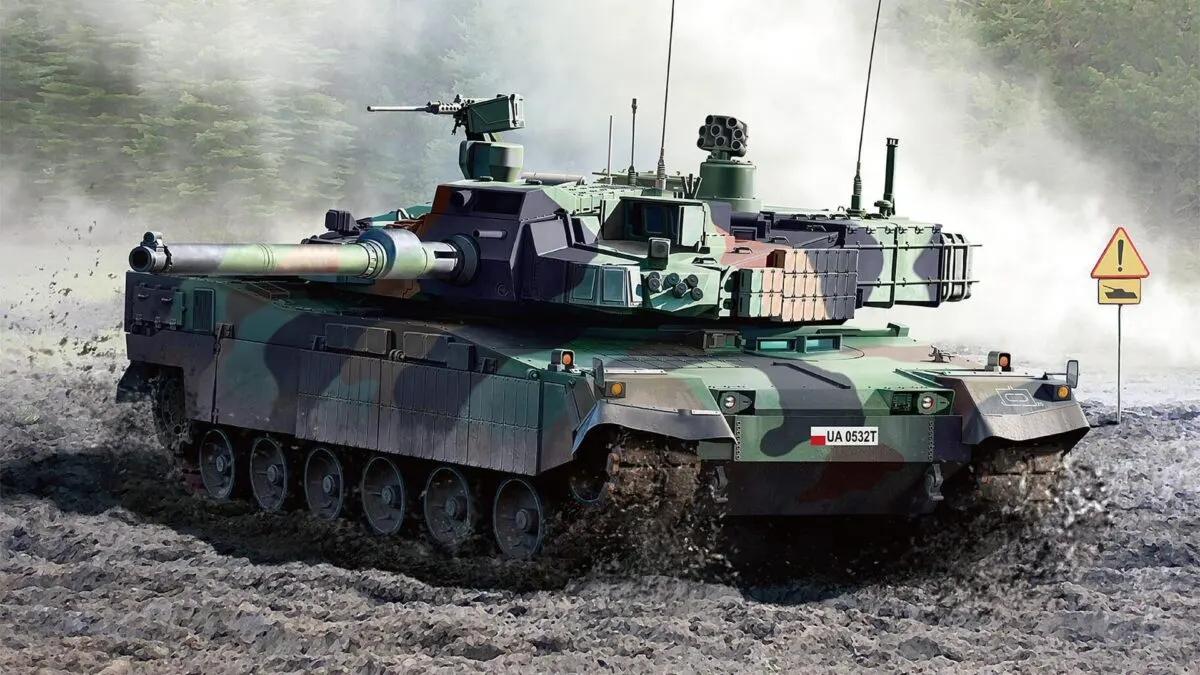
K2 Black Panther Main Battle Tank: A Comprehensive Analysis
Overview
The K2 Black Panther is South Korea’s indigenous 3.5-generation main battle tank (MBT), representing the nation’s cutting-edge armored warfare capability. Engineered to maximize mobility, firepower, and protection, this next-generation platform has become the cornerstone of the Republic of Korea Army‘s armored forces and has achieved notable success in international export markets, including Poland and beyond.
- Key Features
- Formidable Firepower: Equipped with a 120mm L/55 smoothbore cannon and an advanced autoloader system
- Exceptional Mobility: Hydroneumatic suspension system enables speeds up to 70 km/h
- Enhanced Protection: Composite armor combined with an active defense system

Development Background
Through the 1990s, South Korea relied on the K1A1 tank as its primary main battle platform. However, the aging design was widely assessed as lacking adequate firepower and defensive capabilities compared to contemporary systems fielded by North Korea, China, and Japan. The impending threat of North Korea acquiring Russia’s advanced T-90M tank prompted Seoul to accelerate development of a next-generation main battle tank to maintain operational superiority.
- Development Timeline
- 1995: K2 Main Battle Tank development program initiated
- 2007: Prototype unveiled to the public
- 2014: Operational deployment begins with ROK Army units
- 2022: Major export contract signed with Poland
Strengths and Weaknesses
🔹 Advantages
✔ Advanced Fire Control System: Automated target tracking and precision strike capability ✔ Superior Protection: Composite armor paired with an active defense system ✔ Excellent Mobility: Hydroneumatic suspension maximizes cross-country mobility and terrain adaptability ✔ International Export Success: Contracts established with Poland and other allied nations
🔻 Disadvantages ❌ Cost Constraints: Unit price of approximately 8.8 billion won limits procurement volumes ❌ Early Powerpack Challenges: Domestic engine and transmission systems required performance validation ❌ Limited Combat Experience: Relatively fewer operational deployments compared to legacy platforms
Regional Tank Comparison: China, Japan, and North Korea
| Specification | K2 Black Panther (South Korea) | Type 99 (China) | Type 10 (Japan) | Songun-915 (North Korea) |
|---|---|---|---|---|
| Combat Weight | 55 tons | 58 tons | 44 tons | 40–45 tons (estimated) |
| Dimensions (Width × Length × Height) | 3.6m × 10.8m × 2.4m | 3.5m × 11.0m × 2.35m | 3.2m × 9.4m × 2.3m | 3.3m × 9.5m × 2.2m (estimated) |
| Maximum Speed | 70 km/h | 65 km/h | 70 km/h | 55 km/h (estimated) |
| Main Gun | 120mm smoothbore | 125mm smoothbore | 120mm smoothbore | 115mm rifled |
| Armor System | Composite + Active Defense | Composite armor | Composite armor | Steel armor (estimated) |
| Engine Output | 1,500 hp | 1,500 hp | 1,200 hp | 1,000 hp (estimated) |
| Competitive Advantages | Advanced fire control, active defense, superior mobility | Large-caliber cannon, high protection level | Modern electronics suite, lightweight design | Numerical advantage, lower operating costs |
Comparison with Advanced Western Tanks: United States, United Kingdom, Russia, and France
| Specification | K2 Black Panther (South Korea) | M1A2 Abrams (USA) | Challenger 3 (UK) | T-90M (Russia) | Leclerc XLR (France) |
|---|---|---|---|---|---|
| Combat Weight | 55 tons | 67 tons | 66 tons | 48 tons | 57.5 tons |
| Dimensions (Width × Length × Height) | 3.6m × 10.8m × 2.4m | 3.7m × 9.8m × 2.4m | 3.5m × 10.0m × 2.5m | 3.4m × 9.5m × 2.3m | 3.6m × 9.8m × 2.4m |
| Maximum Speed | 70 km/h | 67 km/h | 60 km/h | 65 km/h | 72 km/h |
| Main Gun | 120mm smoothbore | 120mm smoothbore | 120mm rifled | 125mm smoothbore | 120mm smoothbore |
| Armor System | Composite + Active Defense | Composite + Depleted Uranium | Composite armor | Composite + ERA | Composite + Active Defense |
| Engine Output | 1,500 hp | 1,500 hp | 1,500 hp | 1,130 hp | 1,500 hp |
| Competitive Advantages | Advanced fire control, mobility, active defense | Unmatched protection, integrated US logistics network | Robust armor, cutting-edge avionics | High production capacity, lower maintenance costs | Automated systems, exceptional agility |
Future Development Directions
- K2 Performance Improvement Program (PIP): Integration of next-generation fire control systems and enhanced defensive capabilities
- Potential K3 Development: Research underway on an autonomous next-generation combat tank platform
- Expansion of Export Markets: Pursuit of additional contracts with allied nations beyond Poland
- Network-Centric Warfare Enhancement: Implementation of advanced digital battlespace management systems
- Automated Ammunition Resupply Systems: Integration to extend sustained operational capability in extended campaigns
- Extended-Range Combat Capability: Ongoing feasibility studies for next-generation 130mm gun systems