Overview
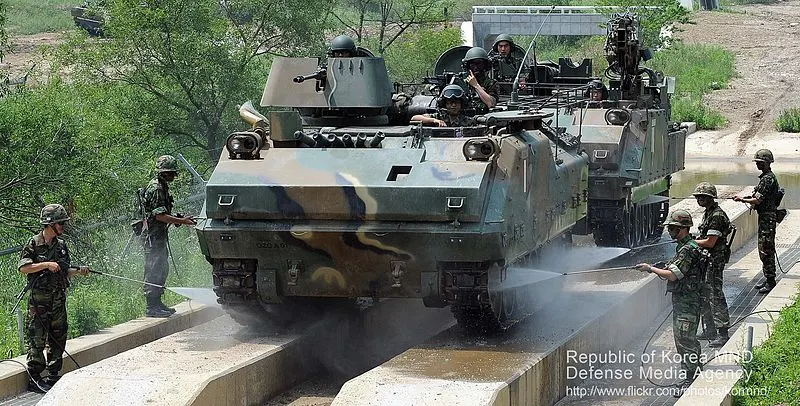
The K200A1 is a South Korean-developed infantry fighting vehicle (IFV) and armored personnel carrier (APC) that serves as a core asset of the Republic of Korea Army’s mechanized infantry units. An upgraded version of the original K200, it incorporates improvements including a more powerful engine and enhanced protection. The vehicle is currently operated by the Republic of Korea Army and Marine Corps and has also been exported to several countries.
- Key features
- Troop-carrying capacity: Can carry up to 12 people, including the crew
- Improved mobility: Equipped with a 350-horsepower engine and capable of amphibious operations
- Flexible armament options: Can be fitted with a 12.7mm machine gun, 40mm grenade launcher, or anti-tank missiles
- Enhanced protection: Features composite armor and can be equipped with additional protection kits
Development Background
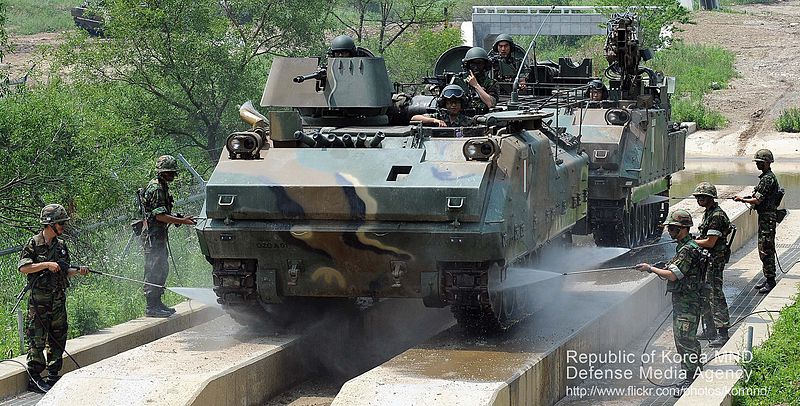
As the U.S.-made M113 armored personnel carriers operated by the Republic of Korea Army grew obsolete, the need emerged for a domestically developed replacement. South Korea responded by developing and deploying the K200 in the 1980s, followed by the introduction of the K200A1, an upgraded variant with improved performance.
- Development timeline
- 1985: K200 development completed and the vehicle entered service
- Late 1990s: K200A1 upgrade program launched
- 2005: K200A1 fielding completed, with further upgrades pursued
- Today: Operated alongside the K21 infantry fighting vehicle
Strengths and Weaknesses
🔹 Strengths
✔ High mobility: Powered by a 350-horsepower engine and capable of amphibious operations
✔ Versatile operational roles: Can be adapted for troop transport, command duties, medical evacuation, and other missions
✔ Cost-effective to operate: Easier to maintain than the older M113
✔ Domestic armored-vehicle platform: Strengthened South Korea’s foundation for self-reliance in the defense industry
🔻 Weaknesses
❌ Limited protection: Vulnerable to modern tanks and anti-tank weapons
❌ Insufficient firepower: Outgunned by more recent infantry fighting vehicles (IFVs)
❌ Limited upgrade potential: The hull design makes further performance improvements difficult
Image source: Republic of Korea Armed Forces / Wikimedia Commons
Comparison with Armored Vehicles in Neighboring Countries (China, Japan, and North Korea)
| Category | K200A1 (South Korea) | ZBD-04A (China) | Type 89 (Japan) | North Korean M2010 |
|---|---|---|---|---|
| Weight | 14.5 tons | 23 tons | 26 tons | 18 tons (estimated) |
| Dimensions (W × L × H) | 2.8m × 6.7m × 2.5m | 3.0m × 7.5m × 2.8m | 3.1m × 7.4m × 2.9m | 2.9m × 7.2m × 2.7m (estimated) |
| Top speed | 70 km/h | 65 km/h | 60 km/h | 55 km/h (estimated) |
| Armament | 12.7mm machine gun, 40mm grenade launcher | 100mm gun + 30mm autocannon | 35mm autocannon | 14.5mm machine gun (estimated) |
| Protection | Composite armor | Composite armor | Composite armor | Basic armor (estimated) |
| Engine output | 350 hp | 590 hp | 600 hp | 400 hp (estimated) |
| Key advantage | High mobility and amphibious capability | Powerful armament and protection | Capable of long-range operations | Suitable for mass production |
Comparison with Armored Vehicles from Advanced Military Powers (the United States, United Kingdom, Russia, and France)
| Category | M2 Bradley (United States) | Warrior IFV (United Kingdom) | BMP-3 (Russia) | VBCI (France) |
|---|---|---|---|---|
| Weight | 30 tons | 25 tons | 22 tons | 32 tons |
| Dimensions (W × L × H) | 3.2m × 6.5m × 3.0m | 3.1m × 6.3m × 2.8m | 3.2m × 7.2m × 2.5m | 3.0m × 7.9m × 2.4m |
| Top speed | 61 km/h | 75 km/h | 70 km/h | 100 km/h |
| Armament | 25mm autocannon, TOW missiles | 30mm autocannon | 100mm gun + 30mm autocannon | 25mm autocannon |
| Protection | Composite armor | Composite armor | Explosive reactive armor | Composite armor |
| Engine output | 600 hp | 550 hp | 500 hp | 600 hp |
| Key advantage | Powerful firepower and networked battlefield integration | Strong protection and excellent mobility | Can carry a wide range of weapons | Balanced mobility and protection |
Future Development
- Enhanced protection: Consideration of additional armor kits and the introduction of active protection systems
- Potential firepower upgrades: Research into upgrades incorporating a 30mm autocannon and anti-tank missiles
- Digital battlefield systems: Integration with network-based battlefield command and control systems
- Expanded overseas exports: Efforts to target markets in Southeast Asia and the Middle East