Overview
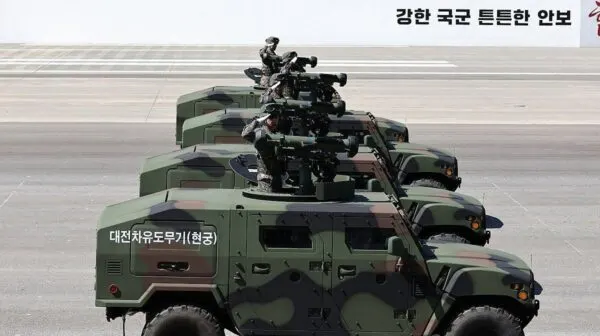
Hyungung is South Korea’s latest indigenously developed man-portable anti-tank missile. Designed to counter tanks and heavily armored vehicles, it delivers powerful precision-strike capability. With fire-and-forget and top-attack modes, the system is designed to address a range of threats on the modern battlefield.
- Key features
- Fire-and-forget capability: Improves the operator’s survivability
- Top-attack mode: Strikes the weaker top armor of armored vehicles
- Precision guidance: Delivers a high hit probability through imaging infrared (IIR) guidance
- Highly portable: Can be carried by infantry or mounted on vehicles

Development Background
South Korea’s Army had determined that its existing anti-tank weapons were limited in terms of performance, accuracy, and portability. As North Korea continued to strengthen its modern tank and armored vehicle forces, the need for a more effective response led South Korea to pursue the development of a high-performance man-portable anti-tank missile.
- Development timeline
- 2007: Hyungung development program launched
- 2015: Performance evaluation conducted and prototype missile unveiled
- 2017: Deployment with the Republic of Korea Army began
- Since 2020: Overseas exports pursued and performance upgrades continued
Strengths and Weaknesses
🔹 Strengths
✔ Precision-strike capability: Maximizes accuracy through imaging infrared guidance ✔ High portability: Can be operated by individual infantrymen and mounted on various platforms ✔ Fire-and-forget capability: Significantly improves operator safety and survivability ✔ Top-attack mode: Can precisely exploit the vulnerabilities of modern tanks
🔻 Weaknesses
❌ Cost: Advanced guidance systems drive up the unit price ❌ Limited range: The maximum effective range is limited to approximately 2.5 km ❌ Operational constraints: Accuracy may be affected by weather and visibility conditions
Anti-Tank Missile Comparison: China, Japan, and North Korea
| Specification | Hyungung (South Korea) | HJ-12 (China) | Type 01 LMAT (Japan) | Bulsae-3 (North Korea) |
|---|---|---|---|---|
| Weight | 24 kg | 22 kg | 17.5 kg | Approximately 20 kg (estimated) |
| Dimensions (diameter × length × height) | 150 mm × 1.2 m × 250 mm | 140 mm × 1.25 m × 240 mm | 140 mm × 0.97 m × 250 mm | 130 mm × 1.1 m × 230 mm (estimated) |
| Maximum speed | 720 km/h | 720 km/h | 700 km/h | 650 km/h (estimated) |
| Warhead | Tandem HEAT warhead | Tandem HEAT warhead | Tandem HEAT warhead | Single HEAT warhead |
| Armor penetration | More than 900 mm | More than 1,100 mm | More than 700 mm | 600 mm (estimated) |
| Range | 2.5 km | 4 km | 2 km | 2 km (estimated) |
| Guidance | Imaging infrared (IIR) | Imaging infrared (IIR) | Laser guidance | Wire guidance |
| Key advantage | High accuracy and top-attack capability | Longer range and greater penetration | Lightweight and highly portable | Simple design and potential for mass deployment |
Anti-Tank Missile Comparison: the United States, the United Kingdom, Russia, and France
| Specification | Hyungung (South Korea) | Javelin (United States) | NLAW (United Kingdom) | Kornet-EM (Russia) | MMP (France) |
|---|---|---|---|---|---|
| Weight | 24 kg | 22.3 kg | 12.5 kg | 33 kg | 15 kg |
| Dimensions (diameter × length × height) | 150 mm × 1.2 m × 250 mm | 127 mm × 1.1 m × 280 mm | 115 mm × 1.02 m × 240 mm | 152 mm × 1.2 m × 270 mm | 140 mm × 1.3 m × 250 mm |
| Maximum speed | 720 km/h | 750 km/h | 800 km/h | 1,000 km/h | 720 km/h |
| Warhead | Tandem HEAT warhead | Tandem HEAT warhead | Single HEAT warhead | Tandem HEAT warhead | Multi-purpose warhead |
| Armor penetration | More than 900 mm | More than 750 mm | More than 500 mm | More than 1,300 mm | More than 1,000 mm |
| Range | 2.5 km | 2.5 km | 1 km | 8 km | 4 km |
| Guidance | Imaging infrared (IIR) | Imaging infrared (IIR) | Predictive guidance | Laser-beam riding | Fiber-optic guidance |
| Key advantage | High accuracy and top-attack capability | Proven combat performance and deployment with the U.S. military | Exceptional portability and simple operation | Long-range capability and powerful penetration | Multi-purpose capability and precision |
Future Development
- Extended range: Development of medium- to long-range variants in the 3–4 km class
- Warhead improvements: Increased penetration and development of multi-purpose warheads
- Expanded operating platforms: Integration with vehicles and unmanned platforms
- Expanded overseas exports: Pursuing exports to countries in Southeast Asia and the Middle East