Overview
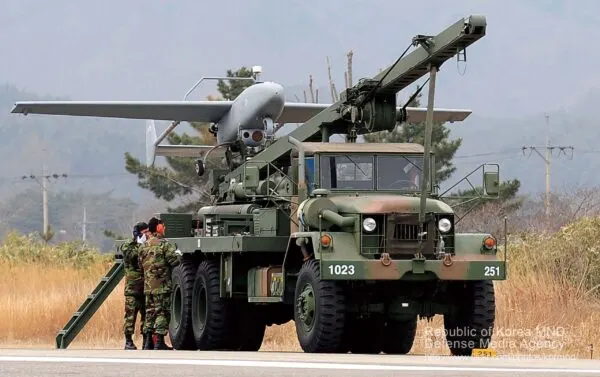
The RQ-101 Songgolmae is a tactical unmanned reconnaissance aircraft developed indigenously by South Korea. It is operated for real-time video surveillance and intelligence-gathering missions. Since entering service in the early 2000s, it has played a central role in surveillance, reconnaissance and battlefield monitoring at corps level and below. Development is also under way on an upgraded variant, the Songgolmae-II.
- Key features
- Tactical UAV: Developed for corps-level operations
- Real-time video transmission: Enables live reconnaissance through links with a ground control station
- Medium-range operational capability: Approximately six hours of endurance and an operational radius of more than 100 km
- Launch method: Catapult-launched, eliminating the need for a runway
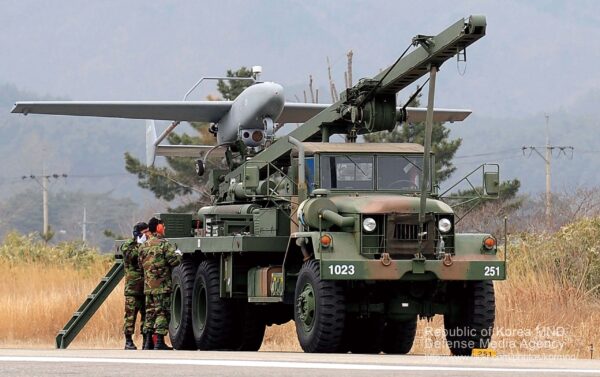
Development background
In the mid-1990s, South Korea launched the Songgolmae program under the leadership of the Agency for Defense Development (ADD) to establish an independent intelligence-gathering capability, while Korean Air took responsibility for production and maintenance. The program placed South Korea among the countries with domestically developed reconnaissance UAVs, and the Songgolmae remains in service as a key intelligence asset for corps-level operations.
- Development timeline
- 1999: Prototype development completed and test flights conducted
- 2001: Mass production began
- 2004: Operational deployment began at corps level
- 2020s: Research and development of the upgraded Songgolmae-II under way
Strengths and weaknesses
🔹 Strengths
✔ Indigenously developed UAV: Helps secure an independent reconnaissance capability ✔ Runway-independent operation: Its launch-rail system enables flexible deployment ✔ Real-time surveillance: Equipped with a video-transmission system ✔ Small and lightweight: Well suited to discreet operations
🔻 Weaknesses
❌ Limited range: Constrained in long-range surveillance missions ❌ Limited surveillance precision: Restricted high-resolution sensor performance ❌ Low survivability: Limited ability to survive being hit ❌ Limited automated evasion and autonomy: Less capable AI functionality than newer drones
Comparison with tactical UAVs in neighboring countries (China, Japan and North Korea)
| Category | RQ-101 Songgolmae (South Korea) | ASN-206 (China) | FFOS (Japan) | Banghyeon-1 (North Korea) |
|---|---|---|---|---|
| Dimensions | 3.4m x 4.2m x 1.2m | 3.8m x 4.6m x 1.5m | 3.2m x 4.0m x 1.3m | 3.5m x 4.0m x 1.2m |
| Weight | Approximately 250 kg | Approximately 220 kg | Approximately 200 kg | Approximately 210 kg |
| Top speed | Approximately 180 km/h | Approximately 170 km/h | Approximately 160 km/h | Approximately 150 km/h |
| Range/endurance | Approximately 6 hours / 100+ km | Approximately 4 hours / 150 km | Approximately 3 hours / 80 km | Approximately 2 hours / 60 km |
| Armament | None | None | None | None |
| Survivability | Low | Low | Low | Very low |
| Key advantage | Real-time video, altitude control | Medium-class surveillance coverage | Compact size and maneuverability | Cost competitiveness and ease of mass production |
Comparison with tactical UAVs from advanced countries (the United States, the United Kingdom, Russia and France)
| Category | RQ-7B Shadow (United States) | Watchkeeper (United Kingdom) | Orlan-10 (Russia) | Sperwer (France) |
|---|---|---|---|---|
| Dimensions | 3.9m x 4.3m x 1.3m | 5.5m x 6.5m x 2.2m | 2.0m x 3.1m x 0.9m | 3.9m x 4.2m x 1.3m |
| Weight | 190 kg | 450 kg | 18 kg | 350 kg |
| Top speed | 200 km/h | 150 km/h | 110 km/h | 210 km/h |
| Range/endurance | 125 km / 9 hours | 150 km / 14 hours | 100 km / 16 hours | 150 km / 6 hours |
| Armament | None | Some surveillance sensors | None | None |
| Survivability | Moderate | Moderate | Low | Moderate |
| Key advantage | Combat-proven and a mainstay of the U.S. military | Integrated surveillance and control | Long-endurance reconnaissance | Strong imaging capability at different altitudes |
Future development
- Deployment of the Songgolmae-II: Plans call for extended range, improved surveillance precision and AESA-class sensors
- AI-based autonomous flight research: Including obstacle avoidance and automatic return-to-base functions
- Drone-to-drone coordinated operations: Building a manned-unmanned integrated ISR system
- Technology transfer to the civilian sector and development of an export base