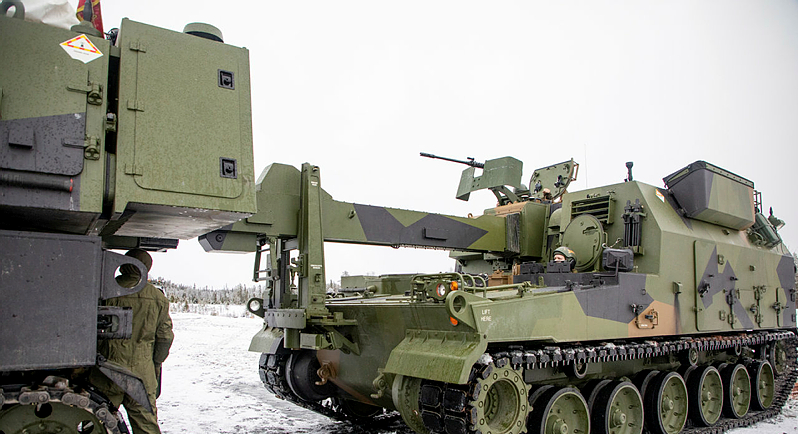
Overview
The K10 ammunition resupply armored vehicle is a South Korean-developed ammunition carrier designed specifically for the K9 self-propelled howitzer. It is intended to deliver ammunition quickly and efficiently during operations alongside the K9 Thunder. Built on the same chassis as the K9, the K10 retains its mobility while enabling fast and safe resupply through an automated ammunition transfer system.
- Key features
- Shares the K9 self-propelled howitzer chassis: Preserves mobility and protection
- Automated ammunition transfer system: Enables efficient resupply, transferring up to 12 rounds per minute
- High ammunition capacity: Can carry more than 104 155mm artillery shells
- Integrated battlefield operations: Can conduct missions in coordination with the K9

Development Background
The Republic of Korea Army had been dealing with lengthy ammunition resupply times and the high risk of vehicles coming under fire during field resupply operations. This created a need for a vehicle that could maintain the K9’s mobility while providing rapid ammunition delivery. The K10 ammunition resupply armored vehicle was developed to address that requirement.
- Development timeline
- Early 2000s: Research into an ammunition resupply system began after the K9 entered service
- 2005: K10 prototype vehicle developed
- 2009: Deployed with the Republic of Korea Army
- Today: Ongoing performance improvements and efforts to expand overseas exports
Strengths and Weaknesses
🔹 Strengths
✔ Mobility equivalent to the K9: Can operate alongside armored units ✔ Rapid ammunition resupply: The automated system enables safer, faster delivery ✔ Protection: Maintains survivability during battlefield resupply operations ✔ Improved operational efficiency: Can be integrated into a network with the K9
🔻 Weaknesses
❌ No offensive capability: A dedicated resupply vehicle with no combat function ❌ Limited range of supported systems: Difficult to support artillery assets other than the K9 self-propelled howitzer ❌ Mechanical maintenance requirements: The automated system adds to maintenance costs
Comparison with Ammunition Resupply Vehicles in Neighboring Countries (China, Japan and North Korea)
| Category | K10 (South Korea) | PCL-181 Resupply Vehicle (China) | Type 99 Ammunition Resupply Vehicle (Japan) | North Korean Ammunition Resupply Vehicle |
|---|---|---|---|---|
| Weight | 47 tons | 40 tons | 45 tons | 35–45 tons (estimated) |
| Dimensions (width × length × height) | 3.4m × 12m × 3.5m | 3.2m × 11m × 3.4m | 3.3m × 11.5m × 3.5m | 3.2m × 10.5m × 3.4m (estimated) |
| Top speed | 67 km/h | 65 km/h | 60 km/h | 55 km/h (estimated) |
| Ammunition capacity | More than 104 rounds | More than 90 rounds | More than 100 rounds | 80–100 rounds (estimated) |
| Automation | Automated ammunition transfer | Partially automated | Semi-automated system | Manual transfer (estimated) |
| Protection | Composite armor | Basic armor | Basic armor | Basic armor (estimated) |
| Key advantage | Fully automated ammunition transfer, optimized integration with the K9 | High mobility and rapid resupply | Integration with Japan Ground Self-Defense Force tactics | Simple design and potential for large-scale deployment |
Comparison with Ammunition Resupply Vehicles in Major Military Powers (the United States, the United Kingdom, Russia and France)
| Category | M992 FAASV (United States) | AS90 Ammunition Resupply Vehicle (United Kingdom) | TZM-2 (Russia) | CAESAR Resupply Vehicle (France) |
|---|---|---|---|---|
| Weight | 28 tons | 35 tons | 40 tons | 32 tons |
| Dimensions (width × length × height) | 3.2m × 10.2m × 3.2m | 3.3m × 11.0m × 3.5m | 3.5m × 12.5m × 3.6m | 3.0m × 11.0m × 3.3m |
| Top speed | 60 km/h | 55 km/h | 50 km/h | 90 km/h |
| Ammunition capacity | More than 90 rounds | More than 80 rounds | More than 100 rounds | More than 80 rounds |
| Automation | Semi-automated | Semi-automated | Automated | Automated |
| Protection | Basic armor | Basic armor | Basic armor | Basic armor |
| Key advantage | Optimized integration with U.S. Army artillery units | Integration with the British Army’s tactical network | Designed for large-scale Russian artillery operations | High mobility and automation |
Future Development
- Potential increase in payload: Consideration of a higher ammunition capacity in future upgrades
- Potential addition of weapons: Research into equipping the vehicle with light weapons for self-defense
- Stronger network capabilities: Improved integration with tactical networks and enhanced data sharing
- Expanded overseas exports: Efforts to offer the K10 alongside the K9 to countries that purchase the K9