Overview
The Jang Bogo-III Batch-I submarine is the Republic of Korea Navy’s first domestically designed and built medium-sized attack submarine and a state-of-the-art diesel-electric submarine equipped with an air-independent propulsion (AIP) system. It boasts formidable anti-ship, anti-submarine and land-attack capabilities and has become a core component of South Korea’s undersea force.
- Key features
- Domestic design and construction: South Korea’s first independently developed medium-sized attack submarine
- AIP system: Extends endurance during submerged operations
- SLBM capability: Provides a strategic strike capability
- Advanced sonar and stealth design: Enhances its ability to evade detection
Development Background
The Republic of Korea Navy saw a need for an indigenous medium-sized submarine with capabilities well beyond those of its existing Type 209 and Type 214 (Son Won-il-class) submarines. The Jang Bogo-III program was launched in response, with the Batch-I variant becoming the first to enter operational service.
- Development timeline
- Early 2010s: The Jang Bogo-III program begins
- 2018: The first boat, ROKS Dosan Ahn Changho, is launched
- 2021: Delivery to the Navy begins
- Present: Additional boats are under construction and entering service
Strengths and Weaknesses
🔹 Strengths
✔ Powerful land-attack capability: SLBM-capable ✔ AIP system: Enables extended submerged operations ✔ Indigenous design incorporating a modern combat system ✔ Enhanced stealth: Incorporates noise-reduction technology
🔻 Weaknesses
❌ Limited endurance compared with nuclear-powered submarines: Shorter operating duration than submarines powered by nuclear reactors ❌ Limited fleet size: The relatively small production run restricts the number of boats in service ❌ Limited operational experience with SLBMs: South Korea has relatively little experience operating strategic weapons
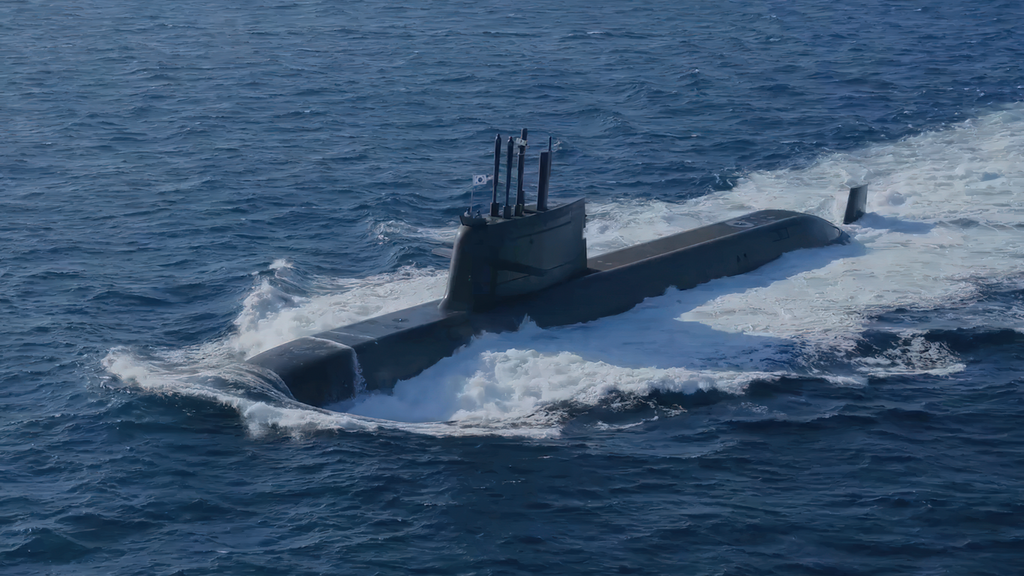
Image source: ROK Ministry of National Defense / Wikimedia Commons[/caption]
Submarine Comparison: China, Japan and North Korea
| Category | Jang Bogo-III Batch-I (South Korea) | Type 039B Yuan-class (China) | Soryu-class (Japan) | New North Korean submarine (estimated) |
|---|---|---|---|---|
| Displacement | 3,700 tons | 3,600 tons | 4,200 tons | 2,500–3,000 tons (estimated) |
| Dimensions (beam × length × height) | 9m × 83.5m × 10m | 8.4m × 77m × 9.5m | 9.1m × 84m × 10.5m | 8m × 70m × 9m (estimated) |
| Top speed | 37 km/h | 35 km/h | 36 km/h | 28–30 km/h (estimated) |
| Armament | SLBMs, Harpoon missiles and torpedoes | YJ-18 missiles and torpedoes | Type 89 torpedoes and Harpoon missiles | Limited (estimated) |
| Propulsion | AIP | AIP | AIP | Diesel-electric (estimated) |
| Key advantage | SLBM capability and advanced sensors | Optimized for anti-ship attacks | Low noise and long operational endurance | Limited force-projection capability |
Submarine Comparison: The United States, United Kingdom, Russia and France
| Category | Virginia-class (United States) | Astute-class (United Kingdom) | Yasen-class (Russia) | Scorpène-class (France) |
|---|---|---|---|---|
| Displacement | 7,800 tons | 7,400 tons | 8,600 tons | 2,000 tons |
| Dimensions (beam × length × height) | 10m × 115m × 11m | 9.8m × 97m × 10.2m | 10.5m × 130m × 11.5m | 6.2m × 66m × 7.5m |
| Top speed | 55 km/h | 56 km/h | 60 km/h | 37 km/h |
| Armament | Tomahawk missiles and torpedoes | Storm Shadow missiles and torpedoes | Kalibr missiles and torpedoes | Exocet missiles and torpedoes |
| Propulsion | Nuclear-powered | Nuclear-powered | Nuclear-powered | Diesel-electric |
| Key advantage | Extended endurance and substantial firepower | Excellent stealth performance | Very long-range strike capability | Cost-effective operation |
Future Development
- Development of Batch-II and Batch-III: Further improvements in SLBM capabilities and overall performance
- Consideration of nuclear-powered submarines: Building the capacity for extended long-duration operations
- Upgrades to electronic warfare and sensor capabilities: Modernizing sonar and command-and-control systems
- Study of export opportunities: Pursuing exports, particularly in Southeast Asian and Middle Eastern markets