Overview
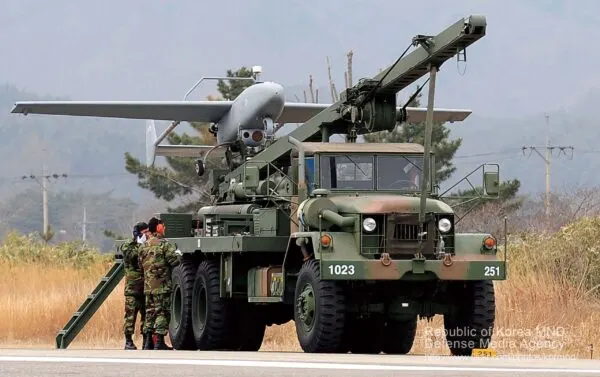
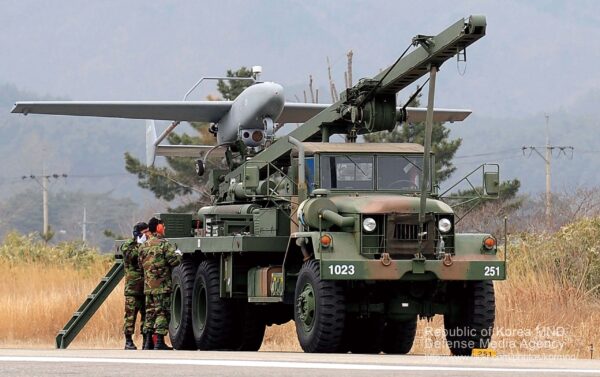
The RQ-101 Songgolmae is a tactical unmanned reconnaissance aircraft developed domestically by the Republic of Korea. It is used for real-time video surveillance and intelligence-gathering missions. Since entering service in the early 2000s, it has played a central role in surveillance, reconnaissance and battlefield situational awareness for corps-level and smaller units. Development is also under way on an upgraded variant, the Songgolmae-II.
- Key features
- Tactical UAV: Developed for corps-level operations
- Real-time video transmission: Enables live reconnaissance through integration with a ground control station
- Medium-range operational capability: Approximately six hours of endurance and an operational radius of more than 100 km
- Launch method: Catapult-launched, eliminating the need for a runway
Development Background
In the mid-1990s, South Korea launched the Songgolmae program under the leadership of the Agency for Defense Development (ADD) to establish an independent intelligence-gathering capability. Korean Air was responsible for production and maintenance. The program made South Korea one of the countries capable of operating an indigenous reconnaissance UAV, and the Songgolmae remains a core intelligence asset for corps-level operations.
- Development timeline
- 1999: Prototype development completed and test flights conducted
- 2001: Production began
- 2004: Entered service and was deployed at the corps level
- 2020s: Research and development under way on the upgraded Songgolmae-II
Strengths and Weaknesses
🔹 Strengths
✔ Indigenously developed UAV: Helps secure an independent reconnaissance capability ✔ Runway-independent operation: The launch-rail system enables flexible operations ✔ Real-time surveillance: Equipped with a video transmission system ✔ Small and lightweight: Well suited to discreet operations
🔻 Weaknesses
❌ Limited range: Constraints on medium- and long-range surveillance ❌ Limited surveillance resolution: Restricted high-resolution sensor performance ❌ Low damage tolerance: Limited survivability if hit ❌ Limited automated avoidance and autonomy: Less capable AI functionality than newer drones
Comparison with Tactical UAVs in Neighboring Countries (China, Japan and North Korea)
| Category | RQ-101 Songgolmae (South Korea) | ASN-206 (China) | FFOS (Japan) | Banghyeon-1 (North Korea) |
|---|---|---|---|---|
| Dimensions | 3.4m x 4.2m x 1.2m | 3.8m x 4.6m x 1.5m | 3.2m x 4.0m x 1.3m | 3.5m x 4.0m x 1.2m |
| Weight | Approximately 250 kg | Approximately 220 kg | Approximately 200 kg | Approximately 210 kg |
| Top speed | Approximately 180 km/h | Approximately 170 km/h | Approximately 160 km/h | Approximately 150 km/h |
| Range / endurance | Approximately 6 hours / 100+ km | Approximately 4 hours / 150 km | Approximately 3 hours / 80 km | Approximately 2 hours / 60 km |
| Armament | None | None | None | None |
| Survivability | Low | Low | Low | Very low |
| Key advantage | Real-time video and altitude control | Medium-sized surveillance coverage | Compact design and maneuverability | Cost competitiveness and mass-production capability |
Comparison with Tactical UAVs from Advanced Military Powers (the United States, the United Kingdom, Russia and France)
| Category | RQ-7B Shadow (United States) | Watchkeeper (United Kingdom) | Orlan-10 (Russia) | Sperwer (France) |
|---|---|---|---|---|
| Dimensions | 3.9m x 4.3m x 1.3m | 5.5m x 6.5m x 2.2m | 2.0m x 3.1m x 0.9m | 3.9m x 4.2m x 1.3m |
| Weight | 190 kg | 450 kg | 18 kg | 350 kg |
| Top speed | 200 km/h | 150 km/h | 110 km/h | 210 km/h |
| Range / endurance | 125 km / 9 hours | 150 km / 14 hours | 100 km / 16 hours | 150 km / 6 hours |
| Armament | None | Some surveillance sensors | None | None |
| Survivability | Moderate | Moderate | Low | Moderate |
| Key advantage | Combat-proven and a mainstay of the U.S. military | Integrated surveillance and control capabilities | Long-endurance reconnaissance | Ability to capture imagery at different altitudes |
Future Development
- Deployment of the Songgolmae-II: Plans call for extended range, improved surveillance resolution and AESA-class sensors
- AI-based autonomous flight research: Including obstacle avoidance and automatic return-to-base functions
- Drone-to-drone coordinated operations: Building an integrated manned-unmanned ISR system
- Technology transfer to the civilian sector and establishing a foundation for overseas exports