How about embarking on a peaceful historical journey through Gochang, following the story of the ancestral shrine, from its founding in 1796 to its destruction and subsequent rebuilding?
Hwadong Seowon was originally established in 1796, but was dismantled due to a government decree. It was rebuilt in 1957 in Daesan-myeon, Gochang-gun. It is a reconstructed ancestral shrine that enshrines four figures of the Gwangsan Kim clan: Kim Yang-gam, Kim In-woo, Kim Seung-gil, and Kim O-haeng.
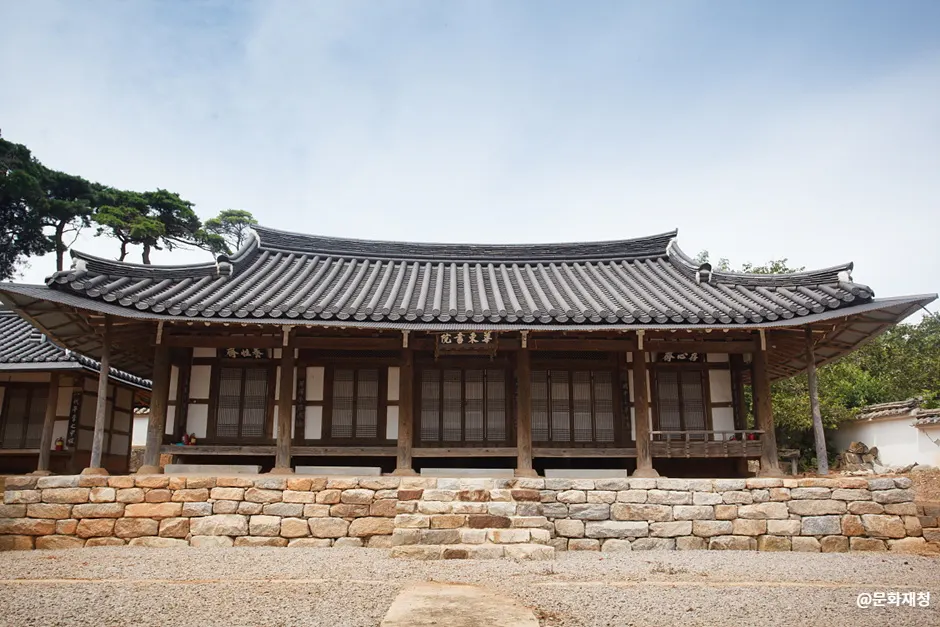
Although the name includes “Seowon” (Confucian academy), the main focus of this place is not education but ancestral rites. It is somewhat different from the other representative tourist attractions in Gochang. If you want to carefully examine the history of the clan and Confucian architecture, you will find a significant story on Gyo-dong-gil in Dae-san-myeon.
It is time for the Sawoo era to begin again, starting from the year 1796.
The origin of Hwado Confucian academy lies in the Jongsa shrine, which was built on the historic site associated with Heung-gwang, the founder of the Gwangsan Kim clan and a Silla prince. Located in Pyangjang-ri, Daejeon-myeon, Damyang-gun, Jeollanam-do (now Pyangjang-dong, Gwangju City), it was established in 1796 to enshrine Kim Yang-gam and hold memorial services.
According to the regulations, the Jongsa Shrine was dismantled, and the Jangseong Gyeonghyun Shrine, which enshrined Kim Seunggil and Kim Ohaeng, was also dismantled during the Japanese colonial period. Later, in 1957, a shrine was built at the current location to enshrine all four individuals. Some records indicate that the shrine was rebuilt in 1958, so there is even a one-year difference in the history of this place.
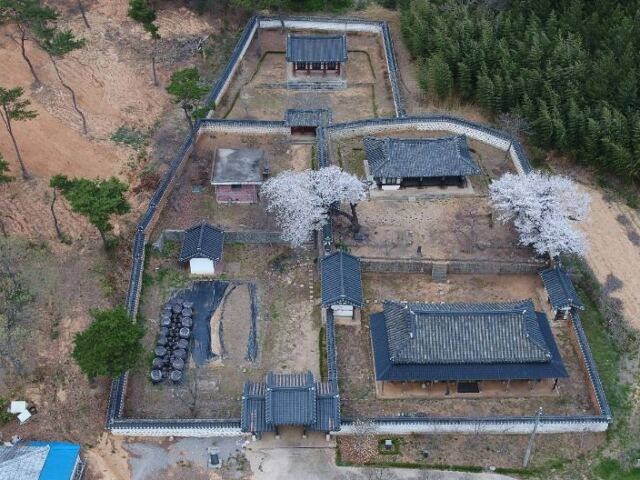
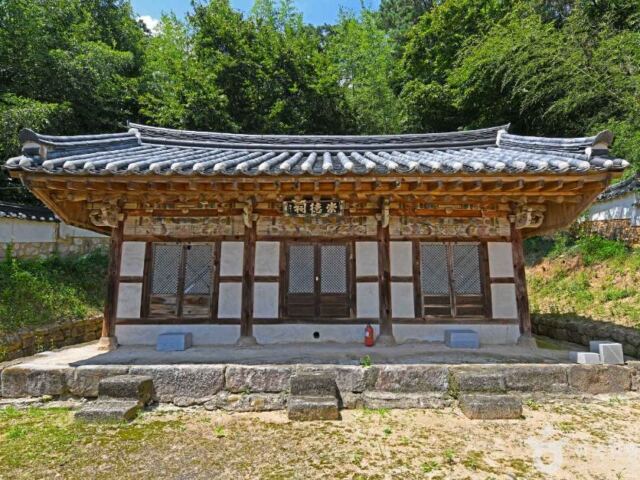
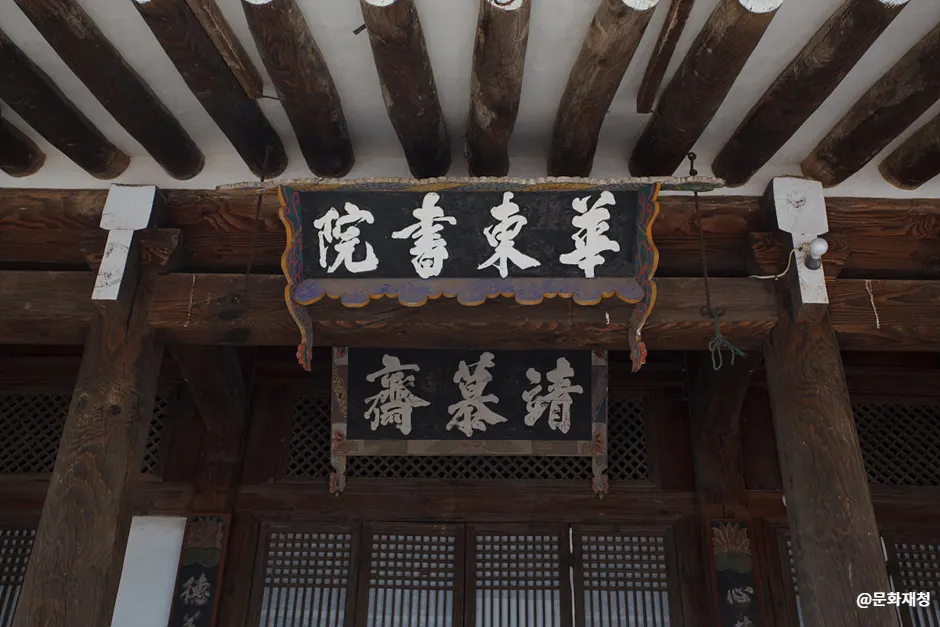
Within the grounds, the main gate, the lecture hall Jeongmojae, the East Chamber and West Chamber, the inner gate, and the memorial shrine Gyodongsa are prominent features. Jeongmojae has a facade of 5 bays and a side of 3 bays, consisting of a central hall of 2 bays and rooms on the left and right, and the number of bays alone reveals the spatial order.
The distinction between a *seowon* and a *sau* is clear.
The distinguishing feature of Hwadong Seowon is its nature as a *sa* (ancestral shrine) dedicated to specific members of a clan. Currently, it houses the spirit tablets of four figures related to the Gwangsan Kim clan: Munan Gong Kim Yang-gam, Jeolli Panseo Kim In-u, Saeon Kim Seung-gil, and Maeon Kim O-haeng.
Gochang Hyanggyo is a local educational institution, and Mujang Hyanggyo was the hyanggyo of the former Mujang County. Doam Seowon and Ungok Seowon are also Confucian academies in Gochang, but they differ in the figures they enshrine and their history. Hwadong Seowon is distinct in that it centers around four members of the Gwangsan Kim clan.
The differences between Gyesan Seowon and Hwadong Seowon become clear when considering their locations and the figures they enshrine. Gyesan Seowon is located in Geumsan-ri, Sangha-myeon, while Hwado Seowon is situated in Daesan-myeon. Even though both are Confucian cultural heritage sites, they commemorate different individuals and preserve the memories of different lineages.
The conversation with my parents often becomes lengthy when the topic turns to masks.
If you are on a historical tour with parents, it is good to present the information in the following order: the establishment in 1796, the demolition according to the regulations, the demolition of Jangseong Gyeonghyeonsa during the Japanese colonial period, and the reconstruction at the current location in 1957. This is not just a tour of the building itself, but an opportunity to understand the process by which a place disappears and is rebuilt.
For adult visitors interested in traditional architecture, the Jeongmojae and the arrangement of the *seowon* are particularly suitable. If you are visiting with children, briefly explain the differences between a *seowon*, a *hyanggyo*, and a *sau*. Hwadong Seowon, rather than being a school, is a ritual space dedicated to honoring individuals, which provides a valuable mini-history lesson.
From the main gate to Gyodongsa Temple, the order is visible.
Within the grounds, the layout is easy to understand: starting from the main gate, one first examines the Jeongmojae lecture hall, and the eastern and western dormitories, then proceeds through the inner gate to the Gyodongsa shrine. Following the “front school, rear shrine” arrangement, one can immediately see how the lecture area in the front is separated from the ritual space in the back.
If you are with a friend who enjoys traditional architecture, be sure to record the structure of Jeongmojae, which has a five-bay facade and a three-bay side, as well as the central main hall and the rooms on the left and right. When taking pictures, it is helpful to capture both the entire building and details such as the signboard and main hall, so that you can easily compare them. If you are with your parents, it would be nice to create a space in the middle where they can sit and chat.
If you are visiting cultural heritage sites in Gochang, consider Hwandongseowon as a ritual space for the Gwangsan Kim clan. By visiting Hwandongseowon together with Gochang-eup Fortress and the Mujanghyeon government office and fortress, you can compare the functions of different historical sites: a ritual space, a fortress, and a government office.
First, Jeong Mo-jae and Ji Jin-yuasan will speak.
Jeongmojae is designated as Jeollabuk-do Cultural Property No. 190, and was designated on November 2, 2012. Hwado Confucian academy itself was designated as a local heritage site of Gochang County on June 8, 2004. It is interesting that the main hall and the entire Confucian academy are designated as separate cultural heritage sites.
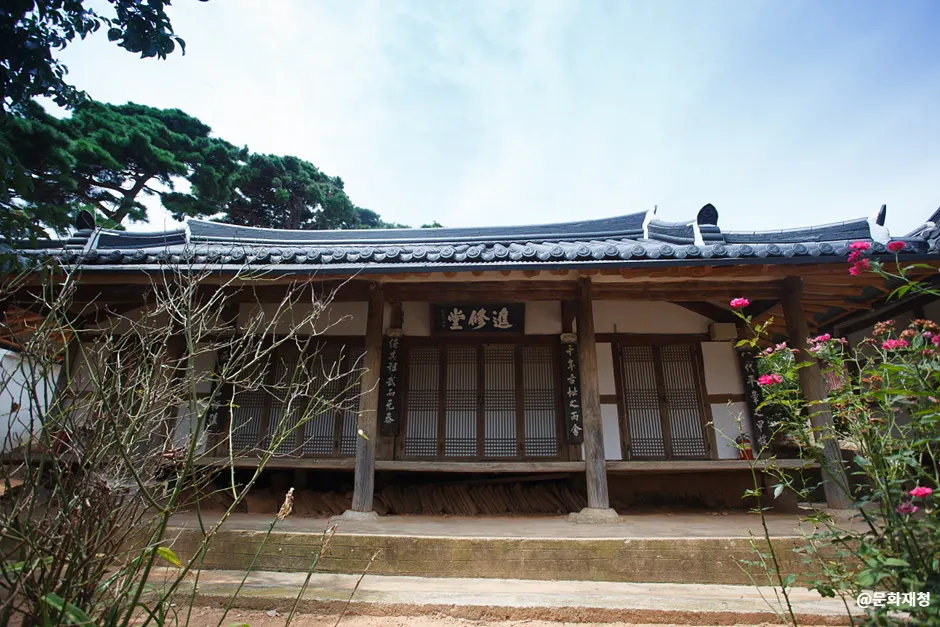
The Digital Gochang Culture Encyclopedia includes Jeongmojae as a separate entry related to the cultural heritage associated with Hwado Seowon. By examining the building’s name and function one by one, even a brief visit can transform a simple architectural viewing experience into a deeper understanding of the clan’s culture.
Please see other cultural assets in Daesan-myeon.
In Daesan-myeon, which includes Hwadongseo Confucian academy, there is a *Yomogi* (Populus cathayana) tree in Jungsan-ri, Gochang. By examining this tree, which is a designated natural monument, one can see the connection between a family’s ritual space and natural heritage within the same region.
Gochang-eup Fortress showcases a historical landscape centered around the fortress walls and government offices. The Mujang-hyeon Government Office and the Mujang-eup Fortress provide insights into the local administration and defense structures of the Joseon Dynasty. Starting from the the shrine and expanding to the fortress walls and government offices reveals that the history of Gochang is not a one-dimensional narrative.
Please make sure to have your address and usage information readily available.
The address is 24, Gyodong-gil, Daesan-myeon, Gochang-gun, Jeonbuk Special Self-Governing Province. If you are driving, enter the address or “Hwado Confucian Academy” into your navigation system.
Information regarding intercity bus routes to and from Gochang and Daesan is available on the Gochang County tourism website, but the location of the bus stop in front of Hwado Confucian Academy and the walking route from the stop are not disclosed. The location, number of spaces, and fees for the dedicated parking lot are also not publicly available, so those traveling by car should factor this into their plans.
No separate information is available in the public materials regarding admission fees, reservation methods, hours of operation, or days closed. Information on regularly offered guided, hands-on, and exhibition programs is also not publicly available. For inquiries, please call 063-560-2943.
Hwado Confucian academy is more closely related to Confucian cultural heritage that venerates figures of the Gwangsan Kim clan than it is to typical educational or experiential tourist attractions. Therefore, a visit to this place is best suited for a leisurely experience, such as slowly reading the names of the four figures and observing the layout from Jeongmojae Hall to Gyodongsa temple, rather than rushing to consume a large amount of information quickly.
When visiting, enter 24, Gyodong-gil, Daesan-myeon, Gochang-gun, Jeonbuk Special Self-Governing Province, into your navigation system. Please visit quietly and observe the space, keeping in mind its purpose as a ritual space.