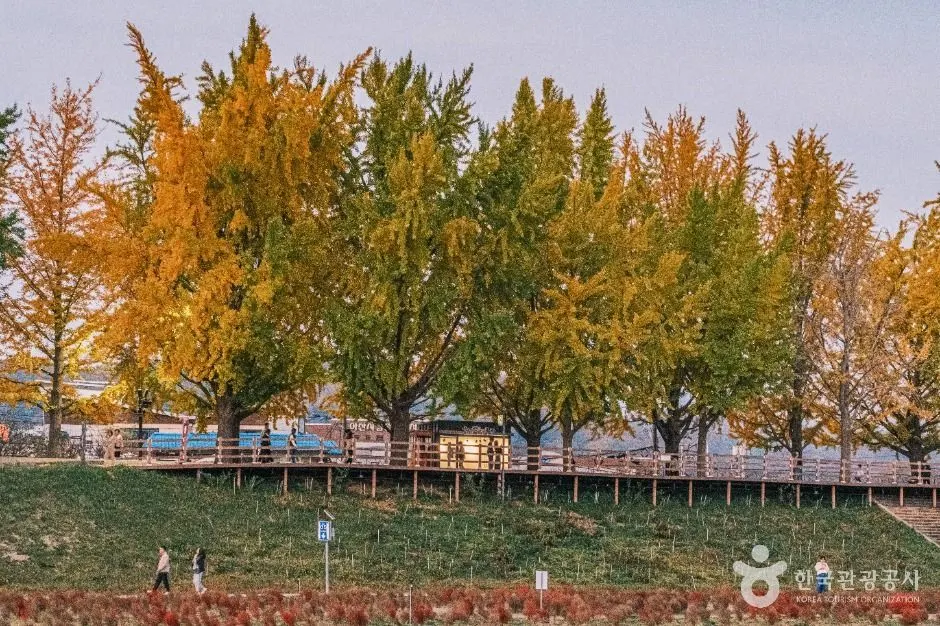
As you walk along the Gokgyocheon Stream, a tree tunnel extends all the way to the entrance to Hyeonchungsa Shrine. Experience the history and the river landscape together, framed by the yellow leaves.
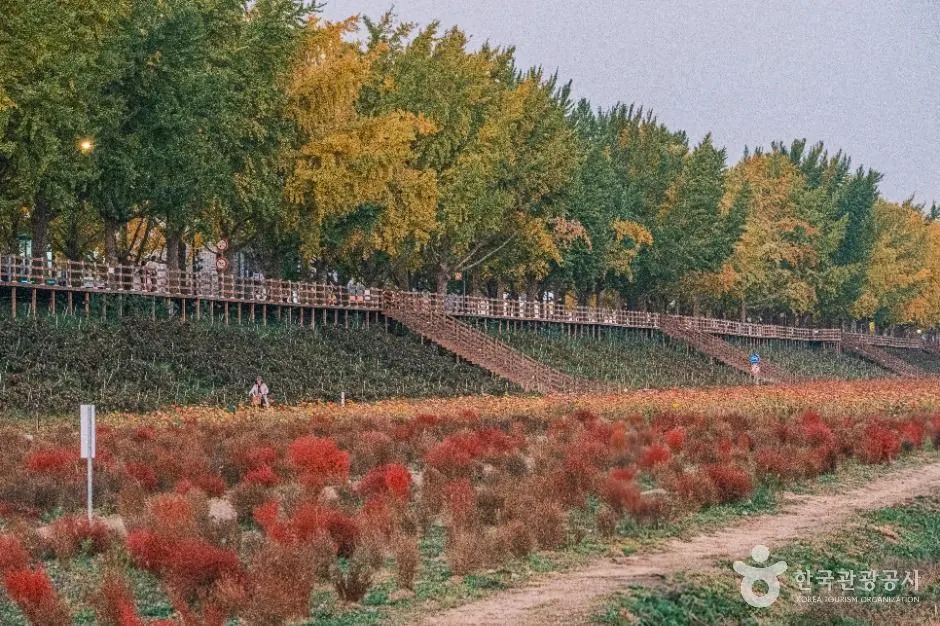
The Gokgyocheon Ginkgo Tree Road, with a total length of 2.1 kilometers, is lined with approximately 350 ginkgo trees from the Chungmu Bridge to the entrance to Hyeonchungsa Shrine.
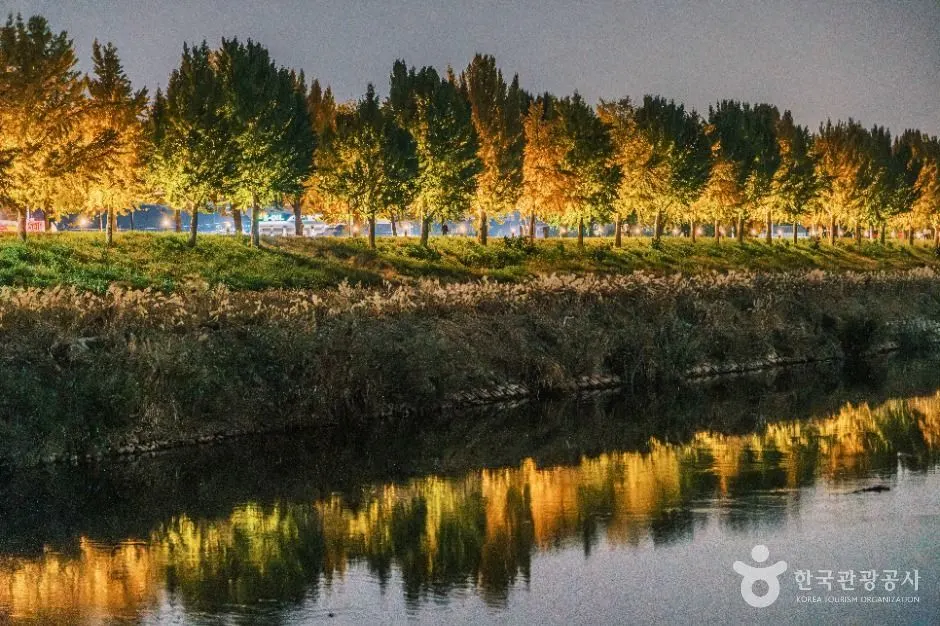
The peak autumn foliage for 2026 was predicted to be around November 3rd, and November 6th is a period shortly after the peak. You can still see the yellow scenery while also witnessing the beginning of the leaves falling.
This is the reason why a yellow tunnel appeared next to the Gogyocheon stream.
This path is a flat, tree-lined walkway created along the Gokgyocheon Stream. Currently, a total of approximately 350 Ginkgo trees grow along this path, and among them, about 180 trees line the banks of the Gokgyocheon Stream.
The path began with the 1966 Hyeonchungsa Shrine sanctification project. In 1973, ginkgo trees about 10 years old were planted along the access road to Hyeonchungsa Shrine, and more than 50 years after they were planted, the trees have grown into magnificent specimens over 60 years old. When you add up the years, it feels less like a walking path and more like a long corridor of time.
This road was originally a major thoroughfare for vehicles, but it was converted into a car-free street following the 2014 public contest project to create a rural-themed street park. The former bus stop is used as an exhibition space for local artists, and the former forestry cooperative building serves as a cultural facility.
The atmosphere is different from that of similar wooden paths.
While the Bonggoksa millennium forest path offers a blend of red pine groves on Mount Bongsu and opportunities for forest bathing, the Gokgyocheon Ginkgo Tree Road is characterized by its ginkgo trees lining the riverbank and its flat, easy walking surface. The Sinjeongho Tourist Area is for viewing the lake, park, and cultural facilities, while this place centers on the yellow ginkgo tree tunnel and the historical significance of the entrance road to Hyeonchungsa Shrine.
While both the Metasequoia Road in Damyang and this location share the characteristic of being a road lined with trees on both sides, the trees here are Ginkgo trees, and the path connects to Gokgyocheon and Hyeonchungsa. If the Ginkgo tree in Banjegi, Wonju, centers around a single, massive natural monument, the Ginkgo tree path along Gokgyocheon is a 2.1 km tree-lined walking path.
While the Maple Tree Forest Path at the Independence Hall of Korea features red maple forests and an exhibition on the history of the independence movement, this place combines yellow Ginkgo trees, a river landscape, and the Memorial Shrine dedicated to Admiral Yi Sun-sin in a single route.
There are reasons why people of all ages, from parents to children, choose to walk.
When accompanied by parents, it is pleasant to walk slowly along the Gokgyocheon River and proceed to the entrance to Hyeonchungsa Shrine. The gentle access road, parking spaces for people with mobility impairments, and accessible restrooms are listed in the Korea Tourism Organization’s barrier-free information, which expands the possibilities for family walks.
If you are with children, try observing the colors and fruit of the ginkgo trees, as well as the flow of Gokgyocheon Stream, in the car-free sections. This is a place where you can connect an appreciation of nature with the historical stories of Hyeonchungsa Shrine all at once. Please hold your child’s hand near the stream.
For couples and friends, the tree tunnels and yellow leaves provide a beautiful backdrop for photos. For solo travelers, the public walking paths offer a designated direction and allow for walking without reservations.
The direction you walk in can change your entire day.
Choose either the direction towards Chungmu Bridge or the direction towards the entrance of Hyeonchungsa Shrine, and walk approximately 2.1 kilometers along Gokgyocheon Stream. You can enjoy the scenery of the stream and the Ginkgo tree-lined streets as a unified experience.
If you are with a romantic partner or a friend, you could try taking photos of the same path at different times of the day, either in the morning or at sunset, using both a low-angle and a high-angle perspective. The length of the Ginkgo tree tunnel is emphasized when you stand between the trees to take the photo.
Visitors who ride bicycles can enjoy the scenery along the Gokgyocheon River by following the designated bicycle paths and connecting to the Ginkgo Tree Road. If you are with parents, it is recommended to park the car in the public parking lot and walk slowly, creating a place to rest along the way.
During the autumn foliage season, prioritize walking over parking.
During peak autumn foliage season, vehicle traffic may be restricted on weekends and holidays. During peak season, parking lots become crowded, and movement in the surrounding area may be more difficult than usual. If you are driving, it is better to consider a wider range of parking options.
It is ideal to combine a visit to Hyeonchungsa Shrine with a walk along the Ginkgo Tree Path on the same day. Walking along the riverbank from the Ginkgo Tree Path and then exploring the relics, historical sites, and memorial spaces related to Admiral Yi Sun-sin at Hyeonchungsa Shrine allows for a seamless blend of nature walk and historical exploration.
From November 14th to November 15th, 2026, the 2026 Ginkgo Avenue Street Art Festival is scheduled to take place in the area surrounding the Ginkgo Avenue in Gokgyocheon. The festival will feature street performances, hands-on activities, vendor booths, and photo zones, and is open to the public for free.
Follow the path from the National Cemetery of Korea to the Onyang Folk Museum.
Hyeonchungsa is a historical site related to Admiral Yi Sun-sin, located at the end of the Ginkgo tree-lined path. The Onyang Folk Museum is a place to experience the folk and traditional culture of Asan, and the Mediterranean Village is a street-style attraction that is well-suited for connecting with other nearby places.
Sinjeongho Garden is a lake and garden-style tourist destination that is connected to the Asan City Tour downtown course. When using the Asan City Tour downtown course from Onyang Oncheon Station, the tour stops at Gokgyocheon Ginkgo Tree Road and operates as a circular route connecting Onyang Oncheon Station, the Onyang Folk Museum, Gokgyocheon Ginkgo Tree Road, Hyeonchungsa, and Sinjeongho Garden.
Here’s how to handle the address and parking:
The address is located in Songgok-ri, Yeomchi-eup, Asan-si, Chungcheongnam-do. By car, access is from Chungmu-gyo in Asan-si, heading towards the entrance of Hyeonchungsa. To use a navigation system, enter “Gokgyocheon Ginkgo Tree Road” or “Hyeonchungsa Gokgyocheon Ginkgo Tree Road Public Parking Lot.”
The Hyeonchungsa Gokgyocheon Ginkgo Tree Road public parking lot is at 71-9, Songgok-ri, Yeomchi-eup, Asan-si, Chungcheongnam-do. The first parking lot on Ginkgo Tree Road is at 519-2, Baekam-ri, Yeomchi-eup, Asan-si, Chungcheongnam-do, and the second parking lot is at 258, Baekam-ri, Yeomchi-eup, Asan-si, Chungcheongnam-do. The Gokgyocheon riverside parking lot is also available, and parking is free.
Public transportation allows access to the Asan City Tour urban route from Onyang Oncheon Station. This circular route connects Onyang Oncheon Station to Gokgyocheon Ginkgo Tree Road.
This is a walking path that is always open to the public and does not require an entrance fee.
Admission is free, and no reservation is required to use the walking trails. The facility is open continuously, and there are no days it is closed.
For inquiries, please contact the Asan City call center at 1422-42. Instead of relying solely on the information that free parking is available during weekends in autumn, it is advisable to plan your visit with ample time.
In November, you may see both autumn foliage and fallen leaves simultaneously, so please wear comfortable shoes. When visiting on weekends, please be aware of potential traffic congestion and vehicle restrictions.