From the expansive courtyard of Geunjeongjeon to the pond of Hyangwonjeong, the king’s daily activities and the royal family’s leisure time are connected within a single palace. Read the spaces of Joseon through the autumn colors.
From October 29 to November 15, 2026, during the Korea Grand Festival, Gyeongbokgung Palace can be visited free of charge, except for the usual Tuesday closure.
Gyeongbokgung Palace is the main palace of the Joseon Dynasty, built in 1395 after the founding of the Joseon Dynasty in 1392. The palace was destroyed during the Imjin War, but rebuilt approximately 270 years later. Simply viewing the buildings allows one to trace the layers of time in Joseon history.
Imagine a day in the life of the king, at the heart of the palace.
Gyeongbokgung Palace was designed with Mount Baekak as its primary mountain, and its buildings were arranged accordingly. The palace was the center of Hanyang, with the Yukjo-geo street extending in front of the main gate, Gwanghwamun. The name “Gyeongbok” embodies the wish for the new dynasty to enjoy great fortune and prosperity.
Geunjeongjeon, the main hall, is the central hall of Gyeongbokgung Palace, where the king’s enthronement ceremonies, audiences with civil and military officials, and receptions for foreign envoys were held, and it is National Treasure No. 223. Continuing on to Sajeongjeon, Gangnyeongjeon, and Gyotaejeon, the state ceremonial spaces and royal living quarters can be seen side by side.
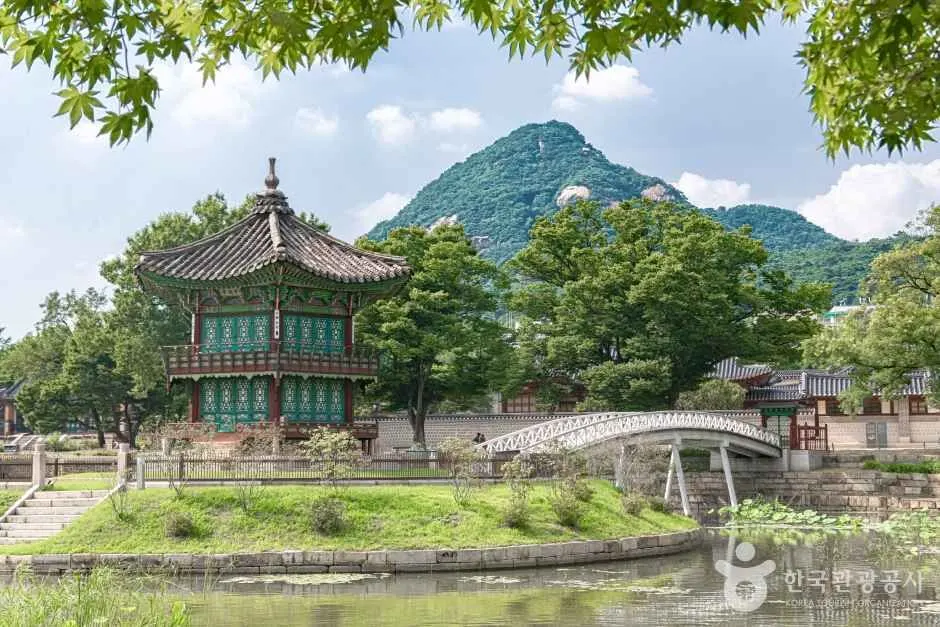
Gyeonghoeru is a pavilion where the king held banquets with his officials or entertained foreign envoys, and it is National Treasure No. 224, while Hyangwonjeong is a hexagonal pavilion built on an island in the center of Hyangwonji and is Treasure No. 1761. Within the palace, banquet venues and places of rest appear in succession, making the character of the space quite varied.
Gyeongbokgung Palace was destroyed during the Imjin War in 1592 and was not rebuilt. It was rebuilt again in 1867. Restoration work began in earnest in the 1990s, and from 1995 to 1997, the buildings of the Japanese Government-General of Korea were demolished, leading to the restoration of the area around Heungnyeongmun Gate, the royal sleeping quarters precinct, and Geoncheonggung Palace, Taewonjeon Hall, and Gwanghwamun Gate.
It is different from Changdeokgung Palace, and it also has a different atmosphere from Deoksugung Palace.
While Changdeokgung Palace showcases the halls and royal living spaces of the Joseon dynasty, its strengths lie in the rear garden that preserves the natural landscape and the palace layout. Gyeongbokgung Palace, befitting its status as the main palace, is characterized by its main hall, Gwanghwamun Gate, the Six Government Offices street, and its wide central axis, creating a clear impression of being the center of national administration.
Changgyeonggung Palace is notable for its royal family’s living spaces and the scenery around Chundangji Pond, while Deoksugung Palace is characterized by its Western-style architecture from the period of the Great Korean Empire and traces of modern history. At Gyeongbokgung Palace, the traditional wooden architecture of the early Joseon period and the reign of King Gojong is the main focus, so even a simple walk through the palace reveals different stories.
Whether you are with your parents and children, or alone, a sense of movement and activity is created.
For adults and parents interested in history, the years 1395 (establishment), the Imjin War (destruction), 1867 (reconstruction), and the Japanese colonial period (damage and restoration) seem to overlap in a single place. By following the main halls from Geunjeongjeon to Geoncheonggung, one can connect the state ceremonies and royal life of the Joseon Dynasty within the palace grounds.
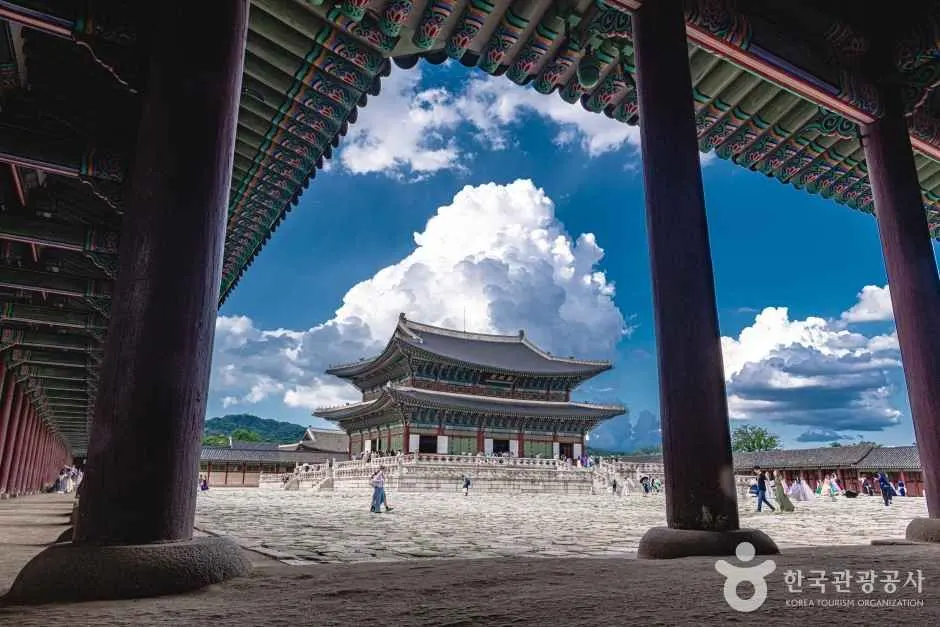
When visiting with children, explore Gwanghwamun Gate, Heungnyemun Gate, Geunjeongjeon Hall, Gyeonghoeru Pavilion, and Hyangwonjeong Pavilion in sequence, and try to identify the functions of each structure, courtyard, pond, and pavilion. By examining the names and uses of each building one by one, even a large palace becomes easier to understand and appreciate.
For couples and friends, the walking spaces connecting the halls, ponds, pavilions, and palace walls are ideal. For those visiting alone, it is recommended to walk at one’s own pace along the designated axes and main pavilions, or to combine a guided tour with visits to the exhibitions.
A stroll through the palace, from Geunjeongjeon to Hyangwonjeong.
When visiting with parents, consider following this route: proceed from Gwanghwamun and Heungnyeongmun to Geunjeongjeon, Sajeongjeon, Gangnyeongjeon, Gyeonghoeru, Hyangwonjeong, and Geoncheonggung. This route allows you to compare the spaces for state ceremonies with the spaces for royal life. It is advisable to find a place to sit and rest along the way.
It is best to explore the palace with children by looking for the platform and sculptures of Geunjeongjeon, the gates and pond of the palace, and the functions of Gyeonghoeru and Hyangwonjeong. By guessing the names and functions of each building, even a large palace can feel like a small adventure.
If you are interested in history, focus on Geoncheonggung Palace and Hyangwonjeong Pavilion to examine the changes in the palaces during the reign of King Gojong and the appearance of the palaces during the period of modernization. You can visit alone or with friends, and each person can choose one building that impresses them, then compare and discuss the functions and meanings of Geungjeongjeon Hall, Gyeonghoeru Pavilion, Hyangwonjeong Pavilion, and Geoncheonggung Palace.
After visiting Gyeongbokgung Palace, you can proceed to the National Palace Museum, located on the west side outside the Heungnyemun Gate, to view the palace structures and royal artifacts that you saw within the palace. The National Folk Museum is located on the east side of the Hyangwonjeong Pavilion within Gyeongbokgung Palace, making it convenient to include Korean folk culture and related materials in your itinerary.
In the autumn, my gaze is drawn to the pond and the walls.
The recommended route is to first visit Geunjeongjeon and Gyeonghoeru, then proceed in the direction of Jakyeongjeon and Hyangwonjeong. From late October to November, the autumn scenery around the halls, the pond, and the palace walls is particularly beautiful, which highlights the difference between the long axis and the tranquil spaces.
If you plan to take photos, pay attention to the areas around Hyangwonjeong and Gyeonghoeru, as well as the Ginkgo tree path in front of Geonchunmun. When with a romantic partner, stroll slowly, focusing on the pond and the pavilions. When with friends, choose different palace buildings to visit and compare their functions, which can add a bit of fun to your walk.
Visiting by car is possible, but the parking lot may become congested on busy days, so it is better to consider public transportation first. Since the route involves a lot of walking, if you are accompanied by your parents, it is advisable to slow your pace and not arrive late in the afternoon.
In November, the exhibition will extend to the National Palace Museum.
In November 2026, Gyeongbokgung Palace will be open from 09:00 to 17:00, with admission ending at 16:00. During the free admission period from October 29th to November 15th, visitors can enjoy the seasonal scenery around the halls, ponds, and walls, except on palace closure days.
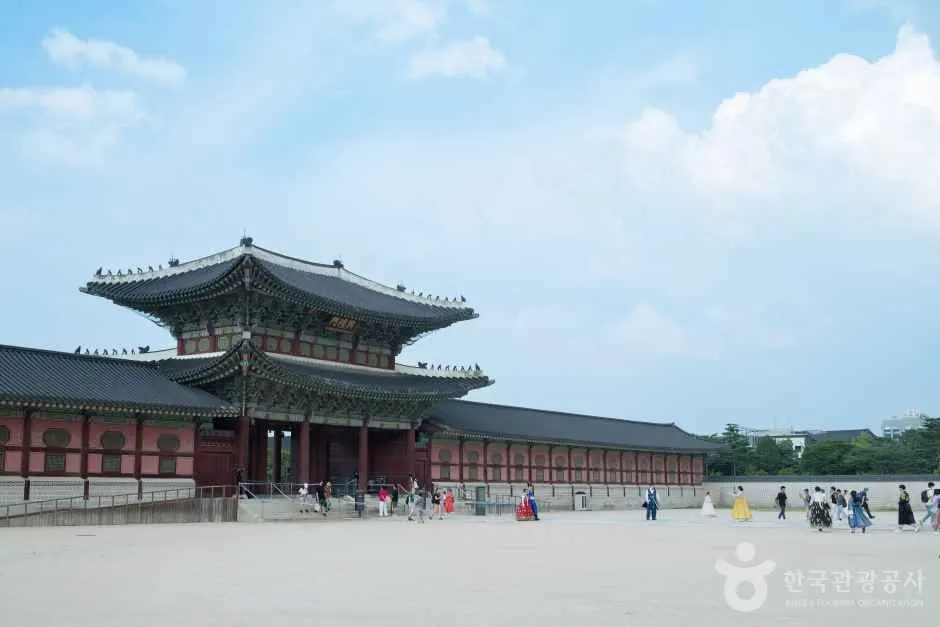
Located near the northern area of Gyeongbokgung Palace, Cheongwadae serves as a space connecting palace visits with urban walks. The National Folk Museum of Korea, located on the east side of Hyangwonjeong, and the National Palace Museum of Korea, located on the west side outside of Heungnyemun Gate, are also nearby, creating a natural flow where visitors can first view the outdoor structures and then explore royal and everyday culture indoors.
You can easily handle the address and transportation arrangements.
The address is 161, Sajik-ro, Jongno-gu, Seoul, Sejong-ro. It is accessible from Exit 5 of Gyeongbokgung Station on Subway Line 3, or Exit 2 of Gwanghwamun Station on Subway Line 5.
Private vehicles can get there by entering the address into a navigation system, and the parking lot can accommodate 240 passenger cars and 50 buses. For small cars, parking costs 3,000 won for the first hour, plus 800 won for every additional 10 minutes; for medium and large vehicles, it costs 5,000 won for the first hour, plus 800 won for every additional 10 minutes.
General admission is available without reservation, but some programs require a reservation.
The general admission fee is 3,000 won per person, and 2,400 won per person for groups of 10 or more. Korean citizens aged 24 or under and 65 or over, as well as foreign citizens aged 18 or under and 65 or over, are eligible for free admission.
General admission is available on-site without reservation. For special programs such as special tours of Gyeonghoeru Pavilion and Hyangwonjeong, guided tours of Chilgung, and Korean-language group tours for 10 or more people, advance reservations are required.
Tuesday is a day off. Please enter the building before 4:00 PM in November.
Gyeongbokgung Palace is closed every Tuesday. If a regular closing day coincides with a public holiday or substitute public holiday, the palace will be open and will instead be closed on the first non-holiday thereafter. Free admission during the Korea Grand Festival also excludes palace closure days.
For inquiries, please call 02-3700-3900, and the website address is royal.khs.go.kr. In November, the last admission is at 16:00 and visiting ends at 17:00, so arriving in the morning or early afternoon allows you to explore the palace buildings and pond without rushing.