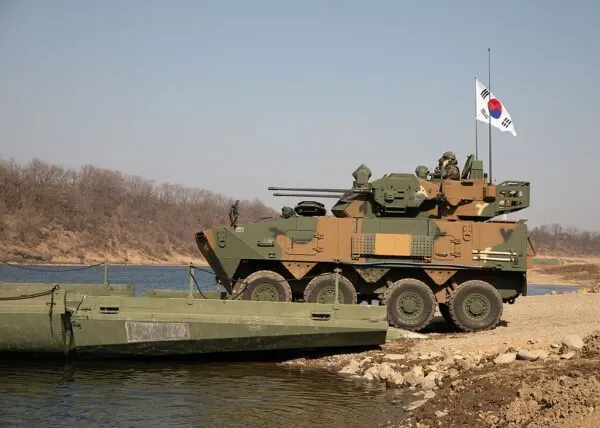
Overview
The K808 wheeled armored vehicle is the Republic of Korea Army’s latest 8×8 wheeled combat vehicle, introduced for rapid-response and highly mobile operations. Compared with older tracked armored vehicles, it offers superior road mobility and faster deployment, making it well suited to rapid troop movements as well as combat in urban and unconventional-warfare environments.
- Key Features
- High mobility: A top speed of 100 km/h enables rapid deployment over long distances
- Potent firepower: Can be fitted with a range of weapons, including a 12.7mm machine gun and a 40mm automatic grenade launcher
- Effective protection: Uses modular ballistic armor
- Amphibious capability: Can cross rivers and operate in a wide range of environments

Development Background
The Republic of Korea Army pursued development of a new wheeled armored vehicle to overcome the K200 tracked armored personnel carrier’s limited road mobility and reduced effectiveness in urban and unconventional warfare. The K808 was designed to improve the military’s responsiveness by providing the rapid mobility and tactical flexibility demanded on the modern battlefield.
- Development Timeline
- 2012: Wheeled armored vehicle program launched
- 2016: Prototype unveiled and testing conducted
- 2017: Deployment began and mass production commenced
- 2020s: Continued upgrades and export efforts
Strengths and Weaknesses
🔹 Strengths
✔ Excellent road mobility: Fast movement and rapid deployment ✔ Flexible firepower options: Compatible with a variety of weapons systems ✔ Operational versatility: Capable of operating in urban combat and a range of other environments ✔ Ease of transport: Its lightweight design facilitates strategic deployment
🔻 Weaknesses
❌ Limited protection: Relatively vulnerable to medium- and heavy-class anti-tank weapons ❌ Off-road mobility constraints: Its performance on difficult terrain is more limited than that of tracked vehicles ❌ Armament limitations: Restricted ability to carry larger-caliber weapons
Comparison with Wheeled Armored Vehicles in Neighboring Countries (China, Japan and North Korea)
| Category | K808 (South Korea) | ZBL-09 (China) | Type 96 Armored Vehicle (Japan) | M2010 Wheeled Armored Vehicle (North Korea) |
|---|---|---|---|---|
| Weight | 20 tons | 21 tons | 14.5 tons | 16 tons (estimated) |
| Dimensions (W × L × H) | 2.7m × 7.4m × 2.5m | 3.0m × 8.0m × 2.6m | 2.5m × 6.8m × 2.4m | 2.8m × 7.0m × 2.5m (estimated) |
| Top speed | 100 km/h | 100 km/h | 100 km/h | 90 km/h (estimated) |
| Armament | 12.7mm machine gun, 40mm automatic grenade launcher and other options | 30mm autocannon | 12.7mm machine gun, 40mm automatic grenade launcher | 14.5mm machine gun |
| Armor | Modular ballistic armor | Basic ballistic armor | Basic ballistic armor | Basic ballistic armor |
| Engine output | 420 horsepower | 440 horsepower | 360 horsepower | 350 horsepower (estimated) |
| Key advantage | Amphibious capability and excellent mobility | Powerful firepower from its autocannon | Mobility and reliability | Tailored for operations in North Korean terrain |
Comparison with Wheeled Armored Vehicles of Advanced Militaries (the United States, United Kingdom, Russia and France)
| Category | K808 (South Korea) | Stryker (United States) | Boxer (United Kingdom/Germany) | BTR-82A (Russia) | VBCI (France) |
|---|---|---|---|---|---|
| Weight | 20 tons | 18 tons | 32 tons | 15 tons | 32 tons |
| Dimensions (W × L × H) | 2.7m × 7.4m × 2.5m | 2.7m × 6.95m × 2.64m | 3.0m × 7.9m × 2.4m | 2.9m × 7.6m × 2.8m | 3.0m × 7.8m × 3.0m |
| Top speed | 100 km/h | 100 km/h | 103 km/h | 80 km/h | 100 km/h |
| Armament | 12.7mm machine gun, 40mm automatic grenade launcher and other options | 12.7mm machine gun, optional 30mm autocannon | 30mm autocannon, optional missiles | 30mm autocannon | 25mm autocannon |
| Armor | Modular ballistic armor | Ceramic composite armor | Composite armor | Basic armor plus ERA | Composite armor |
| Engine output | 420 horsepower | 350 horsepower | 720 horsepower | 300 horsepower | 600 horsepower |
| Key advantage | Amphibious capability and high mobility | Advanced battlefield management capabilities | Excellent protection | Ease of mass production and cost-effectiveness | High firepower and protection |
Future Development
- Enhanced armament: Potential integration of medium-caliber weapons and missiles
- Improved protection: Plans to introduce composite armor and active protection systems
- Upgraded network systems: Expanded integration of digital battlefield management systems
- Expanded exports: Pursuing opportunities in Southeast Asian and Middle Eastern markets