India Advances Air Defense with Rotor Claph III and Sudarshan Chakra
India is pursuing two parallel efforts to counter airborne threats such as drones and missiles: helicopter-based counter-drone operations and a nationwide integrated air defense network. The recently highlighted Rotor Claph III is not an air defense weapons system but an Indian Air Force exercise focused on counter-unmanned aircraft systems. Sudarshan Chakra, meanwhile, is better understood as a long-term air defense initiative designed to combine multiple surveillance and interception capabilities.
The two efforts are distinct, but they share the broader goal of building layered defenses against a wide range of airborne threats, from low-cost drones to cruise and ballistic missiles.
Rotor Claph III Tests Helicopter-Based Counter-Drone Tactics
In August 2026, the Indian Air Force conducted the weeklong Rotor Claph III exercise at the Pokhran Field Firing Range near Jaisalmer in Rajasthan. According to the service, the exercise focused on counter-unmanned aircraft systems and was intended to test how helicopter units could respond to emerging aerial threats.
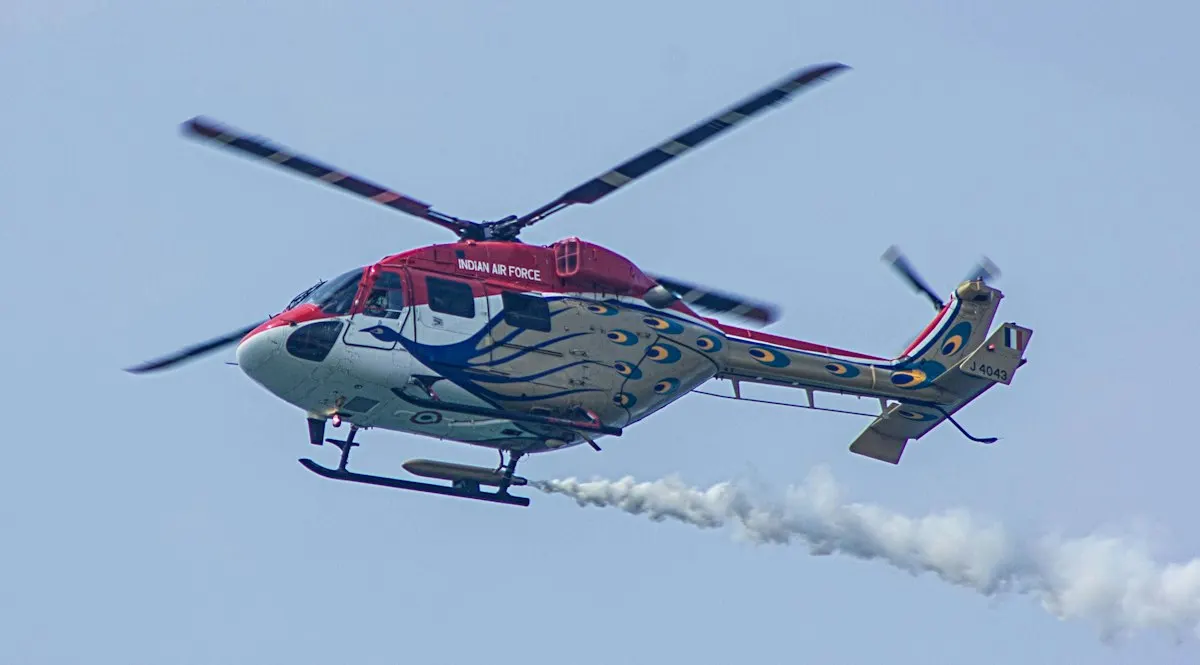
Attack, transport and multirole helicopter units took part, carrying out missions including reconnaissance, target identification, fire support and troop insertion. Public reports said the exercise included a range of rotary-wing platforms, including the Apache, Mi-25/35, Prachand, Mi-17, Chinook and Dhruv.
The central objective of Rotor Claph III was to test helicopters’ ability to detect and track low-flying targets such as small drones and loitering munitions before engaging them with onboard weapons. The approach is seen as a way to add mobility and rapid response in areas where fixed ground-based air defenses may struggle to operate effectively.
A Mobile Response to Complement Ground-Based Air Defense
Helicopters can operate from forward bases and unprepared landing zones, making them particularly useful near borders and in terrain such as deserts, where moving ground equipment can be difficult. But using expensive missiles to intercept low-cost drones can be economically inefficient, making a combination of autocannons, electronic warfare equipment and jamming systems important.
The Indian Air Force is also considering the introduction of counter-drone technologies such as small missiles for helicopters, artificial intelligence-enabled target identification systems, and GPS and radio-frequency jamming equipment. Rotor Claph III serves as a test bed for linking these technologies to an operational concept.
Sudarshan Chakra Is an Integrated Air Defense Concept, Not a Single Weapon
Announced by the Indian government in August 2025, Mission Sudarshan Chakra is not the name of a particular missile. According to the government, it is a long-term plan to gradually strengthen the protection of critical national facilities and public spaces by linking surveillance systems, command-and-control networks, interceptor weapons and electronic warfare capabilities.
Indian Prime Minister Narendra Modi has set a goal of expanding a nationwide security shield covering strategic and key civilian facilities by 2035. Sudarshan Chakra is therefore best understood as a concept for connecting ground-based air defense missiles, radars, satellite and airborne surveillance systems, and electronic warfare equipment into a single operational network.
Some reports have conflated Mission Sudarshan Chakra with instances in which the Indian Air Force has referred to Russia’s S-400 long-range surface-to-air missile system as “Sudarshan.” The S-400, however, is one individual long-range interception system that could form part of an integrated air defense architecture; it is not synonymous with the broader mission.
Testing India’s Indigenous Integrated Air Defense Technology
On August 23, 2025, the Defence Research and Development Organisation conducted the first flight test of an integrated air defense weapons system off the coast of Odisha. According to India’s Ministry of Defence, the system integrates the domestically developed Quick Reaction Surface-to-Air Missile, or QRSAM, the Very Short-Range Air Defence system, or VSHORADS, and a high-power laser-based directed-energy weapon under a central command-and-control system.
During the test, the system simultaneously engaged two high-speed fixed-wing unmanned targets and one multicopter drone positioned at different ranges and altitudes. The exercise was seen as an example of the kind of layered air defense envisioned under Sudarshan Chakra, demonstrating the potential for missiles, lasers, and detection and command-and-control systems to operate together.
Implications for Pakistan and South Asian Security
India’s efforts to strengthen its air defenses could affect military calculations along its western border with Pakistan. As small drones and loitering munitions become more common for surveillance and attack, India is seeking to expand its response options by combining helicopters, ground-based air defense weapons, electronic warfare and radar systems.
That said, it would be premature to conclude that an expanded air defense network will automatically trigger an arms race. Its actual security impact will depend on factors including surveillance coverage, command-and-control speed, interceptor costs and stockpiles, and the ability to operate effectively in a contested electronic warfare environment.
If both India and Pakistan continue to enhance their drone and missile capabilities, the risk of tensions caused by misidentification or miscalculation could also rise. Both countries will need to maintain military communication channels and strengthen safeguards against accidental clashes involving air activity near the border.
Connectivity Is at the Heart of India’s Air Defense Strategy
While Rotor Claph III tested the counter-drone role of mobile helicopter forces, Sudarshan Chakra is the higher-level concept of connecting surveillance, command and interception assets nationwide. Together, the two efforts show India’s shift away from an air defense model centered primarily on fighter aircraft and surface-to-air missiles toward a layered, network-centric system.
The key challenge will be how quickly India can turn its stated ambitions into deployed capabilities. The effectiveness of Sudarshan Chakra will depend on the production capacity for Indian-made radars and interceptors, information-sharing between military branches, the cost-effectiveness of counter-drone weapons, and the level of protection provided to critical civilian facilities.
Frequently Asked Questions (FAQ)
Is Rotor Claph III an air defense weapons system?
No. Rotor Claph III is an Indian Air Force exercise centered on helicopter-based counter-unmanned aircraft operations. Its purpose is to test operational concepts for detecting and responding to low-altitude aerial threats such as drones.
Where was Rotor Claph III held?
It was held in August 2026 at the Pokhran Field Firing Range near Jaisalmer in Rajasthan. The exercise tested the mobility of helicopter units and their ability to respond to drones in desert terrain.
What kind of weapon is Sudarshan Chakra?
Sudarshan Chakra is not a single weapon but India’s long-term concept for integrated air and missile defense. It is intended to link radars, command-and-control systems, surface-to-air missiles, electronic warfare equipment and laser weapons.
Are Sudarshan Chakra and the S-400 the same thing?
No. The S-400 is a long-range surface-to-air missile system, while Mission Sudarshan Chakra is a nationwide initiative to integrate multiple air defense assets. The S-400 can be viewed as one of the individual capabilities that may form part of that architecture.
How will India’s stronger air defenses affect Pakistan?
Improved Indian detection and interception capabilities could complicate Pakistan’s calculations regarding the use of drones and missiles. Conversely, a rapid buildup of capabilities on both sides could increase the risk of misidentification and accidental clashes, making military communication and crisis-management mechanisms especially important.