Overview
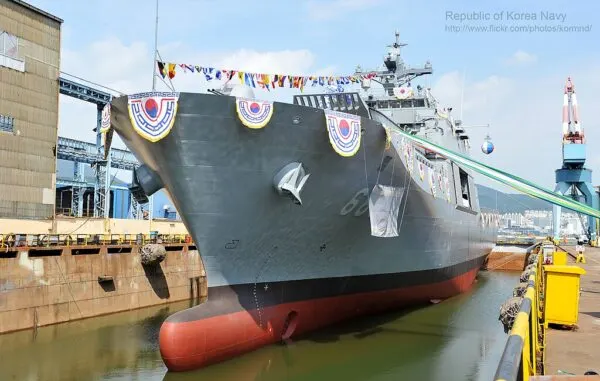
The Cheonwangbong-class landing ships are large transport vessels operated by the Republic of Korea Navy for amphibious operations and the transport of troops and equipment. Developed to replace the aging Gojunbong-class landing ships, they are modern vessels capable of rapidly transporting and deploying large armored vehicles, tanks, self-propelled artillery and troops.
- Key features
- High transport capacity: Capable of carrying large pieces of equipment, including K2 tanks and K9 self-propelled howitzers
- Marine Corps support: Conducts troop landings and maritime transport operations
- LCAC operations: Supports rapid shore landings using air-cushion vehicles
- Helicopter operations: Supports the operation of UH-60s and naval helicopters
Development Background
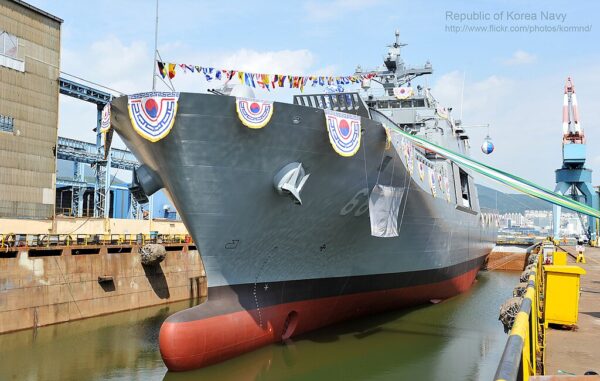
As its Gojunbong-class landing ships began to age, the Republic of Korea Navy determined that it needed a modern landing ship suited to contemporary warfare. The Cheonwangbong-class was subsequently designed, and the vessels began entering operational service in 2014.
- Development timeline
- 2013: Cheonwangbong-class design completed
- 2014: Lead ship ROKS Cheonwangbong launched
- 2015: Entry into Navy service began
- Today: More than four ships in service
Strengths and Weaknesses
🔹 Strengths
✔ Can transport large numbers of troops and vehicles: Capable of carrying large quantities of tanks, self-propelled artillery and armored vehicles ✔ Can operate air-cushion landing craft: Enables the rapid deployment of troops during amphibious operations ✔ Helicopter operations: Supports helicopter landings and takeoffs ✔ Versatile mission profile: Can also be used for humanitarian assistance and disaster relief
🔻 Weaknesses
❌ Limited defensive capability: Lacks robust air-defense and anti-ship defense systems ❌ Limited long-range operating capability: Has a more restricted operational range than destroyer-class forces ❌ Limitations in aviation operations: Offers less aviation capacity than an amphibious assault ship in the LHD class
Regional Landing Ship Comparison (China, Japan and North Korea)
| Category | Cheonwangbong class (South Korea) | Type 071 (China) | Osumi class (Japan) | North Korean Gojunbong class (estimated) |
|---|---|---|---|---|
| Displacement | 4,500 tons | 20,000 tons | 9,000 tons | 3,000 tons (estimated) |
| Dimensions (beam × length × height) | 19m × 127m × 6.5m | 28m × 210m × 8m | 25m × 178m × 7m | 15m × 105m × 5.5m (estimated) |
| Top speed | 37 km/h | 46 km/h | 44 km/h | 30 km/h (estimated) |
| Transport capacity | 10 tanks, 300 troops | 40 tanks, 800 troops | 20 tanks, 600 troops | Limited (estimated) |
| Helicopter operations | Yes (1 aircraft) | Yes (4 aircraft) | Yes (2 aircraft) | No (estimated) |
| Key advantage | Rapid coastal amphibious operations | High transport capacity | Can operate helicopters and air-cushion landing craft | Limited force-projection capability |
Comparison with Landing Ships Operated by Major Powers (the United States, the United Kingdom, Russia and France)
| Category | San Antonio class (United States) | Albion class (United Kingdom) | Ivan Gren class (Russia) | Mistral class (France) |
|---|---|---|---|---|
| Displacement | 25,000 tons | 19,500 tons | 6,600 tons | 21,500 tons |
| Dimensions (beam × length × height) | 32m × 208m × 10m | 28m × 176m × 8m | 20m × 135m × 7.5m | 32m × 199m × 8m |
| Top speed | 44 km/h | 38 km/h | 35 km/h | 42 km/h |
| Transport capacity | 60 tanks, 800 troops | 40 tanks, 700 troops | 13 tanks, 350 troops | 50 tanks, 900 troops |
| Helicopter operations | Yes (6 aircraft) | Yes (4 aircraft) | Yes (2 aircraft) | Yes (6 aircraft) |
| Key advantage | Modern amphibious assault ship | Versatile transport capability | Supports large-scale amphibious operations | Capable of conducting a range of naval missions |
Future Development
- Consider developing an amphibious assault ship (LHD): Greater helicopter and aviation capabilities are needed
- Strengthen self-defense capabilities: Potential additions include air-defense and anti-ship missile defense systems
- Explore export opportunities: Pursue exports, particularly to countries in Southeast Asia and the Middle East
- Research next-generation amphibious forces: Consider developing unmanned landing craft and next-generation landing craft