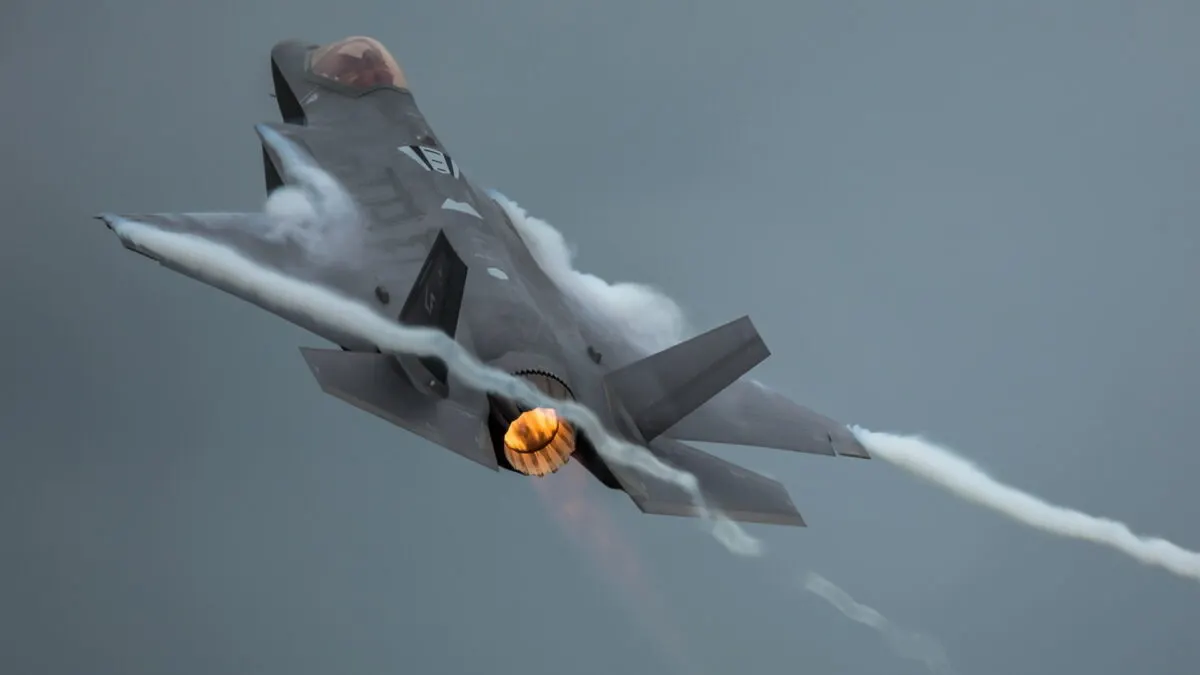
Overview
The F-35A Lightning II is a fifth-generation stealth fighter developed by the United States and now operated by the Republic of Korea Air Force. As a multirole fighter featuring an advanced stealth design, integrated sensors, and network-centric warfare capabilities, it can conduct air-to-air, air-to-ground, and anti-ship missions, making it an all-weather combat aircraft.
- Key features
- Fifth-generation fighter: Combines stealth, sensor fusion, and networked combat capabilities
- Powerful stealth performance: Designed to minimize its radar cross-section (RCS)
- Advanced sensors and electronic warfare capabilities: Equipped with AESA radar, IRST, and EOTS systems
- High-speed, long-range operations: A range of 2,200 km, with aerial refueling capability
- Powerful weapons suite: Can deploy AIM-120, AIM-9X, JDAM, and JSM missiles

Development Background
The F-35A is a multirole fighter developed to replace aging U.S. aircraft such as the F-16, F-15, and A-10 and to serve as a cornerstone of future air power. The Republic of Korea Air Force acquired 40 F-35As to secure a fifth-generation fighter capability and strengthen its air force, and is considering additional purchases.
- Development timeline
- 1990s: The Joint Strike Fighter (JSF) program begins
- 2006: The F-35A completes its maiden flight
- 2015: First deployed by the U.S. Air Force
- 2019: Operational deployment of the F-35A by the Republic of Korea Air Force
- Today: Additional purchases are under discussion
Strengths and Weaknesses
🔹 Strengths
✔ Powerful stealth performance: Its low-RCS design enables it to evade detection effectively ✔ Network-centric warfare: Can coordinate with multiple fighters as well as ground and maritime operations ✔ Precision-strike capability: Can deploy JDAM, JSM, and StormBreaker missiles ✔ Outstanding electronic warfare and situational awareness: Equipped with advanced sensors and electronic warfare systems ✔ Multirole versatility: Capable of air-superiority, ground- and sea-attack, and ISR missions
🔻 Weaknesses
❌ High acquisition and operating costs: Approximately 100 billion won per aircraft, with a substantial maintenance burden ❌ Internal weapons limitations: Internal weapons capacity is restricted in order to preserve stealth ❌ Heat and engine issues: Prolonged operations may create a risk of engine overheating ❌ Limited range: A shorter range than the F-22, making aerial refueling necessary
Comparison with Fighters in Neighboring Countries (China, Japan, and North Korea)
| Category | F-35A (South Korea) | J-20 (China) | F-2 (Japan) | MiG-29 (North Korea) |
|---|---|---|---|---|
| Top speed | Mach 1.6 | Mach 2.0 | Mach 2.0 | Mach 2.3 |
| Combat radius | 2,200 km | 2,000 km | 1,000 km | 1,400 km |
| Maximum weapons payload | 8.1 tons | 12 tons | 8 tons | 3.5 tons |
| Stealth capability | Full stealth | Partial stealth | None | None |
| Key advantage | Advanced stealth and networked warfare | Long-range operational capability | High maneuverability | Limited combat capability |
Comparison with Advanced Fighters (the United States, the United Kingdom, Russia, and France)
| Category | F-22 Raptor (United States) | Eurofighter Typhoon (United Kingdom) | Su-57 (Russia) | Rafale (France) |
|---|---|---|---|---|
| Top speed | Mach 2.2 | Mach 2.0 | Mach 2.1 | Mach 1.8 |
| Combat radius | 1,800 km | 1,400 km | 1,500 km | 1,800 km |
| Maximum weapons payload | 9.1 tons | 7.5 tons | 10 tons | 9.5 tons |
| Stealth capability | Full stealth | Partially applied | Full stealth | Limited application |
| Key advantage | Superior air-combat capability | Excellent air-to-air combat performance | Capable of performing multirole missions | High maneuverability and multirole versatility |
Future Development
- Expanded electronic warfare and weapons capabilities: Integration of long-range cruise missiles, including KGGB and KEPD-350K
- Research into drone-linked operations: Networked warfare in coordination with unmanned combat aerial vehicles (UCAVs)
- Strengthening indigenous maintenance capabilities: Expanding the domestic production of components and maintenance capacity