Overview
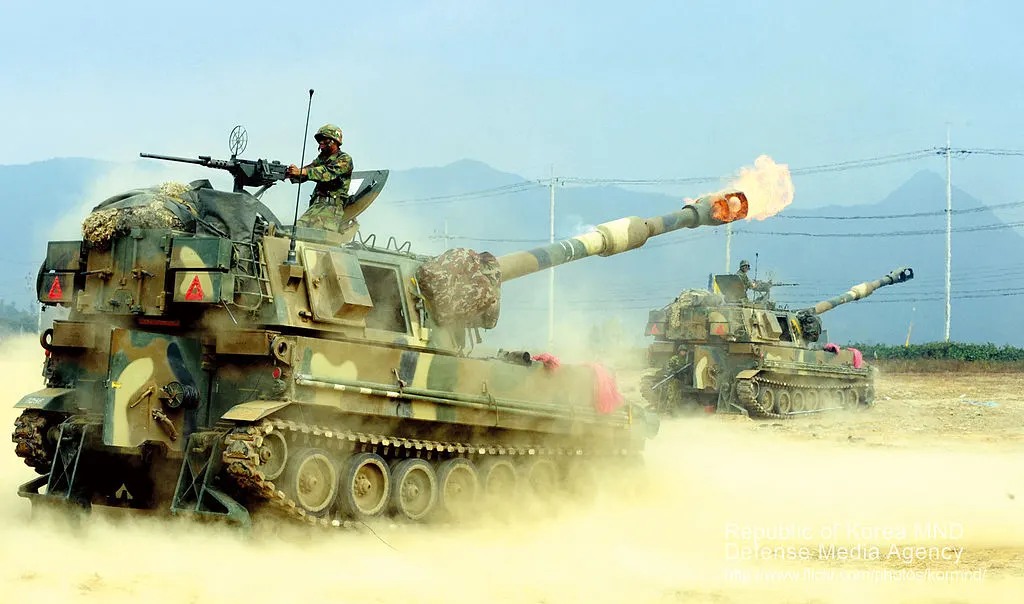
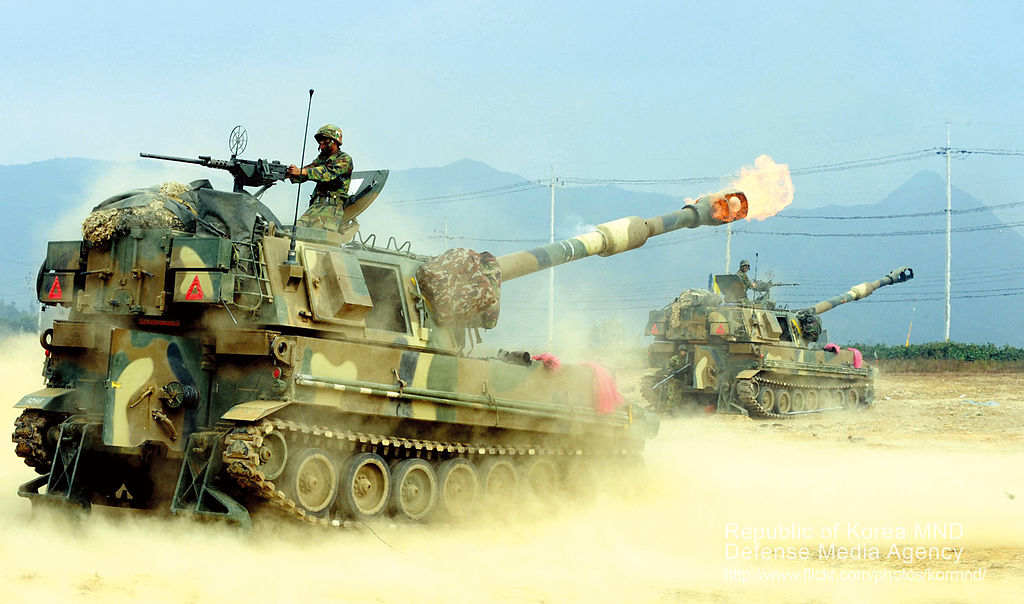
The K55A1 is a 155mm self-propelled howitzer operated by the Republic of Korea Army. It is an upgraded version of the K55, a domestically improved system based on the American M109A2 self-propelled howitzer. Before the K9 entered service, the K55 formed the backbone of South Korea’s artillery force. It now operates alongside the K9, providing fire support.
- Key features
- Integrated operations with the K9: Equipped with a digital battlefield management system
- Extended range: Performance improvements over the original K55, including increased range
- Enhanced automation: Upgraded ammunition handling and fire-control systems
- Integration with the K10 armored ammunition resupply vehicle: Enables rapid ammunition replenishment
Development Background
South Korea began acquiring the American M109A2 self-propelled howitzer in the 1980s and went on to develop and operate a domestically produced version, the K55. However, the original K55 required upgrades to extend its service life even after the K9 entered service. In response, the K55A1 upgrade program was launched, incorporating improvements to the fire-control equipment, extended range and greater automation.
- Development timeline
- 1985: Introduction of the K55 begins
- 2012: K55A1 performance-upgrade program launched
- 2015: Pilot deployment and performance evaluation of the K55A1
- 2017: Full fielding by the Republic of Korea Army completed
Image source: Republic of Korea Armed Forces / Wikimedia Commons
Strengths and Weaknesses
🔹 Strengths
✔ Extended range: Capable of engaging targets at up to 40km when using newer ammunition ✔ Interoperability with the K9: Tactical-network integration enables optimized combined operations ✔ Upgraded fire-control system: Automated firing calculations improve response times ✔ More efficient artillery operations: Easier to maintain than the original K55
🔻 Weaknesses
❌ Mobility limitations: Somewhat slower and less maneuverable than the K9 ❌ Limited protection: Survivability is inadequate for the most demanding modern battlefield environments ❌ Higher maintenance costs over long-term service: The K55 platform imposes limits on further upgrades
Comparison with Self-Propelled Howitzers in Neighboring Countries (China, Japan and North Korea)
| Category | K55A1 (South Korea) | PCL-181 (China) | Type 99 Self-Propelled Howitzer (Japan) | North Korean M-1978 Koksan Gun |
|---|---|---|---|---|
| Weight | 27 tonnes | 25 tonnes | 40 tonnes | 30–35 tonnes (estimated) |
| Dimensions (width × length × height) | 3.1m × 6.9m × 3.4m | 3.0m × 7.5m × 3.2m | 3.3m × 8.0m × 3.5m | 3.2m × 7.8m × 3.3m (estimated) |
| Top speed | 55km/h | 90km/h | 50km/h | 40km/h (estimated) |
| Main gun | 155mm/L39 | 155mm/L52 | 155mm/L52 | 170mm/L50 |
| Range | Up to 40km | Up to 50km | Up to 42km | Up to 60km (estimated) |
| Level of automation | Semi-automatic | Automated system | Semi-automatic | Manual |
| Key advantage | Interoperability with the K9; automated systems | Low weight and high mobility | Long range and reliability | Very long-range fire capability |
Comparison with Self-Propelled Howitzers in Advanced Military Powers (the United States, the United Kingdom, Russia and France)
| Category | M109A7 (United States) | AS90 (United Kingdom) | 2S19 Msta-S (Russia) | CAESAR (France) |
|---|---|---|---|---|
| Weight | 28 tonnes | 45 tonnes | 42 tonnes | 18 tonnes |
| Dimensions (width × length × height) | 3.1m × 7.5m × 3.5m | 3.2m × 9.0m × 3.4m | 3.2m × 9.5m × 3.6m | 2.6m × 10.0m × 3.2m |
| Top speed | 61km/h | 53km/h | 60km/h | 100km/h |
| Main gun | 155mm/L39 | 155mm/L52 | 152mm/L47 | 155mm/L52 |
| Range | Up to 40km | Up to 42km | Up to 50km | Up to 50km |
| Level of automation | Automated | Semi-automatic | Automated | Automated |
| Key advantage | Advanced automated systems | Strong armored protection | Long-range fire capability | High mobility and automation |
Future Development
- Further range extension: Research is under way into next-generation ammunition and increased firepower
- Improved mobility: Additional upgrades are being considered to strengthen interoperability with the K9
- Potential improvements to protection: Studies are examining enhanced ballistic protection and survivability
- Export potential: An upgrade package could be offered to countries that already operate the K55