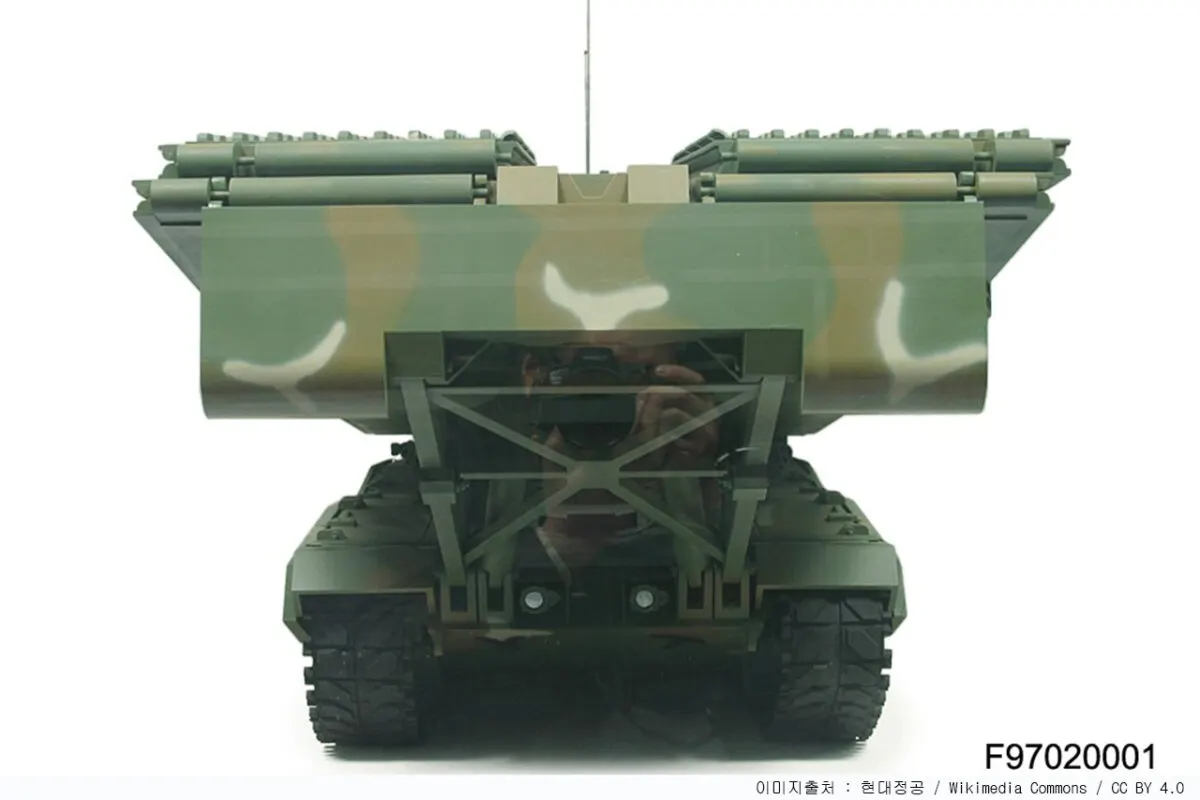
Overview
The K1 AVLB (Armored Vehicle Launched Bridge) is a combat engineering bridge-layer operated by the Republic of Korea. Built on the chassis of the K1 main battle tank, its primary mission is to rapidly deploy a bridge across obstacles, maximizing the mobility of armored units.
- Key features
- Tank-based chassis: Uses the K1 tank chassis to deliver high mobility and protection
- Rapid bridge deployment: Can deploy a 20-meter bridge in one to two minutes
- Tactical flexibility: Capable of operating across varied terrain and improving mobility in the field
- Support for armored operations: Enables tanks and armored vehicles to cross rivers, ditches and other obstacles quickly

Development Background
The Republic of Korea Army recognized the need for a self-propelled bridge-layer to address the mobility constraints created by rivers and other obstacles during armored operations. The Army had previously operated the U.S.-built M60 AVLB, but decided to introduce an indigenous bridge-layer optimized for South Korean military operations and based on the K1 tank chassis.
- Development timeline
- Early 2000s: The need for a bridge-layer emerged
- 2010: Development of the K1 AVLB began
- 2015: The prototype was unveiled and underwent operational evaluation
- 2017: Deployment with the Republic of Korea Army began
Strengths and Weaknesses
🔹 Strengths
✔ Rapid bridge deployment: Can install a 20-meter bridge in a short period of time ✔ High mobility based on the K1 tank: Can operate at the same speed as tank units ✔ High level of protection: Its tank-derived chassis provides excellent durability ✔ Support for armored operations: Improves mobility and helps units overcome obstacles
🔻 Weaknesses
❌ No offensive capability: Its lack of armament prevents it from taking part directly in combat ❌ Limited bridge length: Its maximum 20-meter span makes it difficult to cross wider rivers ❌ High maintenance costs: The specialized equipment onboard adds to operating expenses
Bridge-Layer Comparison with Neighboring Countries (China, Japan and North Korea)
| Specification | K1 AVLB (South Korea) | GQL-111 (China) | Type 07 AVLB (Japan) | North Korean bridge-layer |
|---|---|---|---|---|
| Weight | 55 tons | 50 tons | 48 tons | 40–50 tons (estimated) |
| Dimensions (width × length × height) | 3.6m × 9.7m × 3.5m | 3.5m × 9.5m × 3.4m | 3.4m × 9.0m × 3.3m | 3.3m × 9.2m × 3.4m (estimated) |
| Top speed | 65 km/h | 55 km/h | 60 km/h | 50 km/h (estimated) |
| Bridge length | 20m | 22m | 20m | 18–20m (estimated) |
| Bridge load capacity | More than 60 tons | 55 tons | 50 tons | 45–50 tons (estimated) |
| Armor | Composite armor | Basic armor | Basic armor | Basic armor (estimated) |
| Engine output | 1,200 hp | 1,000 hp | 900 hp | 800–1,000 hp (estimated) |
| Key advantage | High protection and rapid deployment | Slightly longer bridge | Excellent mobility | Simple design allows large-scale deployment |
Comparison with Bridge-Layers from Advanced Military Powers (the United States, the United Kingdom, Russia and France)
| Specification | M104 Wolverine (United States) | Trojan AVLB (United Kingdom) | MTU-90 (Russia) | AMX-30 EBG (France) |
|---|---|---|---|---|
| Weight | 62 tons | 60 tons | 50 tons | 47 tons |
| Dimensions (width × length × height) | 3.7m × 9.8m × 3.5m | 3.6m × 9.6m × 3.4m | 3.5m × 9.3m × 3.3m | 3.4m × 9.0m × 3.2m |
| Top speed | 65 km/h | 60 km/h | 55 km/h | 60 km/h |
| Bridge length | 26m | 24m | 20m | 20m |
| Bridge load capacity | More than 70 tons | 65 tons | 60 tons | 55 tons |
| Armor | Composite armor | Composite armor | Composite armor | Composite armor |
| Engine output | 1,500 hp | 1,200 hp | 1,100 hp | 1,100 hp |
| Key advantage | Long bridge span and powerful protection | Balance of protection and mobility | Strong protection and engine output | Excellent mobility and electronic systems |
Future Development
- Exploring longer bridge spans: Research is underway into adopting bridges longer than 25 meters
- Introducing automated systems: Developing remote-control and AI-assisted deployment technologies
- Improving protection: Considering the adoption of ballistic armor and active protection systems
- Seeking export opportunities: Expanding exports to countries in Southeast Asia and Eastern Europe