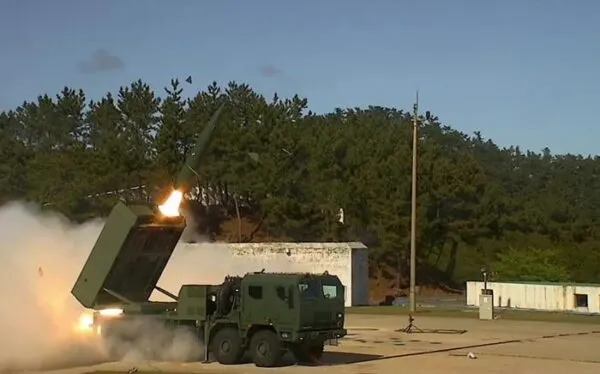
Overview
The Chunmoo Multiple Launch Rocket System (MLRS) is a high-performance rocket artillery system independently developed by South Korea to replace the aging K136 Kooryong. Its ability to fire a range of munitions gives South Korea a powerful tool for countering North Korea’s long-range artillery threat and maximizing long-range precision-strike capability.
- Key features
- Multiple munition types: Can fire 130mm, 230mm and 239mm guided rockets
- Powerful firepower: A range of up to 80km with 230mm guided rockets and 160km with 239mm guided missiles
- Improved mobility and survivability: Operated from a mobile platform based on a new tactical vehicle
- Missile-class precision strikes: Guided munitions provide a high degree of accuracy

Development background
South Korea needed a new system because the existing K136 Kooryong MLRS had limitations in range and precision, making it difficult to counter North Korea’s long-range artillery and multiple rocket launcher forces. The country therefore determined that it needed to develop a next-generation MLRS with greater range and guided-fire capability.
- Development timeline
- 2009: Chunmoo development program launched
- 2013: Chunmoo system induction began
- 2015: Deployed operationally with the Republic of Korea Army
- 2020s: Continued performance upgrades and export efforts
Analysis of strengths and weaknesses
🔹 Strengths
✔ Powerful firepower: Supports multiple munition types, with a maximum range of 160km ✔ High mobility: Its high-mobility tactical vehicle allows for rapid deployment and repositioning ✔ Precision-strike capability: Uses guided rockets equipped with GPS guidance ✔ Flexible ammunition options: Users can choose between 130mm, 230mm and 239mm rockets ✔ Export success: Contracts signed with countries including Poland and Saudi Arabia
🔻 Weaknesses
❌ Cost of guided munitions: Ammunition with guidance systems is expensive ❌ Supply constraints: Supporting multiple munition types complicates logistics ❌ Limited protection: Because it is not an armored vehicle, it is vulnerable if hit
Comparison with MLRS platforms in neighboring countries (China, Japan and North Korea)
| Category | Chunmoo (South Korea) | PHL-03 (China) | Type 19 MLRS (Japan) | KN-09 (North Korea) |
|---|---|---|---|---|
| Weight | 25 tonnes | 42 tonnes | 20 tonnes | 30 tonnes (estimated) |
| Dimensions (W × L × H) | 2.9m × 9.5m × 3.1m | 3.2m × 12.0m × 3.6m | 2.8m × 8.5m × 3.0m | 3.0m × 10.0m × 3.2m (estimated) |
| Top speed | 90km/h | 60km/h | 80km/h | 70km/h (estimated) |
| Armament | 130mm, 230mm and 239mm rockets | 300mm rockets | 227mm rockets | 300mm rockets |
| Armor | Basic ballistic protection | Limited ballistic protection | Basic armor | Basic armor (estimated) |
| Engine power | 450hp | 500hp | 400hp | 450hp (estimated) |
| Key advantage | Guided-munition capability and precision strikes | Large-caliber munitions and massed employment | Ability to conduct integrated operations with the U.S. military | Large-scale deployment by the North Korean military and extended range |
Comparison with MLRS platforms operated by major military powers (the United States, the United Kingdom, Russia and France)
| Category | Chunmoo (South Korea) | M270 MLRS (United States) | GMLRS (United Kingdom) | Tornado-S (Russia) | LRU (France) |
|---|---|---|---|---|---|
| Weight | 25 tonnes | 27 tonnes | 28 tonnes | 43 tonnes | 26 tonnes |
| Dimensions (W × L × H) | 2.9m × 9.5m × 3.1m | 2.9m × 9.7m × 3.2m | 2.9m × 9.5m × 3.2m | 3.2m × 12.3m × 3.5m | 2.9m × 9.6m × 3.2m |
| Top speed | 90km/h | 64km/h | 80km/h | 60km/h | 85km/h |
| Armament | 130mm, 230mm and 239mm rockets | 227mm rockets | 227mm rockets | 300mm rockets | 227mm rockets |
| Armor | Basic ballistic protection | Based on an armored vehicle | Based on an armored vehicle | Basic armor plus ERA | Basic ballistic protection |
| Engine power | 450hp | 500hp | 450hp | 800hp | 400hp |
| Key advantage | Multiple munition types and precision-strike capability | Integration with U.S. military operations and massed employment | Integration with the British military network | Maximum range of 120km and large-caliber munitions | Interoperability with NATO operations |
Future development
- Chunmoo-II development: Increased range and enhanced precision guidance
- K239 guided missile upgrades: Potential range extension beyond 200km
- Expanded overseas exports: Targeting markets in Eastern Europe and the Middle East
- Stronger networked warfare capabilities: Improved real-time strike and operational integration capabilities linked to 드론과 위성이 reshaping ISR의 새로운 패러다임 and 우주 안보 환경의 급속한 악화
These advanced systems align with NATO의 새로운 공중 방어 계획의 배경, positioning Chunmoo as a crucial asset for allied operations.