Overview
Development Background
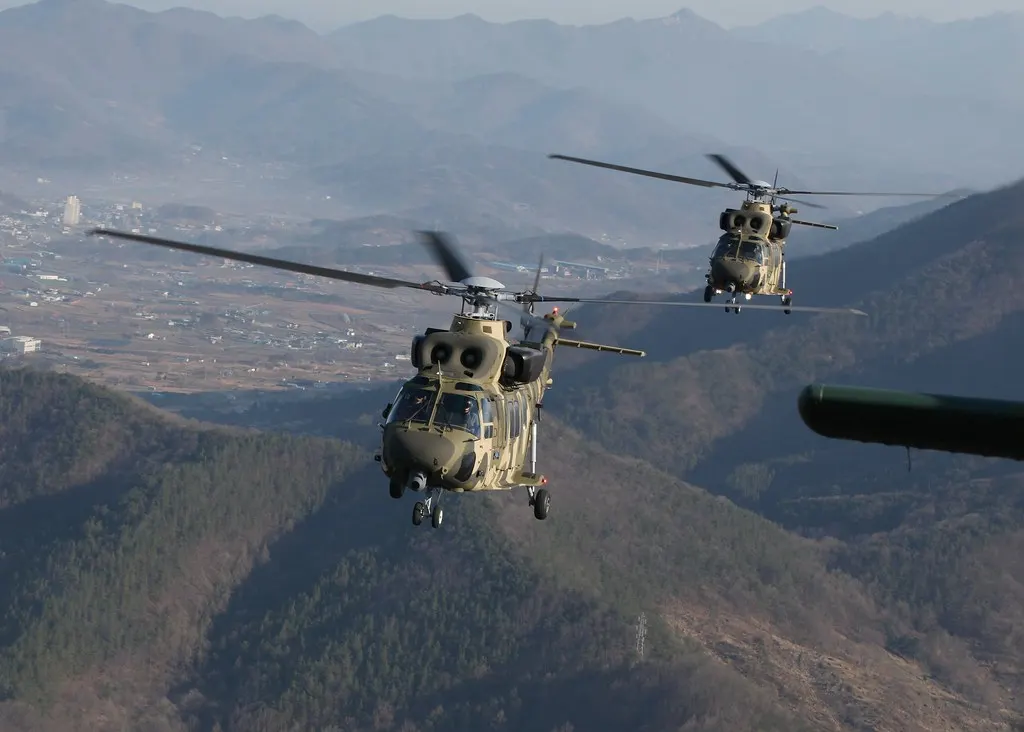
The KUH-1 Surion is a multipurpose utility helicopter developed domestically by the Republic of Korea. Operated by the Army and Air Force, it carries out a wide range of missions, including troop transport, medical evacuation, search and rescue, and command and control. The Surion is widely regarded as a flagship achievement of South Korea’s defense industry, and numerous variants have been developed on the same platform.
- Key features
- More than 60% domestic content: Developed primarily by Korea Aerospace Industries (KAI) and the Agency for Defense Development (ADD)
- Strong transport capability: Can carry up to two pilots and nine troops
- Broad mission flexibility: Adaptable for utility, medical evacuation, police, and firefighting missions
- Tested in extreme conditions: Proven in hot, humid, and cold environments, allowing it to operate across a wide range of conditions
Development Background
South Korea launched the Surion program to replace aging UH-1H and 500MD airframes while developing the aviation technologies needed to strengthen national defense self-reliance. Development began in 2006, and the helicopter entered operational service in 2013. Since then, it has been adapted into a range of variants for police, firefighting, Marine Corps, and medical evacuation missions.
- Development timeline
- 2006: Development begins
- 2009: Prototype completes its first successful flight
- 2013: Introduced into Army service
- Today: Medical evacuation, Marine Corps, maritime, and other variants are in operation
Analysis of Strengths and Weaknesses
🔹 Strengths
✔ Domestic technology base: A substantial share of the core systems was developed in South Korea ✔ Versatile operation: The platform supports not only military missions but also civilian and specialized variants ✔ Strong all-weather performance: Capable of operating in extreme cold, heat, and humidity ✔ Enhanced avionics and survivability: Can be equipped with armor-protected seats, defensive systems, and other survivability features
🔻 Weaknesses
❌ Payload limitations: Carries less than medium-lift helicopters such as the U.S.-made Black Hawk ❌ Speed and range limitations: Some constraints remain in highly mobile operations ❌ Maintenance and parts infrastructure still developing: The support system for domestically produced components was not fully mature in the early stages of localization
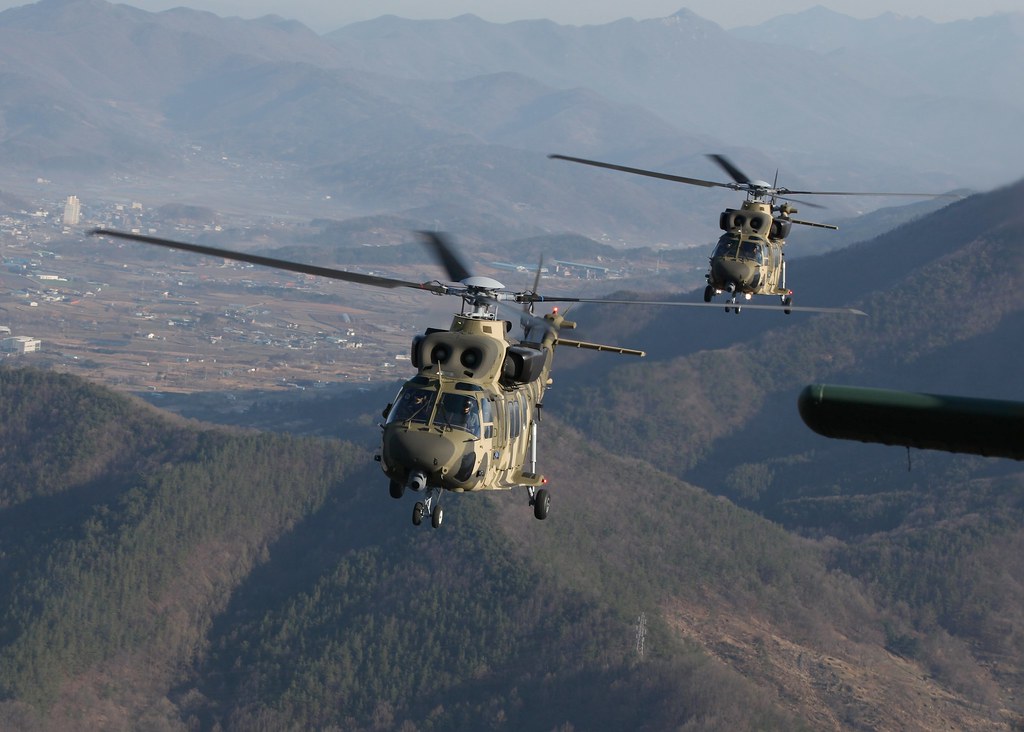
Republic of Korea Armed Forces, CC BY-SA 2.0[/caption]
Utility Helicopter Comparison with Neighboring Countries (China, Japan, and North Korea)
| Category | KUH-1 Surion (South Korea) | Z-20 (China) | UH-60JA (Japan) | Mi-8 (North Korea) |
|---|---|---|---|---|
| Personnel capacity | 11 | 12–15 | 11 | 20 |
| Maximum speed | 259 km/h | 280 km/h | 294 km/h | 250 km/h |
| Range | Approx. 480 km | Approx. 600 km | Approx. 590 km | Approx. 450 km |
| Multirole capability | High | High | High | Moderate |
| Key advantage | Broad range of variants built on a domestic platform | U.S.-influenced technology base and operational testing | High performance and proven reliability | Large troop-carrying capacity |
Comparison with Advanced Utility Helicopters (United States, United Kingdom, Russia, and France)
| Category | UH-60M (United States) | Wildcat (United Kingdom) | Mi-17V5 (Russia) | NH90 (France) |
|---|---|---|---|---|
| Personnel capacity | 11 | 8 | 24 | 20 |
| Maximum speed | 295 km/h | 311 km/h | 250 km/h | 300 km/h |
| Range | Approx. 590 km | Approx. 777 km | Approx. 800 km | Approx. 800 km |
| Multirole capability | Very high | Special operations variant | Optimized for heavy transport | Optimized for multinational operations |
| Key advantage | Global standard | Well suited to special operations | Heavy transport capability | Highly agile helicopter built to NATO standards |
Future Development
- Improve payload capacity: Develop higher-performance variants in the medium-lift class and above
- Develop combat variants: Explore conversion into an attack helicopter or a optionally manned-unmanned teaming platform based on advanced drone and satellite ISR capabilities
- Expand overseas exports: Strengthen marketing efforts in Southeast Asia, the Middle East, and Africa
- Localize the parts supply chain: Build a domestic ecosystem to reduce maintenance and operating costs