Overview
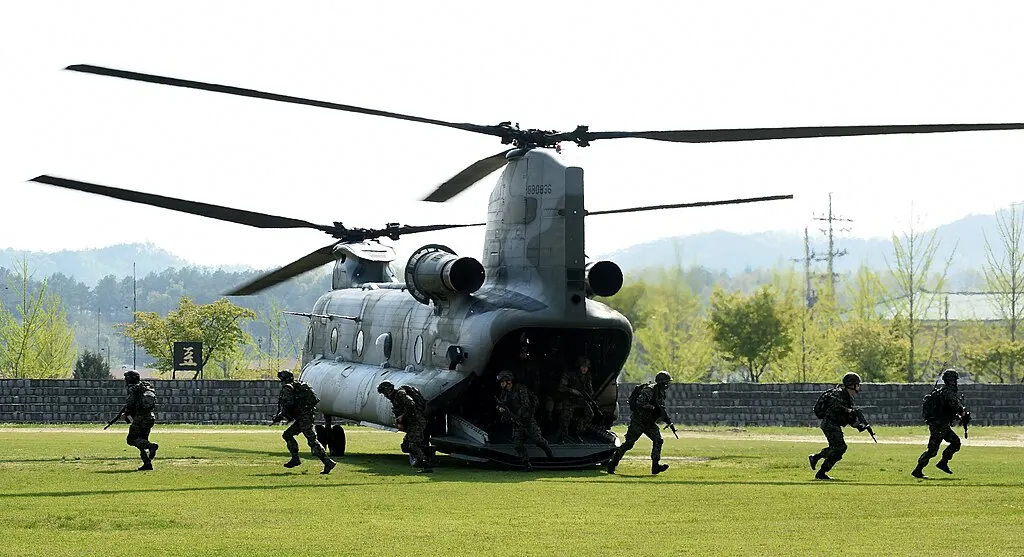
The CH-47 Chinook, developed by Boeing, is a medium-to-heavy transport helicopter and a versatile aircraft operated by the Republic of Korea Army as a key strategic airlift platform. The D and F variants are among its most advanced upgrades and can be deployed for a wide range of missions, including troop transport, cargo hauling, disaster relief, and artillery towing.
- Key features
- Tandem-rotor configuration: High payload capacity and stability provided by its counter-rotating rotor system
- High payload capacity: Can carry up to 55 personnel or 10 tons of cargo
- All-weather capability: Able to operate in mountainous regions, deserts, and maritime environments
- Continuously upgraded platform: The F variant features enhanced digital navigation equipment and sensors
Development Background
The CH-47 series has been in operational service since the 1960s and has undergone continuous upgrades. The CH-47D began entering service in the mid-1980s, while the F variant began deployment in 2007. South Korea introduced the D variant as a major heavy-lift transport asset and has recently pursued an F-variant upgrade program in parallel.
- Introduction and acquisition timeline
- 1988: The Republic of Korea Army introduced the CH-47D for the first time
- Since the 2000s: Service-life extensions and modernization programs have been pursued
- 2020s: The CH-47F acquisition program began, with precision navigation systems scheduled for integration
Advantages and Disadvantages
🔹 Advantages
✔ Large-scale transport capacity: Can carry troops, equipment, cargo, and other loads ✔ High mobility: Speeds of up to 300 km/h and long-range endurance ✔ Excellent stability: The tandem-rotor design improves space utilization and landing safety ✔ Multirole capability: Suitable for logistics support, rescue operations, and civilian disaster response
🔻 Disadvantages
❌ Large size and defensive vulnerability: Its large airframe increases detectability ❌ High maintenance costs: Significant expenses for upkeep and parts procurement ❌ Limited electronic-warfare protection: Some defensive systems remain less capable than those on newer aircraft
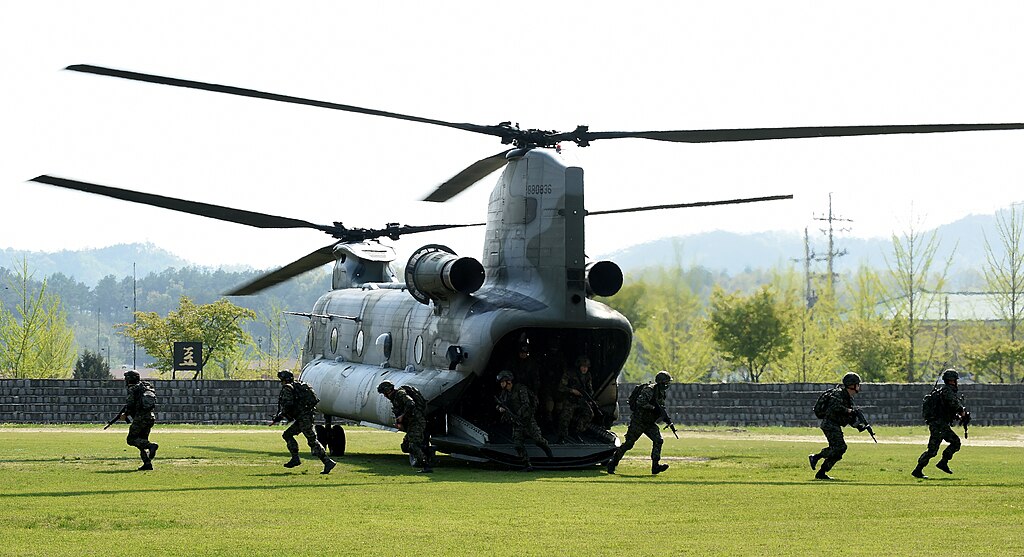
Republic of Korea Armed Forces, CC BY-SA 2.0 / Wikimedia Commons[/caption]
Comparison with Transport Helicopters in Neighboring Countries (China, Japan, and North Korea)
| Category | CH-47D/F (South Korea) | Z-8 (China) | CH-47J (Japan) | Mi-17 (North Korea) |
|---|---|---|---|---|
| Passenger capacity | Up to 55 | 27–39 | 55 | 24 |
| Maximum speed | 302 km/h | 300 km/h | 302 km/h | 250 km/h |
| Range | Approximately 630 km | Approximately 800 km | Approximately 630 km | Approximately 800 km |
| Payload capacity | Approximately 10 tons | Approximately 4 tons | Approximately 10 tons | Approximately 4 tons |
| Key advantage | Heavy-lift capability and stability | Versatility and ease of mass production | Domestic production infrastructure in Japan | Large fleet size |
Comparison with Transport Helicopters Used by Advanced Military Powers (the United States, the United Kingdom, Russia, and France)
| Category | CH-47F (United States) | Merlin Mustang HC4 (United Kingdom) | Mi-26 (Russia) | NH90 TTH (France) |
|---|---|---|---|---|
| Passenger capacity | 55 | 30 | More than 80 | 20 |
| Maximum speed | 302 km/h | 278 km/h | 295 km/h | 300 km/h |
| Range | Approximately 630 km | Approximately 833 km | Approximately 800 km | Approximately 800 km |
| Payload capacity | Approximately 10 tons | Approximately 4 tons | Approximately 20 tons | Approximately 4 tons |
| Key advantage | High-speed transport and upgradeability | Optimized for maritime operations | The world’s largest transport capacity | Suitable for NATO interoperability |
Future Development
- Consideration of CH-47F Block II: The latest variant offers improved fuel efficiency, range, and payload capacity
- Strengthened electronic-warfare protection: Additional survivability equipment, including DIRCM and RWR
- Service-life extension and expanded use of domestic components: Efforts to localize parts to improve maintenance efficiency and reduce costs
- Research into manned–unmanned teaming for transport: Exploring autonomous-operation capabilities for future battlefield environments