Overview
The Jang Bogo-II class, also known as the Sohn Won-il class, is a Type 214 diesel-electric submarine equipped with air-independent propulsion (AIP) operated by the Republic of Korea Navy. Based on Germany’s HDW Type 214 design, it has been extensively adapted and upgraded to meet South Korea’s operational requirements. Capable of anti-submarine, anti-ship, and land-attack operations, it has become a core element of the Republic of Korea Navy’s undersea force.
- Key features
- AIP system: Enables longer submerged operations than the earlier Type 209 class
- Precision strike capability: Can deploy Harpoon anti-ship missiles and Hong Sang-eo anti-submarine missiles
- Advanced sonar suite: Improves detection accuracy and enhances stealth
- Capable of operating submarine-launched cruise missiles (SLCMs)
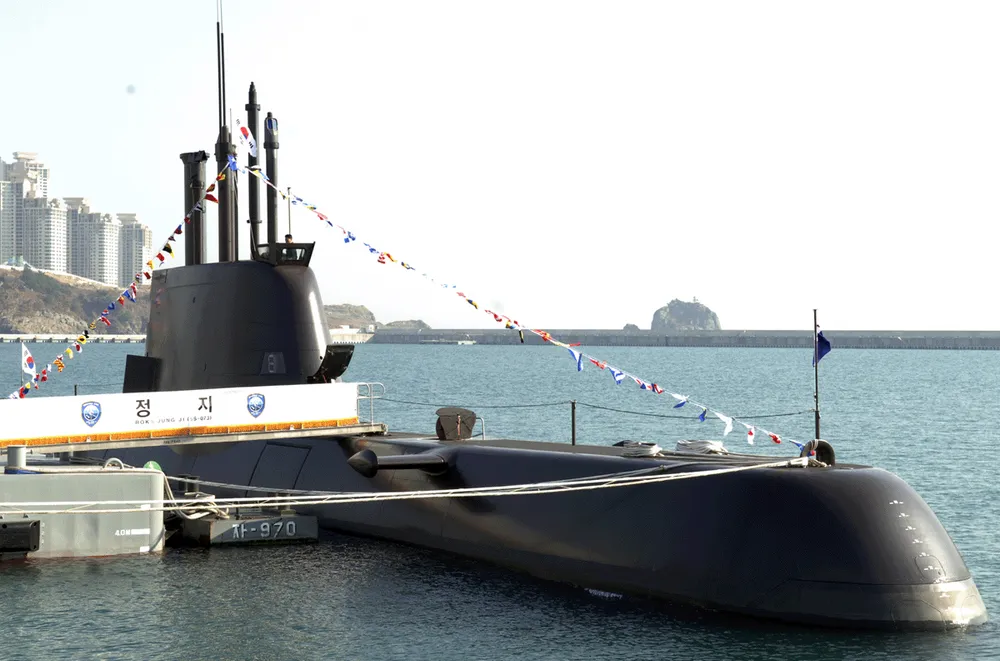
Development Background
The Republic of Korea Navy launched development of the 214-based Sohn Won-il class to overcome the performance limitations of its existing Type 209 Jang Bogo-I-class submarines and establish an indigenous force of medium-sized submarines.
- Development timeline
- Late 1990s: The Jang Bogo-II program gets under way
- 2004: Lead boat Sohn Won-il is launched
- 2007: Deployment with the Navy begins
- Today: A total of nine boats are in service
Strengths and Weaknesses
🔹 Strengths
✔ Strong anti-submarine and anti-ship capabilities: Can deploy Hong Sang-eo and Harpoon missiles ✔ AIP system: Supports extended submerged operations ✔ Improved stealth: Incorporates the latest noise-reduction technologies ✔ Operational efficiency: Offers a substantial performance improvement over the earlier Jang Bogo-I class
🔻 Weaknesses
❌ Limited endurance compared with nuclear-powered submarines: Its operating time is shorter than that of submarines powered by nuclear reactors ❌ Unable to operate SLBMs: Limits its use of strategic weapons ❌ Limited fleet size: The class is expected to be gradually replaced as newer Jang Bogo-III-class submarines enter service
Regional Submarine Comparison (China, Japan, and North Korea)
| Category | Sohn Won-il Class (South Korea) | Type 039A Yuan Class (China) | Soryu Class (Japan) | North Korea’s New Submarine (Estimated) |
|---|---|---|---|---|
| Displacement | 1,800 tons | 2,500 tons | 4,200 tons | 1,500–2,000 tons (estimated) |
| Dimensions (beam × length × height) | 6.3m × 65.3m × 6.8m | 7.5m × 77m × 8.5m | 9.1m × 84m × 10.5m | 5.5m × 65m × 6.5m (estimated) |
| Maximum speed | 37 km/h | 35 km/h | 36 km/h | 28–30 km/h (estimated) |
| Armament | Harpoon missiles, torpedoes | YJ-18 missiles, torpedoes | Type 89 torpedoes, Harpoon missiles | Limited (estimated) |
| Propulsion | AIP | AIP | AIP | Diesel-electric (estimated) |
| Key advantage | Advanced sensors and stealth | Optimized for anti-ship attacks | Low noise and long endurance | Limited operational capability |
Comparison with Advanced-Nation Submarines (the United States, the United Kingdom, Russia, and France)
| Category | Virginia Class (United States) | Astute Class (United Kingdom) | Yasen Class (Russia) | Scorpène Class (France) |
|---|---|---|---|---|
| Displacement | 7,800 tons | 7,400 tons | 8,600 tons | 2,000 tons |
| Dimensions (beam × length × height) | 10m × 115m × 11m | 9.8m × 97m × 10.2m | 10.5m × 130m × 11.5m | 6.2m × 66m × 7.5m |
| Maximum speed | 55 km/h | 56 km/h | 60 km/h | 37 km/h |
| Armament | Tomahawk missiles, torpedoes | Storm Shadow missiles, torpedoes | Kalibr missiles, torpedoes | Exocet missiles, torpedoes |
| Propulsion | Nuclear-powered | Nuclear-powered | Nuclear-powered | Diesel-electric |
| Key advantage | Long endurance and substantial firepower | Excellent stealth performance | Very long-range strike capability | Cost-effective operation |
Future Development
- Gradual replacement through the Jang Bogo-III program: Future variants are expected to evolve toward platforms capable of operating SLBMs
- Consideration of nuclear-powered submarines: To secure the ability to conduct long-duration operations
- Improved electronic warfare and sensor capabilities: Upgrades to the latest sonar and command-and-control systems
- Research into export opportunities: Pursuing exports with a focus on Southeast Asian and Middle Eastern markets