Overview
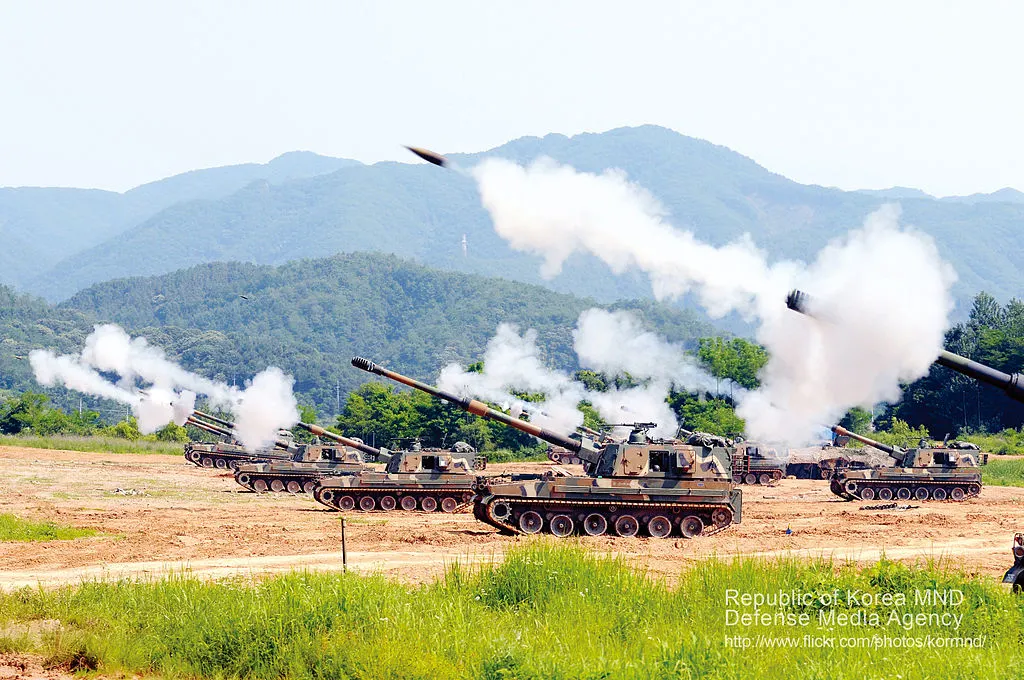
The K9 Thunder is a 155mm self-propelled howitzer developed indigenously by South Korea. Combining formidable firepower with high mobility, it has become a central artillery asset in modern warfare. The system has earned strong reviews not only from the Republic of Korea Army but also from overseas customers, with major export deals signed with Poland, Turkey, Norway, Finland, Estonia, Australia and other countries.
- Key features
- Formidable firepower: Equipped with a 155mm L/52 howitzer, with a maximum range of 54km
- Excellent mobility: Capable of speeds of up to 67km/h and fitted with an automated firing system
- Global export success: Contracts signed with multiple countries, alongside ongoing upgrades
Development Background
South Korea previously operated the K55 self-propelled howitzer, based on the American M109. However, limitations in range and rate of fire made it difficult to respond effectively to the threat posed by North Korea’s long-range artillery. Seoul therefore determined that it needed a next-generation artillery system with greater mobility and firepower.
- Development timeline
- 1989: K9 development begins
- 1998: Prototype unveiled
- 1999: Mass production begins
- 2001: Enters service with the Republic of Korea Army
- From 2010 onward: Ongoing performance upgrades, including the development of the K9A1 and K9A2, along with export success
Pros and Cons
🔹 Advantages
✔ Formidable firepower: 155mm L/52 howitzer with a range of 40–54km ✔ Rapid mobility: Top speed of 67km/h, enabling swift deployment and withdrawal ✔ Global export success: Contracts signed with more than nine countries, including Poland, Finland and Australia ✔ Continuous upgrades: Increasing automation, including the K9A1 and K9A2 programs
🔻 Disadvantages
❌ Relatively heavy: Its 47-tonne weight creates logistical constraints during transport ❌ Limited protection: Its armour is relatively vulnerable compared with that of main battle tanks ❌ Incomplete automatic loading: A fully automated loading system is not expected until the K9A2
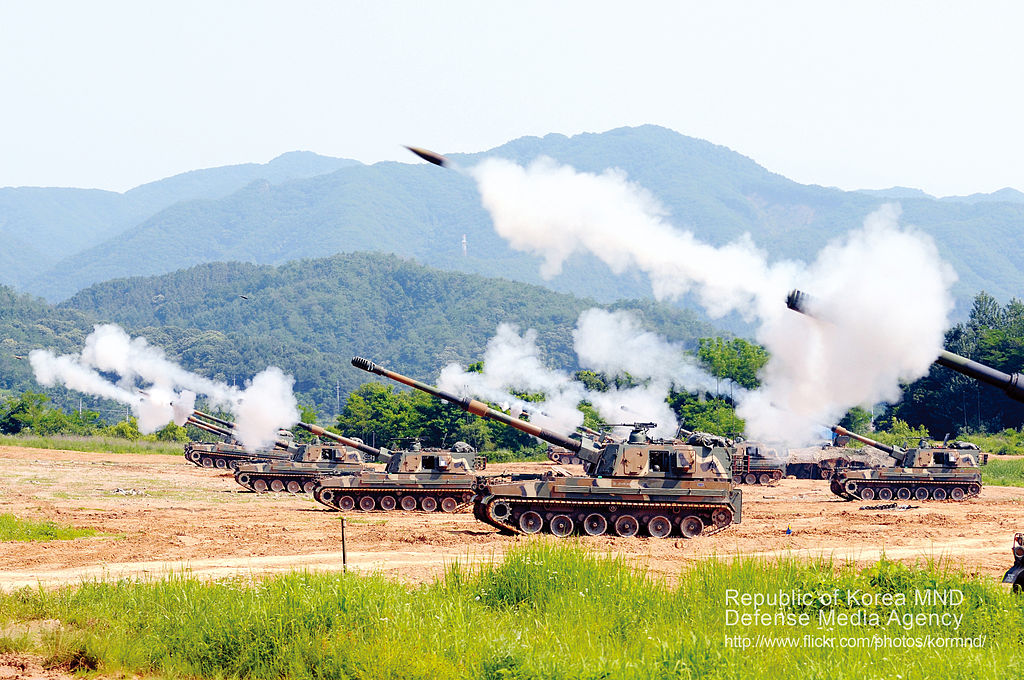
Republic of Korea Armed Forces, CC BY-SA 2.0
Comparison with Self-Propelled Howitzers in Neighbouring Countries (China, Japan and North Korea)
| Category | K9 Thunder (South Korea) | PLZ-05 (China) | Type 99 Self-Propelled Howitzer (Japan) | North Korean M-1978 Koksan Gun |
|---|---|---|---|---|
| Weight | 47 tonnes | 45 tonnes | 40 tonnes | 30–40 tonnes (estimated) |
| Dimensions (width × length × height) | 3.4m × 12.0m × 3.5m | 3.3m × 11.6m × 3.4m | 3.2m × 11.2m × 3.3m | 3.0m × 10.5m × 3.2m (estimated) |
| Top speed | 67km/h | 55km/h | 50km/h | 40km/h (estimated) |
| Armament | 155mm L/52 howitzer | 155mm L/52 howitzer | 155mm L/52 howitzer | 170mm howitzer |
| Armour | Base armour plus ballistic protection | Base armour | Base armour | Base armour (estimated) |
| Engine power | 1,000hp | 800hp | 750hp | 600–800hp (estimated) |
| Key strengths | Long-range fire capability, automation and export success | Large-scale production and strong operational endurance | Rapid firing capability | Large-scale deployment with the North Korean military and numerical superiority |
Comparison with Self-Propelled Howitzers from Advanced Military Powers (the United States, United Kingdom, Russia and France)
| Category | K9 Thunder (South Korea) | M109A7 Paladin (United States) | AS90 (United Kingdom) | 2S35 Koalitsiya (Russia) | CAESAR (France) |
|---|---|---|---|---|---|
| Weight | 47 tonnes | 35 tonnes | 45 tonnes | 55 tonnes | 18 tonnes |
| Dimensions (width × length × height) | 3.4m × 12.0m × 3.5m | 3.2m × 9.7m × 3.2m | 3.3m × 10.5m × 3.4m | 3.6m × 11.5m × 3.8m | 2.7m × 10.3m × 3.1m |
| Top speed | 67km/h | 61km/h | 53km/h | 65km/h | 80km/h |
| Armament | 155mm L/52 howitzer | 155mm L/39 howitzer | 155mm L/39 howitzer | 152mm howitzer | 155mm L/52 howitzer |
| Armour | Base armour plus ballistic protection | Base armour | Base armour | Composite armour | Base armour |
| Engine power | 1,000hp | 600hp | 660hp | 1,000hp | 410hp |
| Key strengths | Long-range fire, automation and high mobility | Integration with US military forces and operational sustainability | High durability and reliability | Powerful firepower and long-range strike capability | Outstanding mobility and lightweight design |
Future Development
- K9A2 development underway: Addition of an automatic loading system to improve operational efficiency
- K9A3 under study: Potential incorporation of unmanned technologies
- Improved ammunition: Potential to extend the range beyond 70km
- Expanded overseas sales: Pursuing additional contracts, including in Poland and Australia
- Stronger network-centric warfare capabilities: Introduction of a real-time fire-control system