Beneath the towering tree at the Daeheungsa temple grounds, reflect on your wishes and experience the arrival of the yellow autumn leaves, which comes later than on other ginkgo trees.
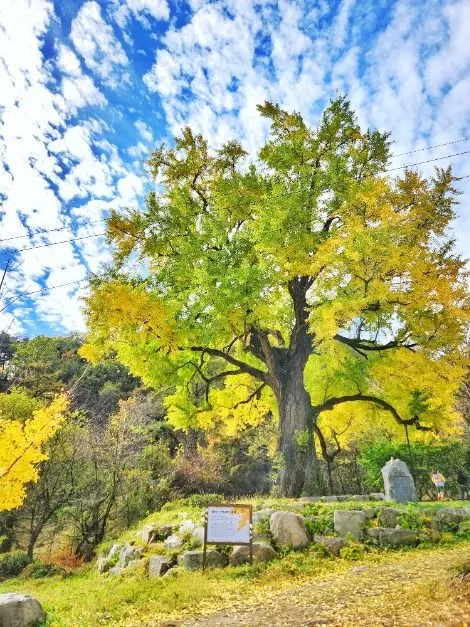
Standing on the grounds of Daeheungsa Temple, which was a large Buddhist temple during the Silla period, is a thousand-year-old Ginkgo tree, approximately 30 meters tall and 7 meters in circumference.
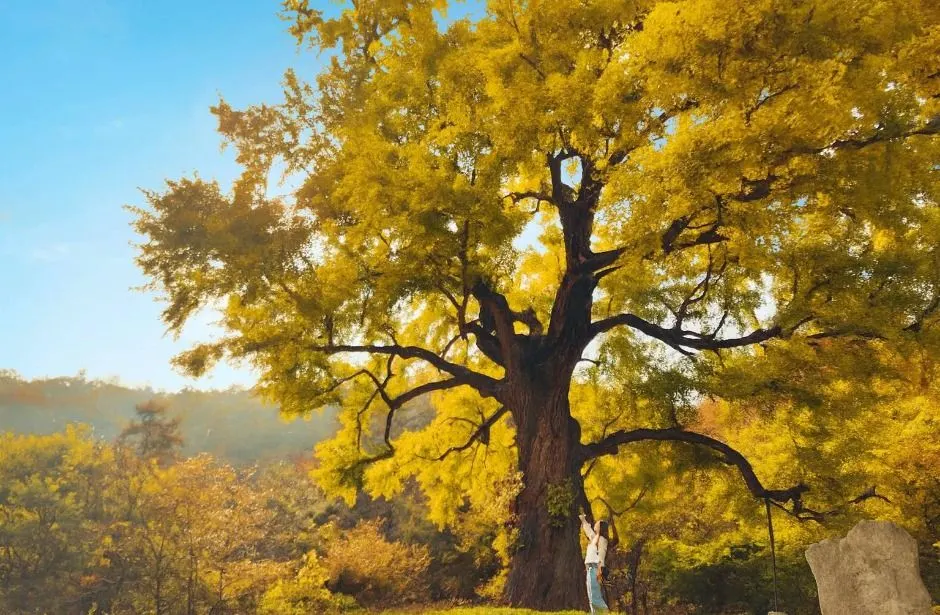
The name itself is interesting. The name “Chilgok Talking Ginkgo Tree” comes from a legend about a tree that listens to the villagers’ concerns and grants their wishes. Because it is a place where you can enjoy the yellow scenery even after the autumn leaves of other ginkgo trees have fallen, it is well-suited for those who have slightly delayed their autumn outings.
This is a place where you can encounter a thousand-year-old tree on a sacred site.
The Ginkgo tree is located on the site of Daeheungsa Temple, which was a large temple during the Silla period, and in a place believed to have been the main gate in the past. It is estimated to have been planted from the 9th year of King Hyeonjong of the Goryeo Dynasty, which is 1018, so even when only looking at the autumn leaves in front of the tree, one suddenly feels the passage of time.
First, observe the trunk. The massive trunk grows, twisting to the right, and the crown rises sharply upwards. Because this tree is the county tree of Chilgok and was designated as a protected tree in 1993, it can be said that the main feature of this place is not the autumn foliage itself, but the old, sturdy trunk that supports them.
The legend that a young bride confided her worries to a tree, received comfort in a dream, and had her wish fulfilled is the basis of the name. There are also stories that people used to predict good or bad fortune by counting how many times its leaves sprouted, and that it was considered a guardian tree protecting the village. For children, seeing a large tree becomes a lesson in nature and history.
It is different in texture from similar sycamore trees.
Gyeongju, North Gyeongsang Province, features the Ungok Confucian academy, where visitors can enjoy the autumn foliage of the old Ginkgo tree. However, while Ungok Confucian academy focuses on its architectural design and the surrounding valley scenery, the Ginkgo tree in Chilgok is primarily known for its association with the Daeheungsa temple ruins and local legends.
The Gasansanseong Fortress and the Dongmyeong Reservoir Ecological Park in Chilgok County are also places that are worth visiting together in the autumn. Gasansanseong Fortress is a place where you can walk along the fortress ruins and mountain trails, while the Dongmyeong Reservoir Ecological Park is centered around the reservoir and a riverside walking path. However, the key experience at the “speaking” Ginkgo tree is spending time in front of a single, protected tree.
Instead of thinking of this place as a large tourist destination to be explored widely, consider it a place to slowly and carefully observe a single, old tree and the memories of the village surrounding it.
It is good for parents and children to watch together.
When accompanied by parents, instead of a long hike, it is good to examine the approximately 30-meter height and 7-meter circumference, and to discuss the history of Daeheungsa Temple and the estimated planting date of 1018. However, there are narrow and uphill sections on the path leading up to it, so it is necessary to adjust your pace and consider the needs of others.
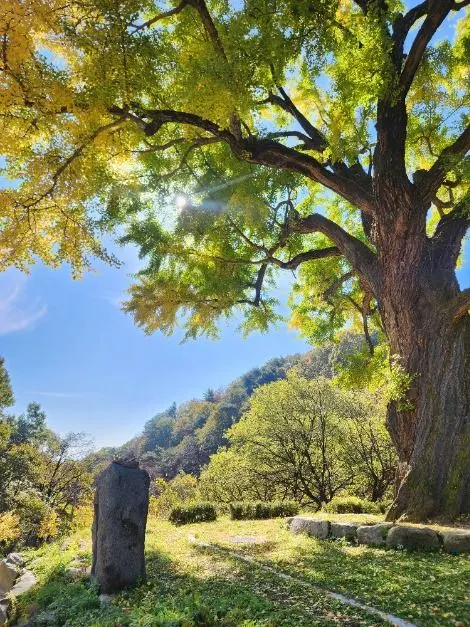
When you are with a child, observe the twisted stem and the upward-rising crown. This ancient tree, a village guardian tree, allows you to talk in one place about the thousand-year-old tree, the village guardian tree, and the legend that it grants wishes, creating a connection between nature and the local community.
It is a good idea to take photos with your partner or friends, using the bright yellow foliage and village scenery as a backdrop. If you are taking pictures, try separately capturing the trunk directly beneath the tree and its overall form from the village side a little farther away.
Please compare the scenery from under the tree and from the direction of the village.
We recommend a short historical walk under the tree, taking in its size and discussing the Daeheungsa temple site and the story that it was probably planted in 1018. If you are alone, you can take your time to observe the twisted trunk and crown, and reflect on it as a protected tree that has watched over the village.
First, help your child find the twisted trunk on the right side of the tree. Starting from the visible shape, it connects to a thousand years of time and the legend of the guardian tree, so the tree itself seems to speak before a lengthy explanation is needed.
With a friend, you could each choose one goal to achieve and create a short photographic record based on a legend. For families, after viewing the Ginkgo tree, you could plan a route that includes a visit to Gasansanseong Fortress or the Dongmyeongji Waterside Ecological Park, allowing for a walk around the fortress or a stroll along the stream.
If you are aiming to catch the late autumn foliage, plan a light and flexible itinerary.
Chilgok is known as a place where the autumn foliage of its Ginkgo trees changes color later than in other regions across the country. The autumn colors are expected to begin in late October 2026, with beautiful scenery expected in early November. From early to mid-November, the timing of the autumn foliage in Chilgok coincides with the period when the autumn colors in other regions are moving southward, making it a place where visitors can experience the late, golden hues of autumn.
During the autumn foliage season, there is not enough parking space for approximately 10 small cars. If the access road near the trees is congested, be prepared to park farther down and walk uphill. Bringing comfortable shoes will help you feel much more at ease.
It is best to take photos first from directly below the tree, capturing the size of the trunk and crown, and then from a slightly more distant location towards the village, capturing the overall shape of the tree and the vibrant yellow autumn foliage. Even with the same tree, changing the distance creates a different impression.
It connects with other autumn landscapes in Chilgok.
After observing the scenery of the Daehungsa temple site and the surrounding village from the Ginkgo tree, change the scene to Gasansanseong Fortress. By following the fortress walls and mountain paths, you can see the autumn forest and historical sites together, allowing you to expand the time spent focusing on a single tree into a broader view of the history and landscape of Chilgok.
At the Dongmyeong Reservoir Ecological Park, visitors can enjoy the Dongmyeong Reservoir, a deck-style walking path, and the scenery of the water surface. While the ginkgo tree offers a close-up look at its trunk and canopy, this park allows visitors to extend their gaze along the shoreline, creating a different atmosphere even during the same autumn season.
The Chilgokbo Ecological Park is also worth visiting. You can take a walk along the riverbanks surrounding Chilgokbo and the Nakdong River, and the experience naturally flows from observing the thick trunks of old trees to enjoying the expansive waterside scenery.
Vehicles can enter all the way to the innermost part of Gaksan Village.
The address is 50, Gaksan 3-gil, Gisan-myeon, Chilgok-gun, Gyeongsangbuk-do. If you are driving, enter “Chilgok Speaking Ginkgo Tree” or the address into your navigation system, and proceed into the Gaksan village.
Parking is available and can accommodate approximately 10 small cars. The road leading up to the location is narrow and has uphill sections, so drive slowly during the autumn foliage season. If parking is limited, it is safer to park at the bottom and walk up.
It is an outdoor attraction that is open to the public free of charge.
Admission is free, and the facility is open year-round. Because it is open every day of the year, it is a good place to plan a visit focusing on the autumn foliage and travel routes, rather than rushing to fit a specific operating time.
However, during the autumn foliage season, you need to consider both parking spaces for approximately 10 small cars and the narrow, uphill roads. If it is difficult to park vehicles close to the trees, parking in the lower areas and walking may become necessary. Therefore, it is advisable to wear comfortable shoes for walking.
For inquiries, please call 054-979-5472. Keep in mind that this is a thousand-year-old Ginkgo tree that can be visited for free, so it is a place where you should focus on the size of the tree and the timing of the autumn leaves, rather than the cost.