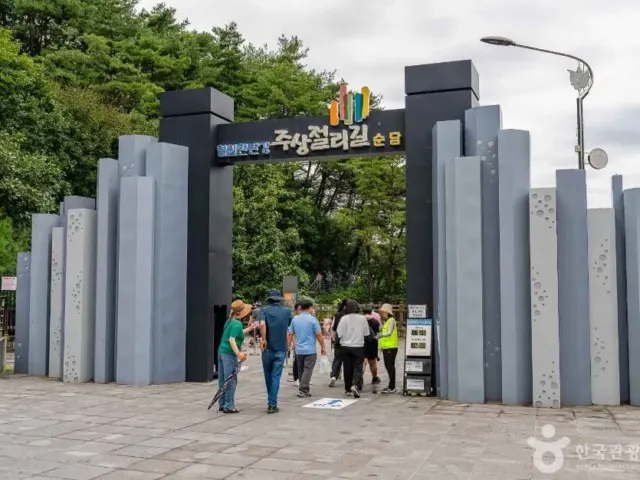
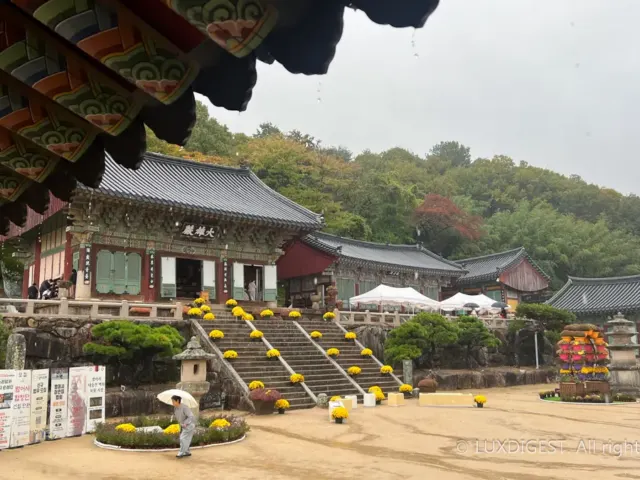
At the end of a quiet road climbing the middle slopes of Munsusan Mountain, would you like to see the moment old maple trees and an ancient temple come together in a single scene?
National Monument No. 463, Munsusa’s Korean maple forest, is home to more than 500 trees estimated to be between 100 and 400 years old. The walk from the one-pillared gate to the entrance of Munsusa is only about 80 meters, so the outing has the pleasantly surprising quality of ending soon after you have steeled yourself for a long trek through the autumn leaves.
Munsusa is a mountain temple set midway up Munsusan Mountain, which rises 621 meters along the border between Gochang and Jangseong in South Jeolla Province. In early to mid-November, the forest turns shades of red and gold, drawing visitors who want to take in autumn foliage and an old temple in the same outing.
A thousand years of stories await beyond the short forest path.
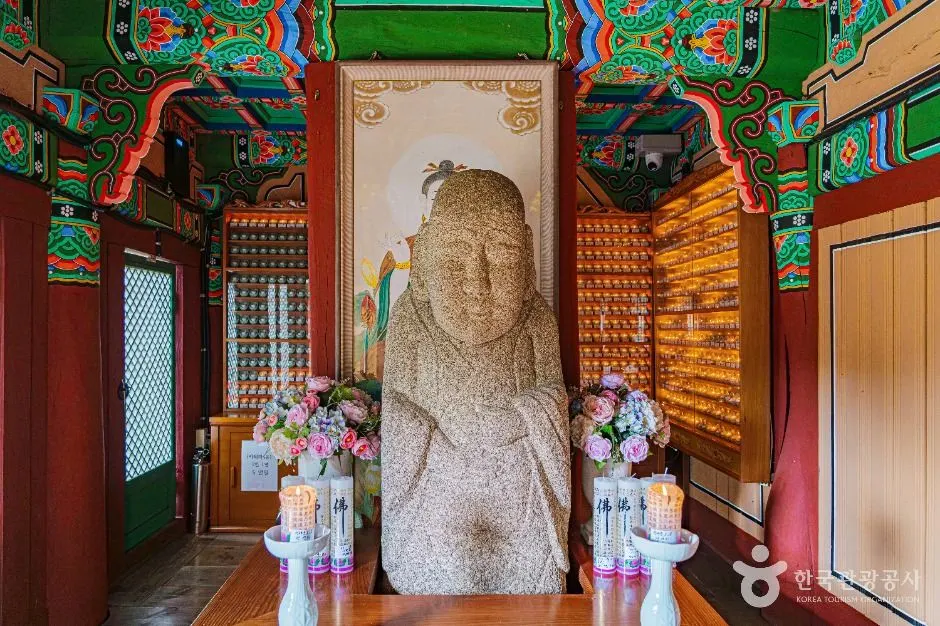
Munsusa was founded by the Silla-era monk Jajang Yulsa, with its establishment traditionally dated to 643 or 644. According to the temple’s founding legend, Jajang returned from practicing at China’s Mount Qingliang and felt that the landscape here resembled the mountain. While praying in a grotto, he discovered a statue of Manjusri emerging from the ground and built the temple.
The temple’s history runs as deep as the autumn colors. Munsusa was rebuilt in 1607, and records show that the main hall was reconstructed in 1653, when a triad of Buddhist statues was enshrined. Also worth seeing are the temple’s Treasure-designated Daeungjeon Hall, the Wooden Seated Vairocana Buddha Triad, the Wooden Seated Ksitigarbha Bodhisattva and Ten Kings ensemble, as well as Munjujeon Hall and the Munsusa stupa, both designated tangible cultural heritage of Jeonbuk State.
Munsusa’s Daeungjeon Hall was removed from Jeonbuk State’s designated cultural heritage list on August 23, 2024, after receiving designation as a Treasure, a nationally designated cultural heritage. With names like these waiting inside, it would be a shame to turn back after looking only at the autumn leaves.
Why choose Munsusa between Seonunsa and Baegyangsa
Seonunsa and Munsusa are both places where visitors can combine a mountain temple with a seasonal forest in Gochang. Seonunsa has a more extensive visitor route, including Dosolcheon Stream and Dosolam Hermitage, while Munsusa centers on the quiet atmosphere of its mountain temple and Korean maple forest.
Munsusa also resembles Baegyangsa in that both offer Korean maples and temple scenery in the Jangseong–Gochang area. Baegyangsa is remembered for Baegamsan Mountain and the scenery around Ssanggyeru Pavilion and the valley; at Munsusa, the focal point is the roughly 80-meter forest path from the one-pillared gate to the temple entrance.
Naesosa Temple in Naejangsan is a large-scale mountain destination within a national park, whereas Munsusa is a smaller mountain temple surrounded by a Korean maple forest designated as a Natural Monument. If you prefer a short, clearly defined forest walk to a sprawling mountain attraction, Munsusa is likely the better fit.
The experience differs depending on whether you come with parents, children or on your own.
If you are traveling with your parents, park the car and take a leisurely walk through the maple forest from the one-pillared gate to the temple entrance, then continue on to the cultural heritage sites, including Daeungjeon and Munjujeon. The itinerary combines time in nature with a visit to historic spaces, making for a manageable day out.
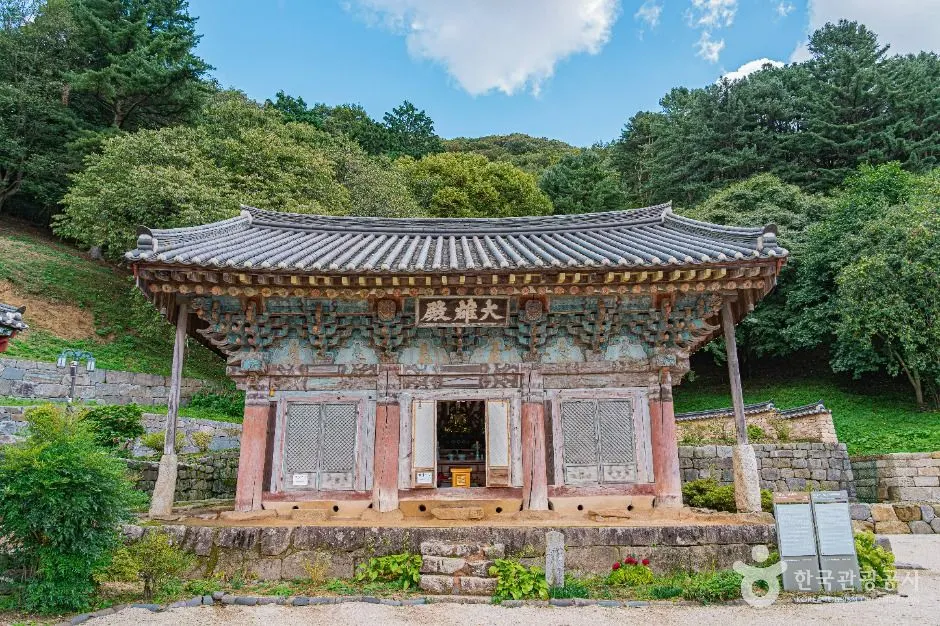
With a partner or friends, try capturing the gently curving forest path, the one-pillared gate and the temple architecture in a single frame. Photographers can bring out Munsusa’s distinctive color contrasts by composing a sequence of red leaves, thick trunks, stone steps and painted details.
With children, walk from the one-pillared gate to the temple while observing the colors and shapes of the maple leaves. Turn it into a nature-and-history activity by looking up the names of the buildings and learning a little about Buddhist cultural heritage; even a short forest path can become a place of discovery.
For solo travelers seeking a quiet break, weekday mornings are ideal. The site is open from sunrise to sunset, so take your time and let the sounds of the forest and temple set the pace.
The more slowly you walk through this forest, the more scenes unfold.
During the foliage season, park your car and walk uphill along the forest path between the one-pillared gate and the temple. The route is only about 80 meters, but the experience changes when you pause to take in the thick trunks, the colors of the leaves, the stone steps and the painted temple details rather than passing through all at once.
Weekdays—especially early mornings—are best for a quiet stroll, with fewer visitors than on weekends. Weekends can be crowded, so if you are with your parents, bring comfortable shoes and match your pace to theirs rather than rushing.
Because the site combines a mountain temple with a forest on the slopes of Munsusan, shoes with good grip and comfortable walking shoes are recommended. When taking photographs, look for a spot where the maple trees, one-pillared gate and temple architecture fit into the same frame; the short length of the path then becomes an advantage.
In November, continue on to Gochang’s other landscapes.
Munsusa’s maple foliage generally peaks from early to mid-November, and estimates based on typical 2026 conditions place the peak around November 11. A 2026 survey memo identifies November 10 through December 1 as a period for taking in the autumn scenery, putting November 11 within the recommended window for visiting the forest.
The exact timing of the foliage can shift with temperatures and weather. After exploring the forest and temple at Munsusa, continue to Seonunsa to compare mountain temples, or visit Ungok Ramsar Wetland for wetland scenery and walking trails.
Add Gochang Fortress, and you can combine Munsusa’s Buddhist heritage with the walls and ramparts of a Joseon-era fortress in a single itinerary. From more than 500 maple trees to wetlands and fortress walls, Gochang changes the mood of its scenery even within one day.
Munsusa follows the road into the valley.
The address is 135 Chilseong-gil, Gосу-myeon, Gochang-gun, Jeonbuk State. By car, drive from central Gосу-myeon through the Gosu Kiln Site to Josan Reservoir, then follow the valley on the left for about 6 kilometers to reach Munsusa.
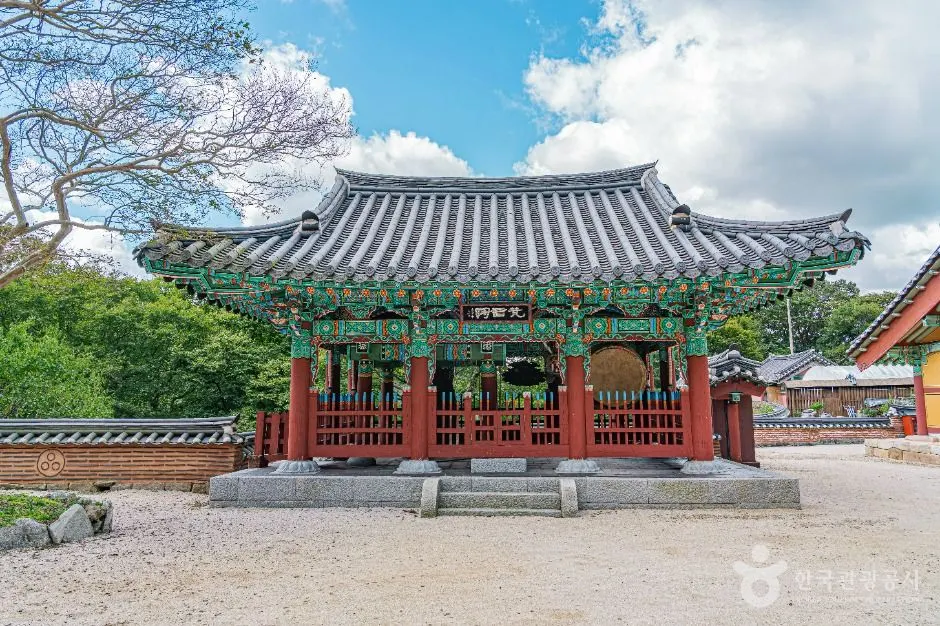
Parking is available. Because the temple lies along a valley road on the middle slopes of Munsusan, it is best suited to visitors arriving by car, and the drive toward this mountain temple becomes part of the outing itself.
Free admission brings together the forest and cultural heritage.
Admission is free. Once inside Munsusa, visitors can encounter the Natural Monument Korean maple forest and the temple’s cultural heritage along the same route, making it easy to enjoy both nature and history without an entrance fee.
During the foliage season, take your time on the forest path from the one-pillared gate to the temple entrance, then continue through the grounds to see cultural heritage sites such as Daeungjeon and Munjujeon. Free admission does not make the forest path any shorter, but it certainly makes it easier to decide on a spontaneous visit.
Open year-round from sunrise to sunset.
Hours are from sunrise to sunset, and the site is open year-round. For the quietest morning atmosphere, visit on a weekday; on autumn weekends, allow extra time and plan for heavier crowds.
If you visit in early to mid-November, consider both the foliage season and weekend crowds, put on comfortable shoes, and take your time along the roughly 80-meter forest path from the one-pillared gate to the temple. The path is short, but with autumn leaves and the temple appearing together, there is no reason to hurry.
For inquiries, call 063-562-0502. The website is Gochang Culture and Tourism at www.gochang.go.kr. After taking in the forest and temple on the slopes of Munsusan, continue to Seonunsa, Ungok Ramsar Wetland or Gochang Fortress to broaden your view of Gochang’s natural and historic landscapes.