USAF CCA to Join Major Exercise for the First Time in December 2026
The U.S. Air Force’s Collaborative Combat Aircraft (CCA) program is set to take part in the Emerald Flag exercise in December 2026 as part of its first large-scale force-integration event. The exercise is expected to provide a real-world test of how uncrewed combat aircraft and crewed fighters operate together within an actual mission flow.
According to military news outlet The War Zone, an official with the U.S. Air Force’s experimental operations unit said Emerald Flag would mark the first time CCA aircraft take part in a large-scale operational exercise. The event, however, will be focused more on testing concepts of operation and command-and-control procedures than on deploying a fully operational combat force.
What Emerald Flag Will Put to the Test
Emerald Flag is a test and training series led by the 96th Test Wing at Eglin Air Force Base in Florida. According to the Air Force, the exercise has focused on evaluating complex weapons systems and command-and-control technologies in environments designed to replicate real-world operations.
Emerald Flag 25-1, held in 2025, tested tactical networks and distributed battle-management systems. The exercise connected sensors, weapons, command-and-control systems, and logistics networks to assess decision-making speed and interoperability in a contested environment—one in which communications and information systems face persistent threats.
During the 2026 exercise, which will include CCA aircraft, the Air Force is expected to examine not only the drones’ flight performance but the entire operational chain, including mission assignment, communications links, target cueing, and air-combat command. The experimental operations unit plans to use the results to define the tactics, techniques, and procedures needed to operate CCA systems.
YFQ-42A and YFQ-44A: The Core of the Air Force’s CCA Fleet
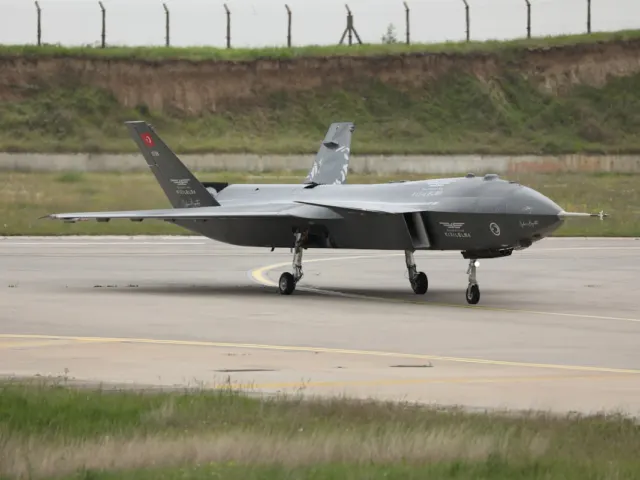
In March 2025, the U.S. Air Force assigned the formal mission designations YFQ-42A and YFQ-44A to two CCA prototypes. General Atomics is developing the YFQ-42A, while Anduril is developing the YFQ-44A.
In the designations released by the Air Force, Y denotes a prototype, F denotes a fighter, and Q denotes an uncrewed aircraft. The naming system reflects the service’s intention to develop CCA into an uncrewed combat system capable of carrying out air-combat missions alongside crewed fighters, rather than treating it as a simple remotely piloted drone.
Air Combat Command describes CCA as an uncrewed force multiplier designed to work with fifth- and sixth-generation crewed fighters. Its central purpose is to extend the sensing and decision-making capabilities of crewed aircraft while assigning them higher-risk missions, improving fighter survivability and operational flexibility.
Combat Drones Will Do More Than Attack
CCA systems are being designed for a range of missions, including reconnaissance and surveillance, electronic warfare, communications relay, and support for crewed fighters. Specific weapons and mission packages will vary by platform and concept of operations, but the Air Force is pursuing a mix of uncrewed platforms with different cost and performance profiles to expand its options on the battlefield.
In 2025, Air Force researchers conducted a crewed-uncrewed teaming flight involving the XQ-58A Valkyrie, an F-16C, and an F-15E. During the test, each crewed fighter pilot controlled two semi-autonomous uncrewed aircraft, allowing researchers to evaluate real-time mission integration and the potential to reduce pilot workload.
Those lessons will help determine how much autonomy future CCA systems should have and at what points human pilots must approve or intervene in their actions. Other key challenges include communications reliability, maintenance personnel, weapons handling, and the size of deployable bases—not just the platforms’ technical performance.
Why the First Large-Scale Integration Exercise Matters
CCA’s participation in Emerald Flag will mark a step toward connecting autonomous-flight technology developed in laboratories and simulators with real-world air operations. A key focus is expected to be the integration of CCA into offensive counter-air operations involving fourth- and fifth-generation fighters.
The Air Force will be assessing far more than whether an uncrewed aircraft can fly. The critical questions are whether pilots can assign missions intuitively, whether the aircraft can continue operating when communications are disrupted or the battlespace becomes more complex, and whether command-and-control systems can rapidly combine information from multiple platforms.
The Air Force’s experimental operations unit was expanded into a formal unit-level organization in 2025. It is refining CCA operating concepts through a combination of virtual training and live testing. The operational data gathered at Emerald Flag could have a significant effect on how CCA systems are deployed, how they are trained, and when they are brought into service.
Remaining Challenges for CCA Fielding
For CCA to become a genuine combat capability, the Air Force will need more than mature autonomous-flight algorithms; it will also need to establish safety and reliability. Pilots in crewed fighters must be able to trust the systems’ decisions and actions, while the military must clearly define how human control will be maintained during operations.
Distributed operations are another major challenge. The Air Force is considering deploying CCA systems not only from major bases but also from forward airfields with limited infrastructure. That will require operating concepts that reduce maintenance manpower and equipment while simplifying weapons loading and launch preparations.
For that reason, Emerald Flag in December 2026 is best viewed not as CCA’s combat debut but as an important interim milestone in determining whether crewed and uncrewed combat systems can function together at the operational level.
Frequently Asked Questions (FAQ)
When will the U.S. Air Force’s CCA take part in Emerald Flag?
According to The War Zone, the U.S. Air Force’s CCA is scheduled to participate in its first large-scale force-integration exercise at Emerald Flag in December 2026.
Which aircraft are included in the U.S. Air Force’s CCA program?
The main publicly disclosed prototypes are General Atomics’ YFQ-42A and Anduril’s YFQ-44A.
How is CCA different from a conventional drone?
CCA systems are designed to support autonomous flight and mission execution beyond simple remote control. They will team with crewed fighters to perform a range of missions, including reconnaissance, electronic warfare, communications relay, and attack support.
What is the main purpose of the Emerald Flag exercise?
The exercise is intended to test mission coordination between uncrewed combat aircraft and crewed fighters, along with command and control, communications, target cueing, maintenance, and deployment procedures in conditions resembling real operations.
Will CCA be deployed in combat immediately?
No. This participation does not mean that CCA has completed formal fielding. It is a test phase focused on validating operational concepts and technology. The Air Force is preparing for future fielding through exercises and testing conducted by its experimental operations unit.