Boeing Brings MQ-28 Ghost Bat to FIA 2026 as CCA Campaign Gains Momentum
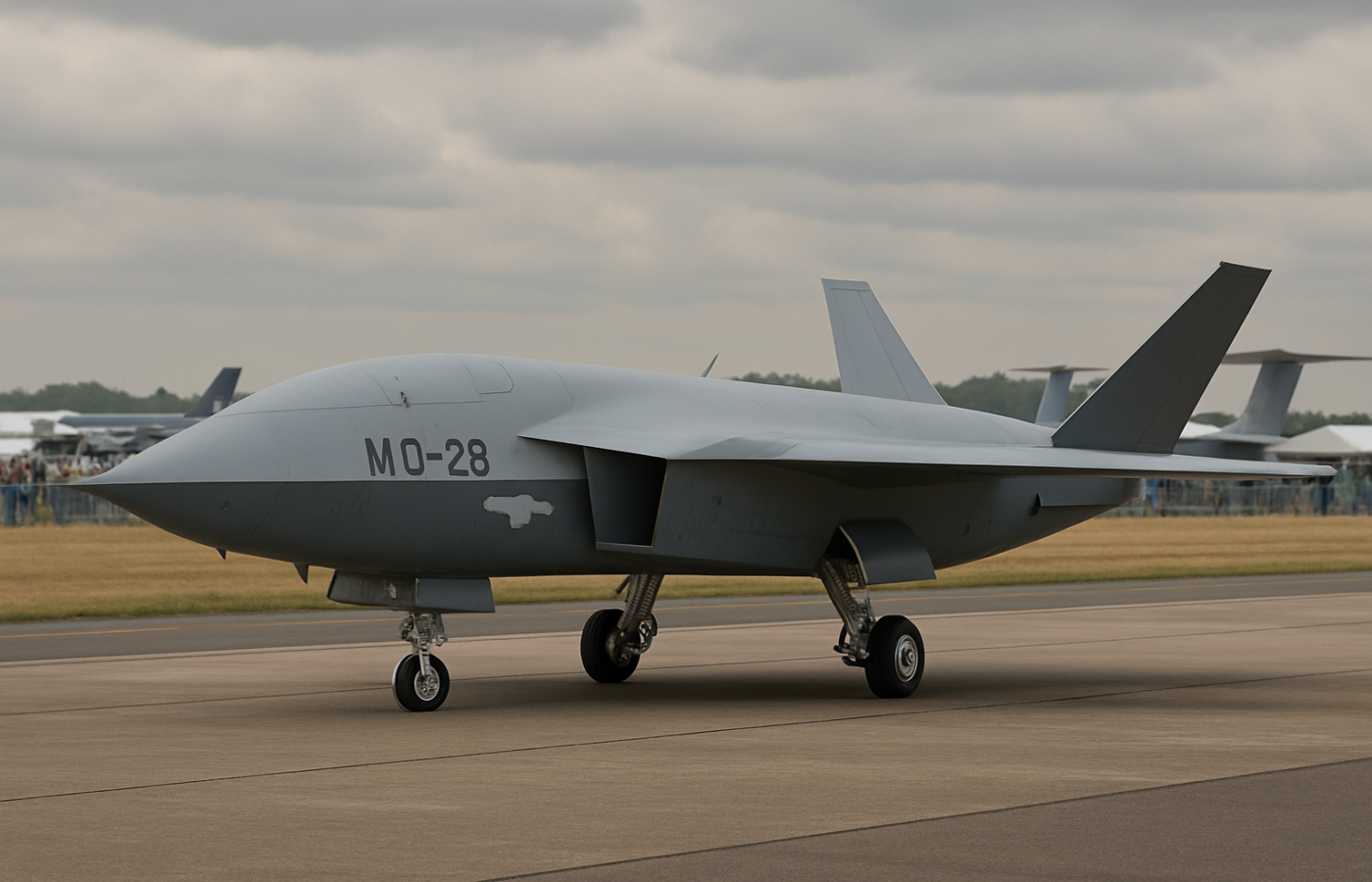
Boeing put its unmanned collaborative combat aircraft, the MQ-28 Ghost Bat, on display in Europe for the first time at the Farnborough International Airshow (FIA 2026), held in Hampshire from July 20 to 24, 2026. According to Boeing, the Ghost Bat is designed to team with crewed fighter aircraft on intelligence, surveillance and reconnaissance, electronic warfare and force-multiplication missions.
The appearance comes as demand for CCA systems expands, highlighting Boeing’s push into overseas markets by emphasizing the Ghost Bat’s development maturity and international industrial partnerships. Boeing has also suggested that demand for CCAs across the Western alliance could exceed the supply capacity of any single manufacturer.
MQ-28 Ghost Bat: Core Missions and Key Technologies
CCA systems connect crewed and uncrewed aircraft through a network, allowing them to divide mission responsibilities. Uncrewed aircraft can take on higher-risk tasks such as reconnaissance, electronic warfare, surveillance and strike support, while crewed fighters focus on command and tactical decision-making.
According to Boeing, the MQ-28 uses an open architecture and modular design that allow payloads and mission systems to be replaced and integrated as needed. The aircraft is being developed with a maximum takeoff weight of 12,000 pounds, a range of more than 2,000 nautical miles, a top speed of Mach 0.9 and an operating altitude above 40,000 feet.
The Ghost Bat has been undergoing testing with the Royal Australian Air Force since its first flight in March 2021. Boeing said it completed the aircraft’s 100th flight in March 2025 and conducted an autonomous air-to-air weapons engagement later that year, in December, in coordination with the E-7A Wedgetail and F/A-18F Super Hornet.
Boeing Highlights International Partnership Strategy at FIA 2026
At the air show, Boeing identified Hensoldt, Eaton and Leonardo as international partners for the Ghost Bat. Hensoldt is supporting sensor-system integration as part of the German industrial team, while Eaton is involved in developing an ejection system for internal payloads. Leonardo is responsible for developing an infrared search-and-track system for the Ghost Bat’s modular nose section.
Boeing previously established a partnership with German defense company Rheinmetall to pursue a CCA program for the German armed forces. The companies are presenting the MQ-28 as a candidate system capable of providing Germany with an air-to-ground mission capability by 2029.
The arrangement reflects a strategy that goes beyond simply exporting an aircraft. It is designed to offer local industrial participation, integration of sensor and communications systems, and the ability to develop sovereign mission capabilities.
CCA Competition Intensifies With BAE Systems’ Brontanax
Boeing was not the only company pursuing the CCA market at FIA 2026. European defense firms also entered the competition, with BAE Systems unveiling the British-designed autonomous CCA Brontanax. According to BAE Systems, Brontanax is being developed at a size comparable to the Hawk trainer and is designed to work with the Typhoon fighter on electronic warfare and air-to-ground and air-to-air strike missions.
Brontanax is built around an open, modular design and a remote-operation concept. BAE Systems says the system could increase the operational effectiveness of crewed platforms while expanding combat mass at a lower cost than acquiring additional crewed fighters.
As a result, competition in the CCA market is expected to extend well beyond basic airframe performance to include autonomous flight software, mission systems, weapons integration, local production and supply-chain security.
Ghost Bat’s Strengths and the Challenges Ahead
The Ghost Bat’s greatest strengths are its accumulated flight-test record and demonstrated cooperation with crewed aircraft. Boeing said it conducted three autonomous flights in May 2026 at the Point Mugu Sea Range in California, testing the aircraft’s ability to operate in the airspace of an ally outside Australia.
Boeing also said the aircraft took part in the multinational joint exercise Valiant Shield in July 2026. The company describes this as the first—and so far only—instance of a CCA participating in a multinational joint operation.
The program’s success, however, will not be determined by flight-test results alone. Key factors will include how quickly the system can be integrated into each air force’s command-and-control architecture and communications networks, how effectively local industrial and production capacity can be established, and whether a cost structure suitable for large-scale operations can be achieved.
Conclusion: Maturity Will Be the Deciding Factor in the CCA Supply Race
FIA 2026 showed that CCAs are moving beyond the experimental-concept stage into real-world force development and international procurement competition. Boeing used the MQ-28 Ghost Bat‘s flight-test record, cooperation with crewed aircraft and international partnerships to position it as a mature CCA candidate.
The CCA market is expected to see the Ghost Bat, BAE Systems’ Brontanax and other platforms compete on autonomy, survivability, weapons integration, cost efficiency and production scale. In practice, contracts are likely to depend not only on the performance of individual aircraft but also on interoperability among allies and the ability to provide a reliable supply at scale.
Frequently Asked Questions (FAQ)
What is the MQ-28 Ghost Bat?
The MQ-28 Ghost Bat is an unmanned collaborative combat aircraft developed by Boeing Australia. It is designed to work with crewed fighters on a range of missions, including intelligence, surveillance and reconnaissance, electronic warfare and force multiplication.
How is a CCA different from a conventional unmanned aircraft?
Rather than serving simply as a remotely piloted drone, a CCA is an uncrewed combat aircraft designed around cooperation with crewed aircraft, autonomous mission execution, open mission systems and survivability in a combat environment.
Has the Ghost Bat undergone actual flight testing?
Yes. The Ghost Bat has been tested with the Royal Australian Air Force since its first flight in March 2021 and completed its 100th flight in March 2025. In 2026, it also conducted international operational testing at the Point Mugu Sea Range in the United States.
What are the Ghost Bat’s main missions?
Its stated missions include surveillance and reconnaissance, electronic warfare, early-warning support, mission coordination with crewed fighters and force multiplication. Its modular design allows its payloads and missions to be adapted.
What is the difference between BAE Systems’ Brontanax and the Ghost Bat?
The Ghost Bat was developed in Australia and has continued flight testing and demonstrations of international operations. Brontanax is a British-designed CCA unveiled by BAE Systems at FIA 2026, with an emphasis on cooperation with the Typhoon and electronic warfare and strike missions.