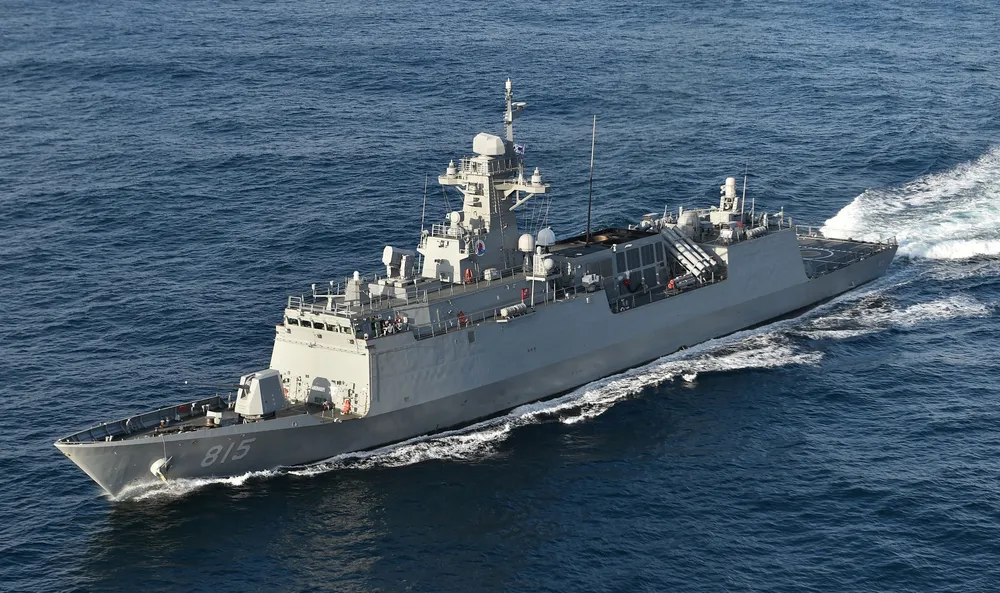
Overview
The Incheon-class frigate (FFX-I) is a multipurpose frigate operated by the Republic of Korea Navy for next-generation coastal defense and maritime operations. Developed to replace the aging Ulsan-class frigates, it has become one of the ROK Navy’s key assets, combining a combat system optimized for coastal and nearshore operations with modern weapons.
- Key features
- Stealth-oriented design: Improved survivability through a reduced radar cross-section (RCS)
- Optimized for anti-submarine warfare: Equipped with modern sonar systems and the Hong Sang Eo anti-submarine missile
- Capable of air-defense and anti-surface warfare: Armed with Haeseong anti-ship missiles and the RAM close-in weapon system
- First-phase FFX program vessel: Served as the foundation for the subsequent development of the Daegu class (FFX-II) and the next-generation frigate (FFX-III)

Development Background
As its Ulsan-class frigates grew increasingly outdated, the Republic of Korea Navy determined that it needed a new frigate incorporating modern technology. The Incheon class was therefore designed as the first phase of the FFX program, South Korea’s next-generation frigate initiative, with operational deployment beginning in 2013.
- Development timeline
- 2008: Incheon-class design completed
- 2011: Lead ship ROKS Incheon launched
- 2013: Deployment with the Navy began
- Today: Six vessels in service, with replacement by the Daegu class (FFX-II) under way
Strengths and Weaknesses
🔹 Strengths
✔ Optimized for coastal and nearshore operations: Well suited to defending South Korean waters ✔ Enhanced anti-submarine capability: Operates modern sonar systems and Hong Sang Eo anti-submarine missiles ✔ Stealth-oriented design: A reduced RCS improves its ability to evade detection ✔ Operational efficiency: More economical to operate than a destroyer
🔻 Weaknesses
❌ Limited firepower compared with larger destroyers: Carries less weaponry than KDX-class destroyers ❌ Limited air-defense capability: Lacks long-range surface-to-air missiles such as the SM-2 ❌ Requires upgrades for future warfare: Modern radar and electronic-warfare systems will need to be enhanced
Comparison with Frigates from Neighboring Countries (China, Japan and North Korea)
| Category | Incheon class (South Korea) | Type 054A frigate (China) | Abukuma-class frigate (Japan) | North Korean frigate (estimated) |
|---|---|---|---|---|
| Displacement | 3,200 tons | 4,000 tons | 2,500 tons | 1,500–2,000 tons (estimated) |
| Dimensions (beam × length × height) | 14m × 114m × 6.5m | 14.2m × 134m × 6.8m | 12.5m × 109m × 5.8m | 11m × 95m × 5m (estimated) |
| Top speed | 55 km/h | 56 km/h | 52 km/h | 45 km/h (estimated) |
| Main gun | 127mm naval gun | 76mm naval gun | 76mm naval gun | 57mm naval gun (estimated) |
| Anti-ship missiles | Haeseong missile | YJ-83 | SSM-1B | Limited (estimated) |
| Anti-submarine capability | Hong Sang Eo and an anti-submarine helicopter | Yu-8 and anti-submarine rockets | Type 07 anti-submarine missile | Limited (estimated) |
| Key advantage | Modern stealth design and strong anti-submarine capability | Advanced electronic-warfare systems | Strong anti-submarine warfare capability | Can provide limited naval capability |
Comparison with Frigates from Major Naval Powers (the United States, the United Kingdom, Russia and France)
| Category | Independence class (United States) | Type 23 (United Kingdom) | Gorshkov class (Russia) | Aquitaine class (France) |
|---|---|---|---|---|
| Displacement | 3,200 tons | 4,900 tons | 4,400 tons | 3,800 tons |
| Dimensions (beam × length × height) | 13m × 127m × 6m | 16m × 146m × 8.5m | 17m × 135m × 8m | 16m × 133m × 8m |
| Top speed | 85 km/h | 55 km/h | 54 km/h | 52 km/h |
| Main gun | 127mm naval gun | 30mm autocannon | 76mm naval gun | 100mm naval gun |
| Anti-ship missiles | RGM-84 Harpoon | None | P-800 Oniks | MM40 Exocet |
| Anti-submarine capability | Anti-submarine rockets and torpedoes | Type 2087 sonar | Torpedoes and anti-submarine rockets | MU90 torpedoes |
| Key advantage | Modern stealth technology | Strong anti-submarine warfare capability | Russian anti-ship missile capability | Optimized for air defense and European naval operations |
Future Development
- Development of FFX-II and FFX-III: Pursuing capability improvements through next-generation frigate programs
- Strengthening electronic warfare and air-defense capabilities: Researching upgrades to modern radar and combat systems
- Expanding overseas exports: Pursuing sales to emerging markets and Southeast Asian navies
- Considering enhancements to long-range air-defense systems