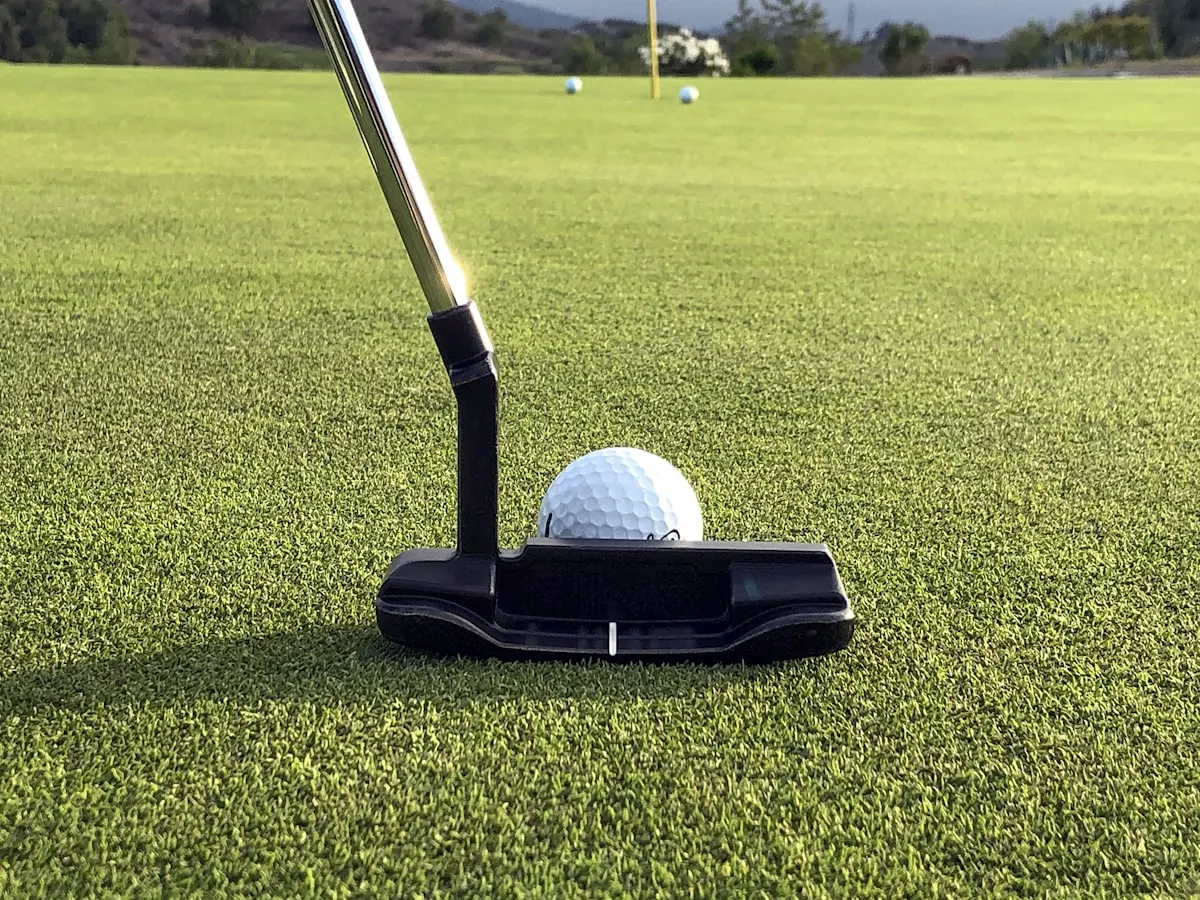
Putting: A key element for improving golf skills
Putting is a crucial element that determines a golfer’s round score, but it is often one of the most challenging aspects for beginner golfers. While there are many pieces of advice available, a systematic approach based on fundamentals is the most effective. This article introduces three basic putting practice methods that every beginner golfer should master.
First: Creating a consistent stroke
Stand with your feet closer than shoulder-width apart, positioning your eyes directly above or slightly inside the ball, and distribute your weight evenly between both feet to minimize body sway.
Using the shoulders’ pendulum motion for the stroke without using the wrists, and keeping your gaze fixed on the ball and your head still during the putting stroke is important. This basic posture forms the foundation of a consistent stroke.
Second: Goal Setting and Visualization
The putter face must be precisely perpendicular to the target line, and the shoulders and arms should be aligned horizontally before attempting the putt. Having a clear target and imagining the path of the ball towards that point can help improve accuracy.
Third: Develop a sense of distance control
In putting, distance control is as important as direction. No matter how good your direction is, if the distance is off, you will end up missing the hole. It is always more efficient to approach putting by considering distance first, then direction.
The most commonly used practice method for improving distance control is the “3-6-9 method.” This involves setting target points at distances of 3 meters, 6 meters, and 9 meters, and then putting 3 balls at each distance to improve distance control. To better prepare for actual play, practice starting from a point within 2.5 meters, on a slightly sloped surface, where the ball will break by approximately one ball to one cup.
The importance of consistent practice
Practicing consistently for even 10 minutes each day is more effective than practicing for 1 hour over the weekend. Practicing just 20 minutes, three times a week, can often lead to a noticeable reduction in the frequency of three-putts within 2 to 3 weeks.
Even beginner golfers can improve their putting skills by practicing the fundamentals of accurate putting and developing a sense of distance. If beginners approach their practice systematically using the three methods described in this article, they can sufficiently improve their putting skills.
Frequently Asked Questions (FAQ)
Q1. How often should one practice putting?
Practicing consistently, even for a short period each day, is effective. Consistent practice for 10 to 20 minutes a day yields better results than long practice sessions crammed into the weekend.
Q2. What are the basic pieces of equipment needed for putting practice?
To practice putting, you need a putter and a putting mat or an actual green. You can also set up a putting mat at home to practice the basics, and it is helpful to have a small object (such as a cup or marker) to set as a target.
Q3. For beginners, which should be practiced first: distance estimation or direction?
It is recommended to first develop a sense of distance. If you do not have a good sense of distance, it is easy to overshoot or fall short of the hole, even if your direction is correct. Therefore, it is more efficient to establish a foundation in distance control before practicing direction.
Q4. What is the most important thing when practicing putting?
Maintaining accurate posture and consistent stroke is the most important factor. Fixing the head and body and using only the pendulum motion of the shoulders for the stroke, along with establishing a clear goal and creating a focused routine, are key to improving putting skills.
Q5. How is the 3-6-9 training method performed?
This method involves putting three balls from each distance of 3 meters, 6 meters, and 9 meters. This allows for a systematic learning of the force required for different distances, and helps develop the ability to adjust the stroke size according to the distance.
Q6. How can excessive body movement be addressed?
By developing a habit of “pendulum putting,” where the wrists are fixed and only the shoulders move, you can reduce instability. Using a putting mirror or alignment stick to check and correct your posture can be helpful.